Author: Abdullah Shoaib | Energy Markets Analyst, 10+ years in the energy industry
Last updated: 16 August 2026
Price and market data checked: 16 August 2026
Table of Contents
There is no single best energy supplier in the UK for every household. The right choice depends on your postcode, annual usage, meter, payment method, and, just as importantly, the type of tariff you actually need.
My view is simple: do not choose an energy supplier because it appears first in a ranking. Choose the contract that works for the way you use energy.
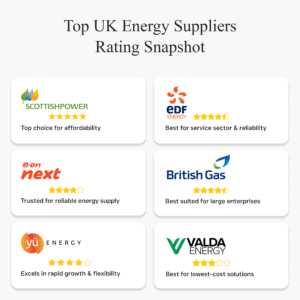
The best energy supplier in the UK is the one offering the right combination of price, service, and tariff structure for your circumstances. In 2026, E, Octopus Energy, 100Green, and Sainsbury’s Energy all perform strongly in independent assessments, but none should be assumed to be the cheapest for every customer.
From 1 July to 30 September 2026, Ofgem’s updated typical household benchmark is £1,663 a year for a dual-fuel customer paying by Direct Debit. That figure uses the revised 2026 Typical Domestic Consumption Values of 2,500 kWh of electricity and 9,500 kWh of gas per year. Average capped rates are 26.11p/kWh for electricity and 7.33p/kWh for gas.
The number itself is useful, but it should not decide whether you switch. Your actual consumption matters far more.
That is the same principle I use when looking at commercial energy. A headline rate can look attractive, but a sensible decision only comes after you understand the consumption behind it, the contract terms and what the customer actually needs.
This guide looks at the major UK energy suppliers, current independent evidence, tariff structures, switching considerations, and the points I would check before making a decision.
UK Energy Market at a Glance
The UK energy market keeps changing, so any supplier comparison needs a date attached to it.
As of March 2026, Ofgem reported 17 active supplier entities across the domestic gas and electricity retail markets. Sixteen supplied both fuels and one supplied electricity only.
| Current market indicator | Latest information |
|---|---|
| Active domestic supplier entities | 17 as of March 2026 |
| Current price cap period | 1 July to 30 September 2026 |
| Typical dual-fuel Direct Debit benchmark | £1,663/year using 2026 TDCVs |
| Average electricity unit rate | 26.11p/kWh |
| Average electricity standing charge | 57.19p/day |
| Average gas unit rate | 7.33p/kWh |
| Average gas standing charge | 29.04p/day |
| Standard household switching time | Up to 5 working days |
One point that is easy to miss is the difference between an energy supplier and an energy brand.
Consumers may see more brands in the market than the number of underlying supplier entities would suggest. Some brands operate through, or alongside, another licensed supplier.
That distinction matters less when you are choosing a tariff than people sometimes think. I would focus first on who is responsible for supplying you, what contract you are entering and what service standards apply.
Brand familiarity is useful. It is not a substitute for reading the offer.
Ofgem Energy Price Cap: July to September 2026
For the period from 1 July to 30 September 2026, average direct debit price cap rates are:
| Energy | Unit rate | Daily standing charge |
| Electricity | 26.11p/kWh | 57.19p/day |
| Gas | 7.33p/kWh | 29.04p/day |
These figures include 5% VAT and are averages across England, Scotland, and Wales. Your actual capped rates can vary by region.
The mistake I would avoid is treating the Ofgem price cap as a target price.
It is better used as a benchmark.
If you are considering a fixed tariff, for example, compare the unit rates and standing charges against the current cap, then ask what you are receiving in return for fixing.
Are you buying useful price certainty?
Are there exit fees?
How long are you tied in?
What happens if market prices fall?
Those questions matter more than whether a tariff simply carries a “fixed” label.
Active Energy Suppliers in the UK
The domestic energy market has changed considerably in recent years. According to Ofgem’s latest retail-market data, there were 17 active suppliers in Great Britain’s domestic gas and electricity market as of March 2026. Of these, 16 supplied both gas and electricity and one supplied electricity only. There were no domestic supplier exits during the first quarter of 2026.
It is important to distinguish between an energy supplier and an energy brand. Ofgem counts active supplier entities, while consumers may see a larger number of brands because some companies sell energy under white-label or partner arrangements. Ofgem itself notes that some energy brands do not hold their own supply licence and instead operate in partnership with a licensed supplier.
The table below therefore covers the main active household energy suppliers and consumer-facing brands available in Great Britain in 2026.
| Energy Supplier / Brand | 2026 Status | Current Positioning / Known For |
|---|---|---|
| British Gas | Active major supplier | One of Britain’s largest established suppliers; broad range of household energy and home services |
| Octopus Energy | Active major supplier | Smart, tracker, time-of-use and EV tariffs; low-carbon technologies |
| E.ON Next | Active major supplier | Major gas and electricity supplier; fixed, variable and smart-energy options |
| EDF Energy | Active major supplier | Large established supplier with fixed and variable tariffs and a strong low-carbon generation presence |
| OVO Energy | Active major supplier | Major household supplier with smart-energy, EV and home-energy services |
| ScottishPower | Active major supplier | Large established supplier offering household electricity and gas tariffs |
| E (Gas & Electricity) | Active supplier | Strong focus on prepayment customers; Which? Recommended Provider for 2026 |
| Utilita Energy | Active supplier | Smart prepayment and pay-as-you-go energy services |
| Utility Warehouse | Active supplier | Energy bundled alongside broadband, mobile and other household services |
| So Energy | Active supplier | Renewable fixed tariffs, EV tariffs, solar and battery products |
| 100Green | Active supplier | Green-energy specialist and Which? Recommended Provider for 2026 |
| Good Energy | Active supplier | Long-established renewable-energy specialist |
| Ecotricity | Active supplier | Renewable-focused supplier with a long-standing environmental positioning |
| Outfox Energy | Active supplier | Challenger supplier competing strongly on tariffs and customer service |
| Fuse Energy | Active challenger supplier | Technology-led supplier offering variable, fixed and multi-rate tariffs |
| Home Energy | Active supplier | Challenger offering household gas and electricity with simple pricing and no-exit-fee options |
| Square1 Energy | Active supplier | Licensed domestic energy supplier; also operates the Tulo Energy brand |
| TruEnergy | Active supplier | Domestic and non-domestic electricity and gas supplier |
| Tulo Energy | Active consumer brand | Household energy brand operated by Square1 Energy, focused on straightforward tariff management |
| Sainsbury’s Energy | Active partner brand | Energy supplied by E.ON Next, with Nectar-related customer benefits |
| EnergyCoop | Active partner brand | Community-focused energy brand supplied in partnership with Octopus Energy |
| Boost | Active consumer brand | Household energy brand included in the government’s 2026–27 Warm Home Discount supplier list |
| London Power | Active consumer brand | Household energy brand included in the government’s 2026–27 Warm Home Discount supplier list |
The government’s confirmed 2026–27 Warm Home Discount supplier list includes brands and suppliers such as 100Green, Boost, British Gas, E, Ecotricity, EDF, EnergyCoop, E.ON Next, Fuse Energy, Good Energy, Home Energy, London Power, Octopus Energy, Outfox Energy, OVO, Sainsbury’s Energy, ScottishPower, So Energy, Square1 Energy, TruEnergy, Tulo Energy, Utilita and Utility Warehouse.
Why Are There More Energy Brands Than Active Suppliers?
Ofgem’s figure of 17 active domestic suppliers refers to supplier entities operating in the regulated Great Britain market. The number of names that consumers encounter is higher because some are partner or white-label brands rather than separate licensed suppliers.
For example:
- Sainsbury’s Energy is a trading name used under licence by E.ON Next Energy Limited, which supplies its electricity and gas.
- EnergyCoop operates in partnership with and is supplied by Octopus Energy.
- Tulo Energy is a trading name of Square1 Energy Ltd.
This distinction is important when comparing supplier numbers, market share and customer-service data because two consumer brands do not necessarily represent two separate licensed energy suppliers.
Which Are the Largest UK Energy Suppliers?
The domestic market remains highly concentrated. Ofgem reported that the six largest suppliers accounted for 92% of the domestic electricity and gas market in Q2 2025. The major suppliers were Octopus Energy, ScottishPower, British Gas, E.ON, OVO, and EDF.
In Ofgem’s published Q2 2025 market-share data:
| Supplier | Electricity Market Share | Gas Market Share |
| Octopus Energy | 25% | 25% |
| British Gas | 21% | 27% |
| E.ON | 16% | 13% |
| OVO | 12% | 10% |
| EDF | 10% | 9% |
| ScottishPower | 8% | 7% |
| Other suppliers combined | 8% | 8% |
For consumers, however, supplier size should not be the deciding factor. The cheapest or most suitable energy supplier can vary according to postcode, annual consumption, payment method, meter type and tariff availability. Comparing the actual unit rates, standing charges, contract terms and service evidence is therefore more useful than choosing a supplier simply because it has the largest customer base.
Compare energy suppliers and switch to a cheaper deal today!
Use our FREE Ofgem-accredited energy comparison service to see how much you can save on your energy bills.
Energy Suppliers Who Have Ceased Trading
During the recent energy crisis, numerous energy companies ceased operations due to volatile wholesale prices and the energy price cap restrictions. Understanding this history helps explain the current market landscape. Here’s a comprehensive list of suppliers that are no longer trading:
| Energy Supplier | Status | New Supplier | No. of Customers Affected |
| Bulb Energy | Ceased Trading | Octopus Energy | 1,500,000 |
| Shell Energy | Ceased Trading | Octopus Energy | 1,300,000 |
| Avro Energy | Ceased Trading | Octopus Energy | 580,000 |
| Green Network Energy | Ceased Trading | EDF Energy | 360,000 |
| People’s Energy | Ceased Trading | British Gas | 350,000 |
| Boost Energy | Ceased Trading | OVO Energy | 350,000 |
| Spark Energy | Ceased Trading | OVO Energy | 290,000 |
| Green | Ceased Trading | Shell Energy | 255,000 |
| Pure Planet | Ceased Trading | Shell Energy | 235,000 |
| Flow Energy | Ceased Trading | Octopus Energy | 230,000 |
| Utility Point | Ceased Trading | EDF Energy | 220,000 |
| Green Star Energy | Ceased Trading | Shell Energy | 200,000 |
| iSupply Energy | Ceased Trading | EDF Energy | 190,000 |
| Igloo Energy | Ceased Trading | E.ON Next | 179,000 |
| Bristol Energy | Ceased Trading | British Gas | 176,000 |
| Together Energy | Ceased Trading | British Gas | 176,000 |
| TOTO Energy | Ceased Trading | EDF Energy | 134,000 |
| Tonik Energy | Ceased Trading | Scottish Power | 130,000 |
| Robin Hood Energy | Ceased Trading | British Gas | 112,000 |
| Extra Energy | Ceased Trading | Scottish Power | 108,000 |
| IRESA Limited | Ceased Trading | Octopus Energy | 95,000 |
| Rebel Energy | Ceased Trading | British Gas | 90,000 |
| PFP Energy | Ceased Trading | British Gas | 82,000 |
| Yorkshire Energy | Ceased Trading | Scottish Power | 74,000 |
| Engie | Ceased Trading | Octopus Energy | 70,000 |
| Orbit Energy | Ceased Trading | Scottish Power | 65,000 |
| M&S Energy | Ceased Trading | Octopus Energy | 60,000 |
| Simplicity Energy | Ceased Trading | British Gas | 50,000 |
| Symbio Energy | Ceased Trading | E.ON Next | 48,000 |
| One Select | Ceased Trading | Together Energy | 36,000 |
| Our Power | Ceased Trading | Utilita | 31,000 |
| Neon Reef | Ceased Trading | British Gas | 30,000 |
| Eversmart Energy | Ceased Trading | Utilita | 29,000 |
| Colorado Energy | Ceased Trading | Shell Energy | 15,000 |
| Tomato Energy | Ceased Trading | British Gas | 12,000 |
| Zog Energy | Ceased Trading | EDF Energy | 11,700 |
| Daligas | Ceased Trading | Shell Energy | 9,000 |
| GnERGY | Ceased Trading | Bulb Energy | 9,000 |
This consolidation has created a more stable energy market, though it has reduced consumer choice. The remaining different energy suppliers are generally more financially robust and better equipped to handle market volatility.
Best Energy Suppliers for UK Businesses
Business energy needs to be treated separately from household energy.
This is where my experience is strongest.
I have seen businesses make very good procurement decisions by reviewing the market early, and I have also seen companies create unnecessary costs by leaving contracts until the last minute.
The first point to understand is that the domestic Ofgem price cap does not protect business energy contracts.
Commercial electricity and gas contracts are priced according to the business and the contract being offered.
A serious business energy comparison should therefore look at:
- annual electricity and gas consumption;
- unit rates and standing charges;
- contract end date;
- notice requirements;
- MPAN for electricity;
- MPRN for gas;
- meter type and settlement status;
- number of business locations;
- future changes in consumption;
- business credit profile;
- fixed or variable contract preference;
- renewable requirements;
- contract duration;
- termination conditions.
What matters most when comparing business energy?
For me, the first thing is timing.
You do not want to start reviewing the contract after the existing agreement has already expired.
That is normally where businesses lose negotiating control.
A business that falls onto deemed or out-of-contract rates may end up paying more while it tries to arrange a replacement contract.
The second issue is consumption.
A restaurant, factory, office and convenience store may all be quoted very differently because their consumption profiles are different.
Even two businesses in the same industry can require different contracts.
The third issue is the contract itself.
I would never advise a business owner to choose a supplier simply because the supplier is well known.
Look at what you are actually being offered:
What is the unit rate?
What is the standing charge?
How long is the contract?
Is the price fully fixed?
What charges can still move?
What happens if you leave the premises?
What happens if consumption changes significantly?
Those are commercial questions, not branding questions.
Which business energy supplier is best?
There is no universal best business energy supplier.
Major suppliers may include British Gas Business, E.ON Next Business, EDF, ScottishPower and a range of other commercial or specialist suppliers.
The right choice depends on the quotation available for your business.
Over the years, one of the most expensive mistakes I have seen is treating business energy like a household comparison.
It is not.
For a business, a small difference in the unit rate can become significant when multiplied across large annual consumption.
Contract length matters more.
Timing matters more.
Terms matter more.
That is why I would compare the actual offers side by side before making the decision.
Energy Solutions helps UK businesses review electricity and gas contracts, compare supplier options and understand procurement timing based on their real consumption and commercial requirements.
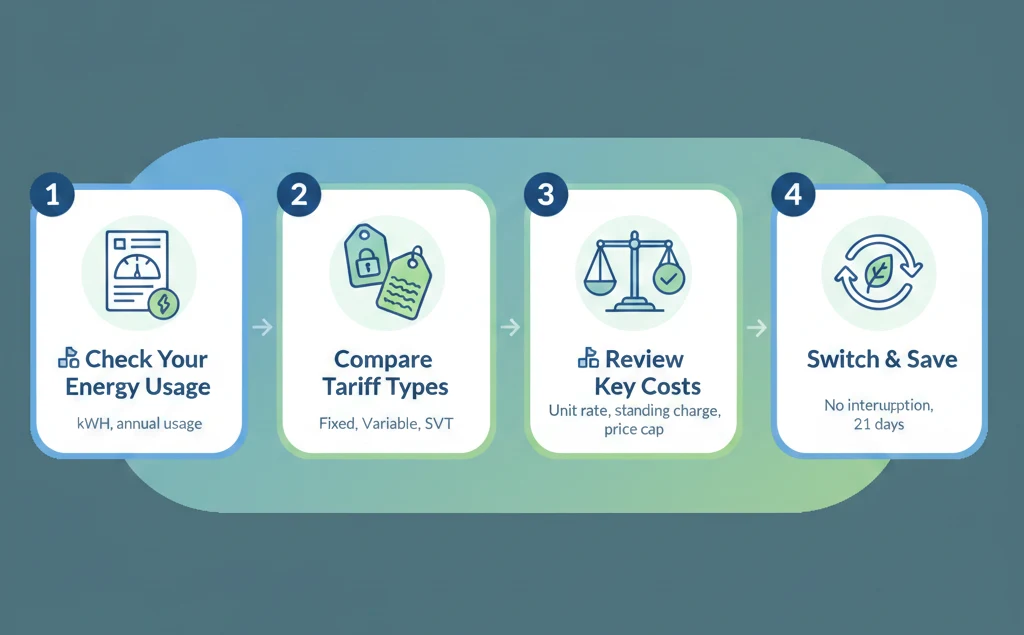
Understand Your Usage
Before comparing, analyze your consumption:
- Review 12 months of bills for accurate annual usage
- Note electricity and gas consumption in kWh
- Check your meter type (standard, smart, or prepayment)
- Identify seasonal variations
Does Your Postcode Affect Energy Prices?
Yes. Your postcode can affect the energy rates you pay.
Ofgem publishes regional price cap tables because electricity and gas costs are not identical across Great Britain.
Network costs, regional demand and the cost of transporting and distributing energy can contribute to those differences.
That means two households using the same amount of energy can still see different rates depending on where they live.
Your comparison can also change according to:
- annual electricity and gas consumption;
- Direct Debit, standard credit or prepayment;
- meter type;
- fixed or variable tariff preference;
- smart meter compatibility;
- available tariffs in your area.
This is why I would be cautious when someone asks, “Who is the cheapest energy supplier in the UK?”
Without a postcode and annual consumption, there is no reliable answer.
The figure I would use when comparing tariffs is your annual kWh consumption, not simply your monthly Direct Debit.
A monthly payment can be misleading because it may include previous credit, debt adjustments or an estimate of future usage.
The underlying consumption gives you a much cleaner comparison.
Fixed, Variable, Tracker, Smart and EV Energy Tariffs
Choosing the supplier is only half of the decision.
The tariff structure can have just as much effect on what you eventually pay.
Fixed-rate tariffs
A fixed tariff normally fixes the price you pay for each unit of electricity or gas for a defined period.
It does not fix your total bill.
If you use more energy, your bill still increases.
The real benefit of fixing is certainty.
That can be worthwhile if you prefer predictable unit rates and are comfortable giving up some flexibility.
The trade-off is that market prices may fall after you fix. You may also face an exit fee if you want to leave early.
Before fixing, I would check:
- the unit rate;
- standing charge;
- contract length;
- exit fee;
- whether the tariff is genuinely competitive against the current variable rate.
Do not pay a large premium simply because the word “fixed” feels safer.
Standard variable tariffs
Standard variable tariffs can rise or fall.
Eligible household default tariffs are protected by Ofgem’s price cap, although the cap does not limit your total annual bill.
Variable tariffs can give you more flexibility, but you accept the risk that rates may change at the next price cap period.
The decision comes down to how much you value certainty versus flexibility.
Tracker tariffs
Tracker tariffs link some or all of your energy price to an external market measure.
They can work well when wholesale prices move in your favour.
They can also move the other way.
Before choosing one, understand exactly what is being tracked, how often the rate changes and whether the supplier applies any upper limit.
If you do not understand the pricing formula, I would not enter the tariff simply because the current rate looks cheap.
Smart and time-of-use tariffs
Smart tariffs can charge different electricity prices at different times of the day.
These can be useful for households that can genuinely shift consumption.
Examples include:
- charging an EV overnight;
- running a washing machine in a cheaper period;
- charging a home battery when electricity costs less;
- moving other heavy electricity use away from peak periods.
By July 2025, Ofgem reported that around 835,000 customers were on smart Time-of-Use tariffs, up 68% year on year. EV-specific tariffs accounted for around 653,000 customers.
The key question is not whether the off-peak rate looks good.
It is how much of your electricity use you can realistically move into that period.
EV tariffs
EV tariffs commonly offer cheaper electricity during defined off-peak hours.
If most of your vehicle charging happens overnight, that can make a meaningful difference.
But look at the full tariff.
A very cheap EV charging window can be offset by a higher daytime electricity rate.
Run the numbers across your whole household, not only the car.
Economy 7 and other multi-rate tariffs
Economy 7 and other multi-rate tariffs charge different rates depending on the time electricity is consumed.
They work best when a significant percentage of your use falls into the cheaper period.
If most of your consumption happens during the expensive hours, the tariff may work against you.
Again, usage behaviour decides whether the tariff is suitable.
Solar and export tariffs
For households with solar panels, comparing import tariffs alone only gives you half the picture.
You should also look at how much the supplier pays for electricity exported back to the grid.
A supplier with a slightly higher import price may still produce a better overall result if the export arrangement is stronger.
That is why I would calculate the whole energy position rather than choosing the lowest advertised import rate.
How to Switch Energy Supplier
Switching household energy supplier is now much faster than the old 21-day process many people still remember.
Ofgem says a household switch should normally complete within five working days, although you can request a later date.
Before comparing, get the following information together:
- Your postcode.
- Current supplier.
- Current tariff.
- Current unit rates.
- Current standing charges.
- Annual electricity consumption in kWh.
- Annual gas consumption in kWh, if applicable.
- Any exit fee on your existing tariff.
This preparation makes the comparison much more useful.
I would not compare suppliers using estimated monthly payments alone.
Once you choose a new supplier, the new supplier normally handles the transfer.
New domestic energy contracts also have a 14-day cancellation period.
If you are leaving a fixed tariff, check your exit fee before confirming the switch.
Ofgem’s current switching standards also provide for £40 automatic compensation where a supplier fails to meet certain switching requirements.
After the switch completes, take a meter reading and keep it.
Then check your final bill carefully.
Your previous supplier should normally issue the final bill within six weeks and return an eligible credit balance within 10 working days after that bill.
It is a small administrative step, but it avoids a surprising number of billing disputes.
How Green Are UK Energy Suppliers?
A tariff described as 100% renewable electricity does not automatically tell you how much a supplier contributes to new renewable generation.
There are several ways suppliers can support or account for renewable electricity, including:
- Renewable Energy Guarantees of Origin, known as REGOs;
- buying directly from renewable generators;
- long-term Power Purchase Agreements;
- owning renewable generation;
- matching customer consumption with renewable production;
- offering biomethane or green gas;
- helping customers adopt EVs, heat pumps, solar or battery storage.
Two suppliers can therefore make similar renewable claims while operating very differently behind the scenes.
Which?’s June 2026 sustainability assessment placed Good Energy and Octopus Energy joint first at 85%.
Ecotricity scored 75%, while 100Green scored 70% and was the only supplier in the assessment offering 100% green gas.
My advice is to decide first what “green” means to you.
If your priority is simply having electricity matched with renewable certificates, that is one decision.
If you want your supplier to invest directly in renewable generation, buy through long-term agreements or help increase low-carbon energy use, you need to look deeper.
I have seen the same issue in commercial procurement. A business asks for “green energy”, but that phrase can mean several different things.
The right question is not only, “Is this renewable?”
It is, “How is the renewable claim being achieved?”
Understanding Energy Bills
Unit Rate: Price per kWh of energy consumed, varying by supplier, tariff, and payment method.
Standing Charge: Fixed daily fee covering infrastructure and meter costs.
VAT: 5% applied to domestic energy bills.
Smart Meters provide automatic readings, real-time usage monitoring, and accurate billing without estimates.
Energy Saving Tips
Reduce bills regardless of supplier:
- Insulation: Loft insulation saves £355 annually, cavity wall £385 annually
- Heating controls: Reduce thermostat by 1°C saves £145 annually
- Efficient appliances: LED lighting saves £50+ annually
- Behavioral changes: Shorter showers, full washing loads, unplugging standby devices saves £65 annually
Business Energy Considerations
Business energy differs from domestic supply with higher consumption, longer contracts (1-5 years), bespoke pricing, and negotiable rates. Start procurement 6-9 months before contract ends to avoid expensive auto-renewals. Compare business electricity and business gas tariffs to find the best deals for your company.
How We Compare UK Energy Suppliers
I do not believe the biggest supplier is automatically the best supplier.
I also do not believe the cheapest advertised rate automatically represents the best decision.
When we assess an energy supplier, these are the areas that matter:
- Current tariff availability and pricing
- Price against current Ofgem benchmarks
- Independent customer service evidence
- Complaints and billing performance
- Fixed and variable tariff options
- Smart and Time-of-Use tariffs
- Prepayment support
- EV tariffs and low-carbon technology
- Renewable energy sourcing
- Business energy suitability where relevant
We use regulatory information from Ofgem and GOV.UK, alongside independent research from organisations such as Which? and Citizens Advice.
That combination matters.
Regulators can tell you about the market rules, pricing framework and supplier obligations.
Independent assessments can tell you more about customer experience.
Your own tariff comparison then tells you what is available for your household.
No single source answers every part of the decision.
Energy prices and supplier performance also change, so market-sensitive information on this page should be treated as dated evidence rather than a permanent ranking.
Common Questions
When to switch? When contracts end, on expensive standard tariffs, or finding significantly cheaper deals.
Can I switch with debt? Usually possible if owing under £500 on prepayment meters; larger debts may need payment plans.
How much can I save? Typically £200-400 annually switching from standard variable to competitive fixed tariffs.
Will I be cut off? Never. The switch guarantee ensures continuous supply throughout.
Why Choose Energy Solutions for Your Energy Comparison?
At Energy Solutions, we provide expert guidance to help you navigate the UK energy market:
Comprehensive Market Coverage
- Access to all major UK energy suppliers
- Independent comparison service
- Both domestic and business energy options
Expert Guidance
- Energy expert team available for advice
- Free, impartial price comparison
- Personalized recommendations based on your energy usage
Simple Switching
- Handle the entire switch process
- No direct contact with old energy provider needed
- Track switch progress
Ongoing Support
- Contract end date reminders
- Regular market updates
- Alerts when better energy deals available
Transparent Service
- No hidden fees
- Clear comparison results
- Honest about savings potential
Get Started Today
Don’t overpay for your gas and electricity. Use our comparison service to:
- Compare energy suppliers in minutes
- Find the cheapest energy for your needs
- Switch to a better deal hassle-free
- Save £200-400 annually on energy bills
Start your energy comparison now at Energy Solutions and take control of your energy costs. Whether you’re looking for cheap energy deals, green energy options, or simply want to pay less, we’ll help you find the best energy supplier for your home or business.
Compare Energy Now and start saving today!
UK Energy Supplier FAQs
Who is the best energy supplier in the UK?
Octopus Energy is the top-rated supplier, achieving the highest overall score of 74% in Which?’s 2025 survey, with nearly nine in 10 customers satisfied and willing to recommend it NimbleFins Octopus Energy. Octopus has overtaken British Gas as the UK’s largest energy provider with 24.6% market share, and maintains an impressive 4.8-star Trustpilot rating Expert Reviews. The company excels in customer service, innovation (including EV tariffs and solar deals), and has over 2,000 complaints per 100,000 customers but resolves issues efficiently The Eco Experts. Octopus also offers 100% renewable electricity and consistently competitive pricing.
Is Octopus cheaper than British Gas?
Yes, Octopus Energy typically offers better value. Octopus consistently prices its tariffs below the energy price cap and sets its standing charges significantly lower than British Gas. While both companies’ prices vary by tariff and region, Octopus is known for innovative deals that can save money, especially for customers with smart meters, electric vehicles, or solar panels. British Gas tends to charge closer to the maximum price cap limits. However, always compare current tariffs using independent comparison tools, as prices change regularly.
Which energy source is best for the UK?
The UK needs a diverse energy mix for reliable, affordable, and clean power. Renewables reached a record 47% of UK electricity generation in 2025, overtaking gas at 28% and nuclear at 11% Carbon Brief. Wind and solar are essential for meeting net-zero targets, but they’re intermittent. Nuclear provides reliable baseload power, though capacity fell to a 50-year low in 2025 due to outages Carbon Brief. The optimal strategy combines renewable energy for sustainability, nuclear for consistent supply, and gas for flexible backup during low wind and solar periods. Emerging technologies like Small Modular Reactors also show promise.
Is OVO the worst energy supplier in the UK?
OVO ranks among the poorest performers. OVO received the lowest customer satisfaction score of 56% in Which?’s 2025 survey, with customers expressing strong dissatisfaction regarding value for money and communication NimbleFinsOctopus Energy. However, Scottish Power scored only marginally better with 59%, while British Gas, Scottish Power, OVO and So Energy all scored below 60% overall NimbleFins. Common OVO complaints include billing issues, high direct debits, and slow problem resolution. While OVO does score well for supporting vulnerable customers, its overall performance places it at the bottom alongside other major suppliers.
Which energy supplier has the most complaints?
Large suppliers including British Gas, OVO and Octopus have the highest complaint rates, with over 1,400-2,000 complaints per 100,000 customer accounts The Eco Experts. Large suppliers average around 1,525 complaints per 100,000 customers, compared to just 261 for small-sized companies. British Gas performed poorly for both the volume of complaints received in the first half of 2024 and for how efficiently it resolved them. In contrast, smaller suppliers like Outfox, Green Energy UK E and Ecotricity had the lowest rates with under 230 complaints per 100,000 customers. The most common complaints across all suppliers relate to billing and meter readings.
Comparing energy for your business? Energy Solutions can help review commercial electricity and gas contracts, supplier options and procurement timing using your business’s actual consumption and requirements.