
Author: Abdullah Shoaib | Energy Markets Analyst, 10+ years in the energy industry
If you’ve ever compared your agreed energy rate to what you actually paid, the difference usually comes down to pass-through charges. They’re not a billing error, and they’re not your supplier padding their margin. They’re a real, regulated part of how UK business energy pricing works, and most businesses either don’t know they exist or don’t understand them until the first surprise bill arrives.
Table of Contents
So let’s fix that.
Pass-through charges are costs your energy supplier collects on behalf of third parties, including the National Grid, regional distribution companies, and government-backed energy schemes. Your supplier doesn’t set these rates and doesn’t keep the money. They simply pass them on to you as part of your total energy price.
Unlike your fixed unit rate (the wholesale cost of electricity or gas you agreed at contract), pass-through costs can move up or down throughout your contract. They’re shaped by network investment decisions, peak demand pressures, and government policy, all of which are overseen by the energy regulator Ofgem. That’s why even on a so-called “fixed” contract, your total bill can still change.
Think of it like booking a flight. The advertised fare is your base price, but airport taxes, fuel surcharges, and security levies always get added on top. In UK business energy, the same logic applies:
Your wholesale energy rate is agreed and fixed. The pass-through charges sit on top, and they’re variable.
For a typical UK business on a pass-through electricity contract, these extra costs cover maintaining and operating the national electricity network, government levies that fund renewable generation and carbon reduction, and real-time system balancing costs. None of this is supplier-specific. These charges apply universally across the UK energy market, regardless of who supplies your energy.
Understanding how they work puts you in a much stronger position when negotiating contracts, switching suppliers, or simply making sense of your monthly bill.
Before you sign anything, check your contract terms for a “pass-through clause” that lists which costs can change during your term. Also ask your supplier for a full cost breakdown, not just a headline unit rate. The difference between those two numbers is where the surprises hide.
What Are Pass-Through Charges?
Your total business energy price is made up of two separate layers. The first is your commodity cost, which is the rate per kWh for wholesale electricity or gas that you agreed when signing your contract. The second is your pass-through costs, the variable charges linked to network operation, system balancing, and government energy policy.
These charges come from different parts of the supply chain. The National Grid charges for using the high-voltage transmission network. Regional distribution companies charge for getting electricity through local infrastructure and into your premises. The government introduces levies that every licensed supplier must fund. Your supplier pays all of these costs as part of operating in the UK energy market, then recovers them from you.
Ofgem reviews and approves all of these charges, but that doesn’t mean they stay fixed. Approval and stability are two different things, and plenty of businesses learn that the hard way.
A practical analogy that usually lands well: imagine renting space in a shopping centre. Your rent is fixed, but the service charge, covering maintenance, security, and shared utilities, fluctuates based on actual costs. In energy, your unit rate is the rent and pass-through charges are the service charge.
Here’s how it plays out in practice. A business signs a two-year electricity contract at a fixed unit rate. Partway through, Ofgem approves an increase in transmission charges to fund network upgrades. The business’s unit rate hasn’t moved, but their total bill has gone up because the pass-through element increased. This isn’t uncommon. It catches businesses off guard precisely because they assumed “fixed contract” meant fixed bill.
Review your electricity contract carefully and confirm whether you’re on a fixed-price or pass-through tariff. That single distinction determines how exposed you are to cost changes. Once you’re in a contract, track your bill monthly and look for line items labelled “network charges,” “policy costs,” or “non-commodity costs.” Those are the pass-through components to watch.
What Are Pass-Through Charges on Business Energy Bills?
If your energy bills keep shifting even though your contract is in place, pass-through charges are the variable driving those changes. Most businesses don’t realise it because the charges don’t always appear with a clear label.
On a typical business electricity or gas bill, costs split into two layers: energy supply, which is what you pay per kWh of energy used, and pass-through costs, which cover networks, government schemes, and balancing operations. The second category is where the unpredictability lives.
Suppose you sign a two-year electricity contract at a fixed rate of £0.15/kWh. The following year, network costs increase due to infrastructure investment. Your commodity rate stays at £0.15/kWh, but pass-through charges add an extra £0.03 to £0.05/kWh on top. Your bills rise without any change to your agreed terms.
For many UK businesses, particularly those on pass-through contracts, these non-commodity costs represent 40 to 60% of the total electricity bill. That figure genuinely surprises most finance teams who budgeted based on unit rate alone. It’s one of the most common and costly oversights in business energy management.
Ask your supplier for a fully itemised bill showing each pass-through charge category separately. This isn’t a special request; it’s information you’re entitled to. When comparing contract options, always model the total cost, not just the unit rate.
Why Do Pass-Through Charges Exist?
The UK energy system isn’t a single pipe from generator to meter. It’s a layered infrastructure involving multiple organisations, and every layer has costs to recover.
Electricity generated at a power station travels across high-voltage transmission lines managed by the National Grid, then gets stepped down and distributed through local networks run by Distribution Network Operators (DNOs) before reaching your premises. In real time, the National Grid constantly adjusts generation and demand to keep the system balanced. And across all of it, the government runs policy schemes that fund renewable energy, carbon reduction, and long-term energy security.
Your supplier pays into all of this as a condition of their operating licence. They then pass those costs on to you. None of it is profit for them. It’s the cost of maintaining the infrastructure that keeps the lights on.
Beyond infrastructure, charges like the Contracts for Difference (CfD) levy, the Renewable Obligation, and the newer Nuclear RAB Levy exist because the UK government has made policy commitments, and those commitments have price tags that get distributed across every business energy customer in the country.
If you’re on a pass-through contract, always build a 10 to 15% buffer into your energy budget. Network and policy costs can shift meaningfully within a contract period, and businesses that plan for this avoid the cash flow pressure that catches others out.
What Is Included in Pass-Through Charges? A Full UK Breakdown
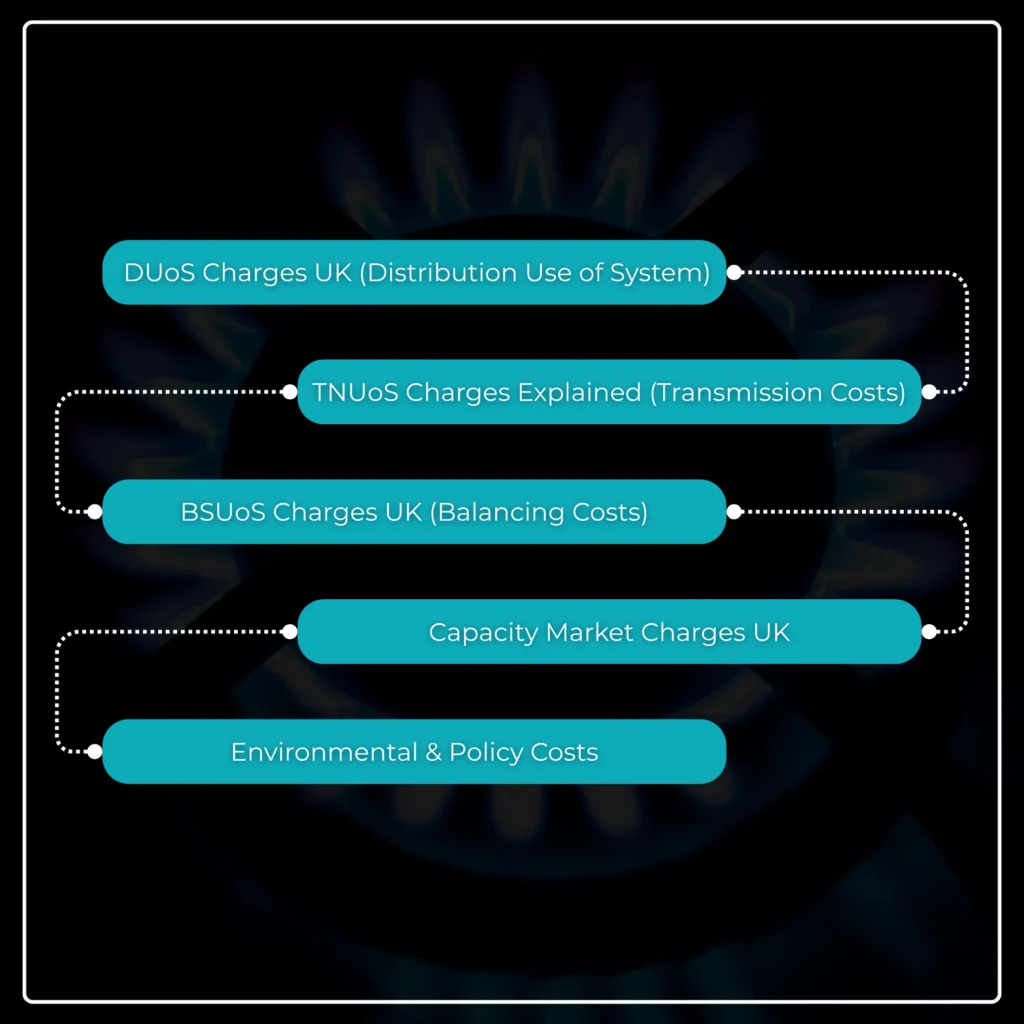
Pass-through charges aren’t a single fee. They’re a collection of distinct components, each tied to a different part of the energy system. Here’s what you’re actually paying for.
DUoS Charges (Distribution Use of System)
DUoS covers the cost of delivering electricity from local substations to your premises through the regional distribution network. Charges are set by your regional Distribution Network Operator and vary based on your location, consumption, and critically, when you use electricity.
DUoS charges are split into three time bands: red (peak), amber (shoulder), and green (off-peak). Using electricity during red band periods, typically weekday evenings, costs significantly more. Shifting energy-intensive processes to green band periods, overnight or at weekends, is one of the most straightforward ways to reduce this cost.
TNUoS Charges (Transmission Network Use of System)
TNUoS funds the operation and maintenance of the high-voltage national transmission network. Charges vary by location. Businesses in Scotland typically pay more than those in southern England because of the network geography involved in getting power south from generation-heavy areas.
These charges are reviewed annually. From April 2026, TNUoS charges increased significantly due to investment needed to connect new renewable generation capacity to the grid. Businesses that weren’t expecting this saw a meaningful jump in their bills.
BSUoS Charges (Balancing Services Use of System)
BSUoS covers the real-time cost of keeping supply and demand in balance. The National Grid is constantly adjusting, and those adjustments cost money. BSUoS is one of the most volatile pass-through charges because it fluctuates daily based on generation mix, unexpected outages, and demand conditions. It’s also one of the hardest to forecast.
Triad Charges
This is the one most businesses overlook, and it can be expensive. Triads are the three highest half-hour demand periods on the national grid between November and February, at least 10 days apart. Your demand during those three specific windows is used to calculate a large portion of your annual TNUoS charge.
Businesses that actively monitor Triad alerts and reduce their demand on high-risk evenings can save thousands. A 200kW reduction across three Triad events can translate to significant annual savings, and the impact scales with your size and location. Businesses that ignore Triad risk on pass-through contracts often end up paying far more than they expected.
Subscribe to a Triad alert service. Most energy brokers and management platforms offer these. The savings potential far outweighs the effort involved.
Capacity Market Charges
These fund a government scheme that pays generators to keep backup capacity available during peak demand. The cost is passed through to all business customers based on usage during peak periods.
Contracts for Difference (CfD)
CfD is the UK’s main mechanism for funding new low-carbon generation, primarily offshore wind and new nuclear. When wholesale energy prices are low, CfD costs actually rise, because the gap between the guaranteed generator price and the market price widens. This creates the counterintuitive situation where falling energy prices can increase your non-commodity costs.
Renewable Obligation (RO)
This scheme obligated licensed suppliers to source a portion of supply from renewable sources. Though closed to new applicants, existing generators still receive RO support, and those costs continue to be passed through to business customers.
Feed-in Tariff (FiT)
FiT subsidised small-scale renewable generation, domestic solar and small wind installations, for example. Closed to new applicants since 2019, but existing recipients still receive payments, and the cost continues to appear on business energy bills.
CCL is a tax on business energy use designed to encourage efficiency and carbon reduction. It appears as a separate line item on your bill and applies per kWh of electricity and gas consumed. There’s no avoiding it unless your business holds a Climate Change Agreement (CCA) with the Environment Agency, which can reduce your rate by 80 to 90%.
Nuclear RAB Levy
One of the newer additions to the non-commodity cost stack. This levy helps fund the construction of new nuclear power stations, starting with Sizewell C, under the Regulated Asset Base model. It will increase as the scheme progresses.
Gas Pass-Through Charges
Gas bills carry their own equivalent costs, though they receive less attention. NTS (National Transmission System) charges cover transporting gas across the national high-pressure network. LDZ (Local Distribution Zone) charges cover delivery through regional networks to your premises. Gas pass-through charges operate on similar principles to electricity but are structured differently, with charges based on daily supply capacity as well as consumption volume.
How Much Are Pass-Through Charges? Real UK Examples
Estimating pass-through charges is genuinely difficult, and that difficulty is partly by design. The variability that makes these charges hard to predict is also what makes suppliers reluctant to give firm estimates. But you can build a reasonable picture.
As a general benchmark, pass-through charges represent 40 to 60% of a business electricity bill for half-hourly metered customers. For non-half-hourly customers, the proportion is usually lower. In periods of high wholesale market volatility or following regulatory changes like the April 2026 TNUoS increase, that proportion can shift upward noticeably.
Here’s a worked example for a small retail business:
| Cost component | Rate | Monthly usage | Monthly cost |
| Commodity (unit rate) | £0.14/kWh | 8,000 kWh | £1,120 |
| DUoS charges | £0.04/kWh | 8,000 kWh | £320 |
| TNUoS charges | £0.02/kWh | 8,000 kWh | £160 |
| BSUoS charges | £0.015/kWh | 8,000 kWh | £120 |
| Environmental levies | £0.025/kWh | 8,000 kWh | £200 |
| Total bill | £1,920 |
Pass-through costs account for £800 of that £1,920 bill, roughly 42%. If network or policy costs rise by 20% during the contract, that adds around £160 per month without any increase in usage or unit rate. Over a two-year contract, that’s nearly £4,000 in additional costs that wouldn’t be visible from the unit rate alone.
For larger businesses, the numbers get more dramatic. A manufacturing site running 24/7 with significant winter evening consumption could face Triad charges of £15,000 to £30,000 per year, depending on grid location and actual demand during the three Triad windows. That single line item can exceed all other pass-through charges combined.
Ask suppliers or brokers for historical pass-through rate data covering the last 12 to 24 months before signing. And always model total cost, not just unit rate, when comparing contracts.
How Pass-Through Charges Affect Your Energy Bill
The practical impact of pass-through charges depends on what type of contract you’re on, and that difference is more significant than most businesses realise when they’re choosing between options.
On a fixed-price, all-inclusive contract at, say, £0.28/kWh, your bill is predictable. The supplier has factored in expected network and policy costs, added a risk margin, and given you one stable number. When network costs rise, that’s the supplier’s problem.
On a pass-through contract at £0.15/kWh commodity plus variable charges, you start cheaper. But when network costs rise mid-contract, that increase lands directly on your bill. Business A stays flat. Business B’s bill climbs.
The trade-off is real: pass-through contracts can deliver savings when costs are stable or falling, and fixed contracts provide certainty regardless of market direction. Neither is universally better. The right choice depends on your business’s ability to manage risk and its appetite for variability.
Beyond contract structure, three things drive pass-through costs higher on a month-to-month basis: consumption during peak network periods, exposure to Triad windows, and policy changes. The first two are within your control. The third isn’t, but you can anticipate it with the right information.
Monitor your usage patterns and identify any consumption during peak network periods. Small shifts in operational timing can reduce costs without affecting output. Review your contract structure annually too, not just at renewal. Market conditions change, and what was optimal 18 months ago may not be the best structure now.
How to Calculate Pass-Through Charges
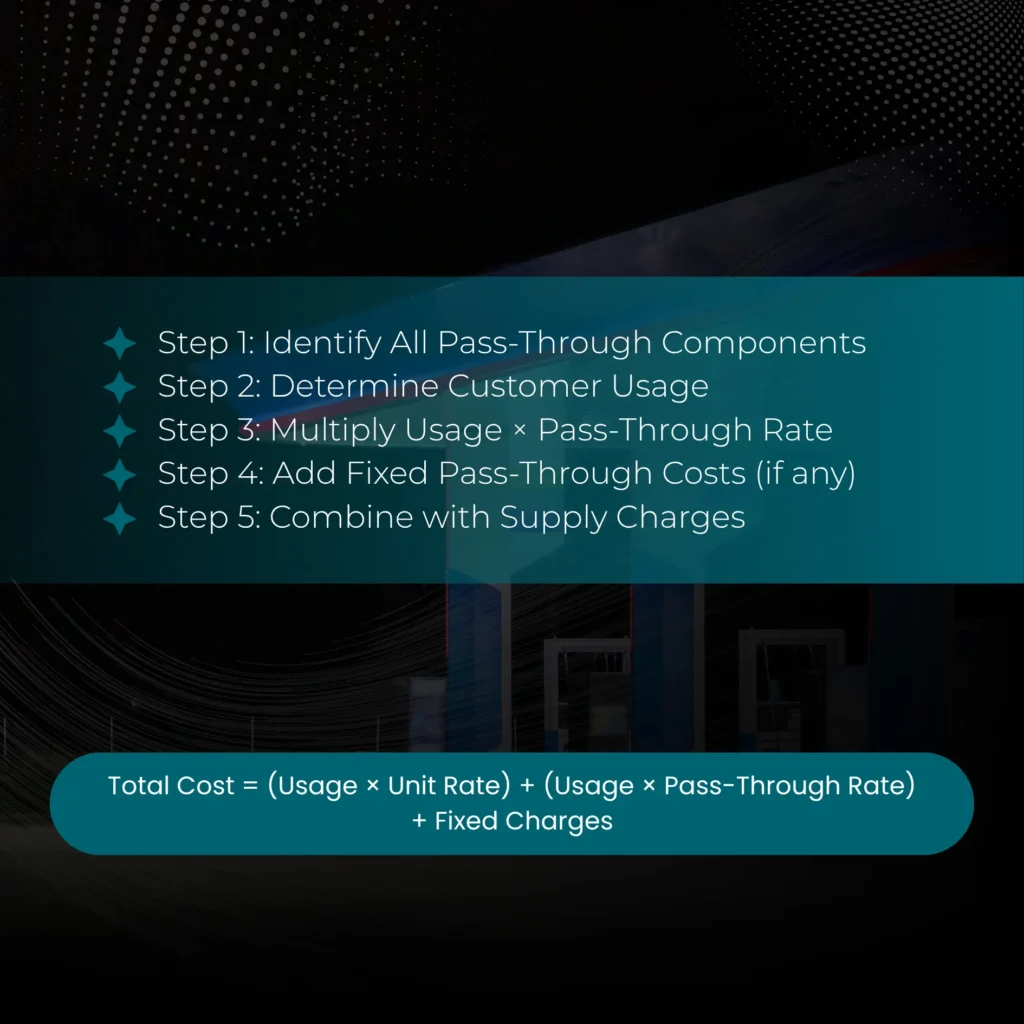
Calculating these charges isn’t complicated once you have the right data, but getting that data from suppliers is often where businesses get stuck.
Start with your total consumption in kWh for the billing period. If you’re a half-hourly metered customer, you’ll also have interval data showing when energy was consumed, which matters because DUoS charges vary by time band.
Next, get a rate card from your supplier listing DUoS rates by time band, TNUoS, BSUoS, and each policy cost levy. These are usually expressed per kWh or as daily standing charges.
Apply the relevant rate to your consumption in each time band. For example, 3,000 kWh during red band at £0.08/kWh DUoS gives £240. A further 5,000 kWh during green band at £0.02/kWh gives £100. Some charges, particularly Triad-related TNUoS, are based on peak demand rather than total consumption, so those need separate treatment.
Add policy costs, CCL, RO, CfD, and other levies, which are typically flat per-kWh charges applied to total consumption. Then sum everything: commodity cost plus all pass-through components.
Most reputable suppliers and independent brokers will provide a bill modelling spreadsheet that automates this. Asking for one before signing a contract is entirely reasonable and a good test of how transparent a supplier is willing to be.
Where Do Pass-Through Charges Appear on Your Bill?
If you’re scanning your bill for a line labelled “pass-through charges” and not finding it, that’s normal. Different suppliers use different terminology, and some bundle everything in ways that make individual components genuinely hard to identify.
Look for these labels: network charges (usually covering DUoS and TNUoS), system charges or balancing charges (BSUoS), policy costs, government levies, or environmental costs (CfD, RO, FiT, CCL), non-commodity costs as a general term, or third-party charges.
Some suppliers present a single non-commodity total. Others break down every component individually. The more granular the breakdown, the easier it is to track changes over time and compare suppliers on a genuinely like-for-like basis. Suppliers who resist providing itemised bills are worth questioning.
Request a sample invoice from any supplier before committing to a contract. That one step shows you exactly how charges will be presented and whether you’ll have the visibility needed to manage them.
Are Pass-Through Charges Fixed or Variable?
Variable. That’s the short answer, and understanding why matters.
Pass-through charges fluctuate because they depend on things that change constantly: demand on the electricity network, infrastructure investment by the National Grid and DNOs, government policy decisions, and real-time balancing conditions. Ofgem oversees all of it, but oversight is not the same as price control.
Here’s how the two main contract types compare:
| Contract type | Commodity rate | Non-commodity costs | Risk sits with |
| Fixed price (all-inclusive) | Fixed | Included in unit rate | Supplier |
| Pass-through | Fixed | Variable, passed to customer | Customer |
| Partially fixed | Fixed | Mix of fixed and variable | Shared |
If you choose a pass-through contract because the initial rate looks attractive, make sure you have processes in place to monitor variable charges throughout the contract. The savings potential is real, but so is the exposure.
Pass-Through vs Fixed Energy Rates: What Is the Difference?
This is fundamentally a question about risk appetite, not just price.
On a fixed rate contract, your supplier bundles commodity and most non-commodity costs into one all-inclusive unit price. The rate you agree is what you pay, with very limited exceptions. The supplier carries the risk that underlying charges will rise.
On a pass-through contract, your commodity rate is fixed, but non-commodity costs flow through to you directly at the rate your supplier incurs them. You take on the variability, including the upside if charges fall and the downside if they rise.
Pass-through contracts tend to work well for businesses that have half-hourly metering and detailed consumption data, can actively manage usage timing (particularly around Triad periods), have broker support to monitor costs and regulatory changes, and are comfortable with billing variability. These are generally larger businesses, usually spending more than £50,000 per year on energy.
Fixed contracts suit businesses that need budget certainty, don’t have the resource or inclination to actively manage energy usage timing, and prefer simplicity over potential savings. They’re also the right choice when you believe costs are more likely to rise than fall during your contract term.
The one thing both approaches have in common: never compare them on unit rate alone. The all-in cost is what matters, and the gap between those two figures is where most businesses either win or get caught out.
Pass-Through vs Bundled Tariffs
A bundled tariff wraps everything, energy supply and non-commodity costs, into a single unit price. A pass-through tariff separates them. The practical difference is transparency versus simplicity.
| Pass-through tariff | Bundled tariff | |
| Transparency | High, charges itemised | Low, one rate covers everything |
| Predictability | Lower, variable components | Higher, one stable rate |
| Initial price | Often lower | Often slightly higher |
| Admin burden | Higher | Lower |
| Savings potential | Higher if costs fall | Lower |
The thing most businesses don’t factor in: bundled tariffs include a risk premium. The supplier has priced in their expected exposure to rising pass-through costs. You pay for that certainty whether or not costs actually rise during your contract. In a stable or falling cost environment, you’re paying for insurance you didn’t need.
Always ask for a full cost comparison that includes estimated pass-through charges alongside the headline unit rate. And check historical data before deciding whether the bundled premium is genuinely worth paying.
How to Reduce Pass-Through Charges UK
You can’t eliminate these charges, but you can significantly reduce what you pay. Here’s how businesses that actively manage their energy costs approach it.
Analyse your half-hourly consumption data. Request your HH data from your supplier or broker and map it against pass-through cost periods. Identify when peak charges, DUoS red band and Triad windows specifically, are driving your bill highest. This one exercise usually reveals savings opportunities most businesses didn’t know existed.
Manage Triad risk actively. For large energy users, this is the highest-impact action available. Subscribe to a Triad alert service (available from brokers, energy management platforms, and some suppliers). On the evenings when a Triad event is likely, typically the coldest weekday evenings in November and February, reduce demand as much as your operations allow. A 200kW reduction across three Triad events can save thousands annually. The saving scales with your size and grid location.
Shift load to off-peak periods. DUoS charges vary by time band. Moving energy-intensive activity, production runs, EV charging, HVAC pre-conditioning, to green band periods (overnight and weekends) directly reduces distribution costs. This doesn’t require capital investment. It requires scheduling.
Choose the right contract structure. Ask suppliers specifically which non-commodity components are fixed versus variable in each option. Some offer semi-fixed contracts that lock in certain charges while passing others through. These can offer a useful middle ground between certainty and cost opportunity.
Work with an independent energy broker. An experienced broker can model total costs across multiple contract structures, help you understand Triad and DUoS exposure, and negotiate which pass-through components can be partially fixed or capped. According to Energy UK, many large business customers that use independent procurement support consistently outperform those that negotiate directly on total energy costs.
Improve overall energy efficiency. Every kWh saved reduces both commodity and non-commodity costs simultaneously. Efficiency measures, LED lighting, smart building controls, compressed air optimisation, have a compound effect. The capital cost is recoverable. The pass-through savings persist for the life of the contract.
Monitor regulatory changes. TNUoS, BSUoS, CCL, and CfD charges all change periodically. Review Ofgem’s published charge forecasts each autumn. Understanding what’s coming allows you to time contract decisions, efficiency investments, or operational changes ahead of cost increases rather than reacting to them.
Can You Avoid Pass-Through Charges Completely?
No, and it’s worth being clear about why.
These charges fund the physical infrastructure and policy frameworks that make the UK energy system function. Every business connected to the grid contributes. That’s not going to change.
What does change based on your contract choice is who carries the risk of fluctuations. On a pass-through contract, you see and bear the cost directly. On a fixed or bundled contract, the charges are still there, embedded in your unit rate, with a risk premium added by the supplier. You pay for the certainty of not seeing them move.
What you can control is your exposure through contract structure, your consumption during high-cost periods through usage management, and your overall volume through efficiency investment. Those three levers give you genuine influence over your total energy spend, even though the underlying charges themselves are unavoidable.
Why Are Pass-Through Charges So High in the UK?
UK businesses often find their pass-through charges higher than they expected, and in some cases higher than businesses in comparable European countries. There are structural reasons for this.
The UK has an ageing electricity network that requires substantial ongoing investment, both to maintain existing infrastructure and to connect new renewable generation, primarily offshore wind, to demand centres. These costs are recovered through regulated charges like TNUoS, which have risen significantly in recent years as the pace of network investment accelerated.
The UK’s net zero commitments require large-scale funding of renewable energy schemes, capacity markets, and new nuclear development. CfD, the Capacity Market, the Renewable Obligation, and the Nuclear RAB Levy all add to the non-commodity cost stack. These aren’t going away. If anything, they’re likely to grow as the energy transition progresses.
Balancing the grid is also becoming more complex and costly. As coal exits the system and variable renewables increase their share, maintaining real-time balance requires more active intervention. BSUoS charges reflect that complexity, and they’ve been notably volatile as the generation mix shifts.
There’s also a geographic dimension that catches many businesses out. UK pass-through charges vary significantly by location. Scottish businesses typically face higher TNUoS charges because they’re further from major demand centres. Understanding your regional cost profile, which your broker or DNO can provide, is worth doing before signing a long-term contract.
Who Controls Pass-Through Charges in the UK?
No single organisation controls all pass-through charges. They’re the product of multiple regulated bodies operating across different parts of the energy system.
Ofgem oversees the energy market and approves the charging frameworks and methodologies used by network operators. It conducts periodic price control reviews, known as RIIO (Revenue = Incentives + Innovation + Outputs), that determine how much network operators can recover from customers over multi-year periods.
The National Grid (now operating as the National Energy System Operator, NESO) manages the national transmission network and sets TNUoS and BSUoS charges within Ofgem-approved frameworks.
Distribution Network Operators, companies like UK Power Networks, National Grid Electricity Distribution (formerly Western Power Distribution), and Scottish and Southern Electricity Networks, operate regional networks and set DUoS charges for their areas.
The UK Government introduces policy schemes through legislation and budget decisions. CfD, the Capacity Market, the Renewable Obligation, CCL, and the Nuclear RAB Levy all originate here.
Your energy supplier acts as the collection agent for all of these charges. They don’t set the rates, but they’re responsible for applying them correctly and showing them transparently on your bill.
Understanding this structure matters because changes can come from any of these directions. A government budget decision can create a new levy. An Ofgem price control review can increase network charges. A cold winter can push BSUoS costs higher than forecast. Staying informed across all three means fewer surprises.
Pass-through charges aren’t hidden fees, they’re a major part of your energy bill, often making up 40–60% of total costs and changing even when your unit rate is fixed. They fund the UK’s energy infrastructure, government schemes, and grid stability.
You can’t avoid them, but you can control their impact by choosing the right contract, shifting usage away from peak times, and staying informed.
And the funny truth? Most businesses fight hard for a cheaper unit rate… while the “extra charges” quietly run the show behind the scenes
Frequently Asked Questions About Pass-Through Charges
What are pass-through charges on business energy bills?
They’re additional costs your supplier collects on behalf of third parties and passes directly to you. They cover the non-commodity costs of delivering and regulating energy: network fees (DUoS, TNUoS), system balancing (BSUoS), Triad charges, and government levies including CfD, RO, FiT, CCL, Capacity Market, and the Nuclear RAB Levy. Even if your unit rate is fixed, these charges can change throughout your contract term.
How much of my bill are pass-through charges?
For half-hourly electricity customers, typically 40 to 60% of the total bill. For non-half-hourly customers, usually lower. The exact figure depends on your location, usage profile, when you consume energy, and your contract structure.
Are pass-through charges fixed or variable?
Variable in most cases. Your commodity rate may be locked in, but pass-through charges fluctuate based on network demand, infrastructure investment, and government policy. Some contracts can partially fix certain components, but full exposure to all pass-through costs is the nature of a standard pass-through contract.
Can I avoid pass-through charges by choosing a fixed contract?
No, but a fixed or bundled contract removes the variability. Your supplier prices those charges into your unit rate in advance, so you pay a stable amount regardless of what happens to actual network or policy costs. The charges are still there. The difference is who carries the risk of them changing.
What are Triad charges, and should I be concerned?
Triads are the three highest national demand peaks each winter, between November and February. Your consumption during those three specific half-hour windows contributes significantly to your annual TNUoS charge. For large energy users, Triad charges can be a major cost. Actively managing demand during Triad windows can reduce them substantially. If you’re on a pass-through contract without a Triad management strategy, this is the most important thing to address first.
Why are UK pass-through charges so high?
Network investment requirements, ambitious decarbonisation policy, increasing grid balancing complexity, and geographic cost variation all contribute. TNUoS charges increased particularly sharply from April 2026 due to investment in connecting new generation capacity. These structural pressures are unlikely to reverse in the near term.
How can I reduce pass-through charges?
The highest-impact steps are: actively manage Triad risk by subscribing to alerts and reducing demand on peak winter evenings; shift load to DUoS green band periods where operationally possible; choose a contract structure that fixes components you can’t manage; improve overall energy efficiency to reduce consumption volume; and work with an energy broker who monitors regulatory changes and can model total costs across contract options.