
Author: Abdullah Shoaib | Energy Markets Analyst, 10+ years in the energy industry
E.ON Next is one of the UK’s biggest energy suppliers, but size alone doesn’t make it the right choice for your home or business. If your fixed deal is ending, you suspect you’re overpaying, or you’re just weighing up your options, this guide gives you a straight, honest picture.
We cover current tariffs and prices, what real customers are saying, contact details, and the questions most supplier guides quietly skip, especially what existing customers should know before accepting any renewal offer.
One number worth knowing upfront: for the April to June 2026 Ofgem price cap period, a typical dual-fuel household on a standard variable tariff pays around £1,641 per year. That’s based on average usage, not a hard limit on your bill. Use more energy, pay more. Simple as that.
What Is E.ON Next? The Brand Transition Explained
Is E.ON Next the Same as E.ON?
This confuses a lot of people, and most competitor pages don’t bother explaining it clearly.
E.ON Next is the UK retail energy arm of the broader E.ON group. It was created to separate the customer-facing supply business from E.ON’s other operations. If you were an E.ON customer before the transition, your account moved across to E.ON Next automatically. Your contract terms came with you, but the brand, app, and online account system all changed.
If you’re searching “eon energy reviews” and landing on old E.ON pages, those aren’t a reliable reflection of what you’d experience today. For any comparison you’re making in 2026, E.ON Next is the entity you’re dealing with.
Who Owns E.ON Next and Is It Regulated?
E.ON Next Energy Ltd is a subsidiary of E.ON UK, itself part of the German-headquartered E.ON SE group. It’s licensed and regulated by Ofgem, which means it must follow the same consumer protection rules as every other licensed UK supplier. That includes the price cap on standard variable tariffs, complaints handling obligations, and the Guaranteed Standards of Performance.
E.ON Next Tariffs and Prices in 2026
E.ON Next offers several tariff types, and the differences matter more than most people realise. Some products that sound fixed aren’t fully fixed at all.
The Standard Variable Tariff: Next Flex
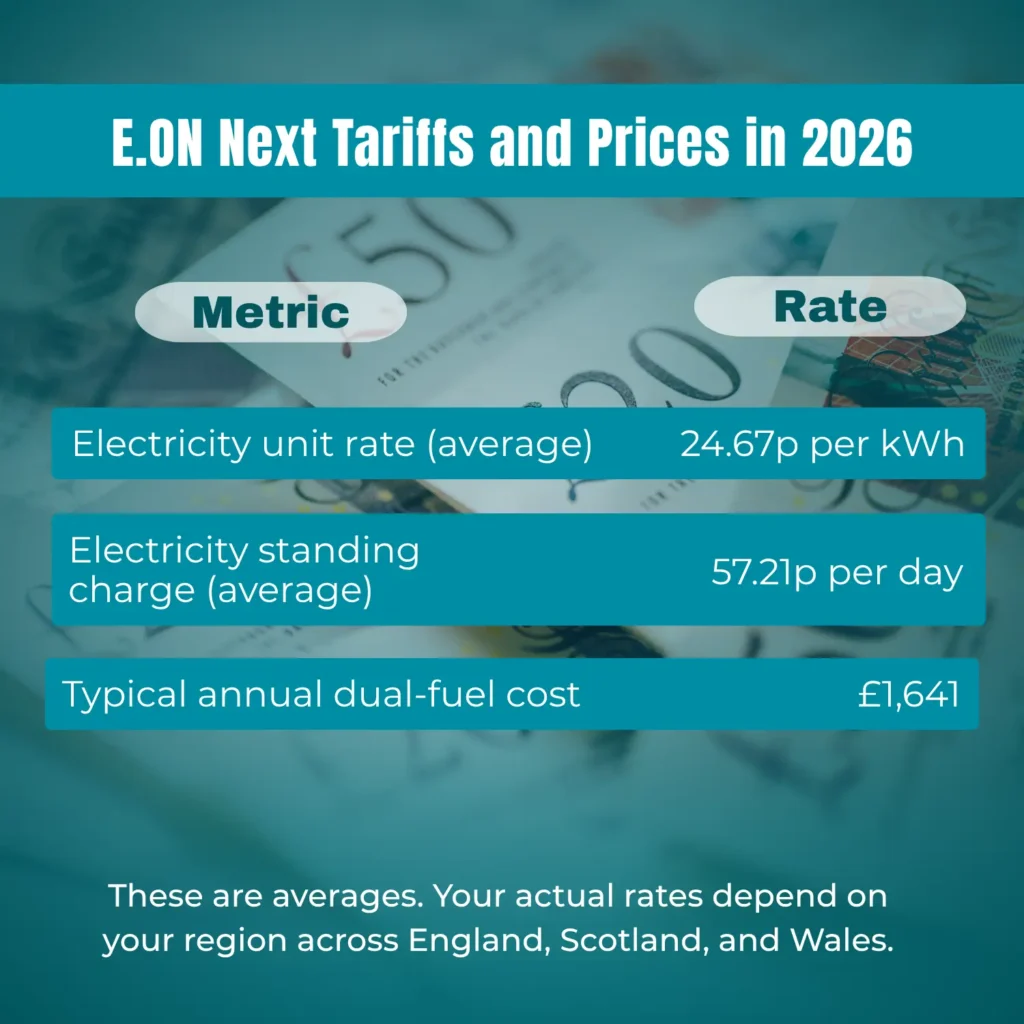
Customers on Next Flex sit under the Ofgem price cap, which is reviewed every three months. For the April to June 2026 period, the national averages for a direct debit customer look like this:
| Metric | Rate |
| Electricity unit rate (average) | 24.67p per kWh |
| Electricity standing charge (average) | 57.21p per day |
| Typical annual dual-fuel cost | £1,641 |
These are averages. Your actual rates depend on your region across England, Scotland, and Wales.
The price cap controls what suppliers can charge per unit, not your total bill. Think of it like a motorway speed limit: it sets the maximum, but how far you drive is still down to you. Use more energy, your bill rises regardless.
Fixed Tariffs: Are They Worth It?
A fixed tariff locks in your unit rates for a set contract period. That means more predictable costs and protection against price cap increases during the term. What it doesn’t mean is automatically cheaper.
Before signing any fixed deal, check all of the following:
- Unit rates for electricity and gas versus the current price cap rates
- Standing charges for both fuels
- Contract length
- Exit fees (E.ON Next has previously listed these at £50 per fuel on fixed deals)
- Whether the deal covers both fuels or just electricity
- Whether the annual estimate reflects your actual usage
A fixed tariff makes sense when the rates sit meaningfully below the current cap and you expect the cap to rise. If prices fall and the cap drops, a fixed deal with exit fees could leave you worse off.
E.ON Next Pledge: Read This Before You Sign Up
This one trips people up regularly. E.ON Next describes Next Pledge as a 12-month fixed-term tracker tariff. The contract length is fixed. The rates are not.
Rates under Next Pledge are designed to track below the Ofgem price cap, meaning they can still change when the cap is updated quarterly. An exit fee of £25 per fuel applies if you leave early.
The question to ask yourself: do you want genuine rate certainty, or rates that stay below the cap but can still move? If you want true price stability, a fixed tariff is the right choice. If cap-linked rates with a structured contract suit you better, Next Pledge might work. Just don’t confuse the two.
Are Existing Customers Being Overcharged?
This is probably the most important question for a large proportion of people reading this, and it’s the one most competitor guides ignore entirely.
When your fixed deal ends, E.ON Next will typically send you a renewal offer by letter, email, or inside your online account. Many customers accept this without checking whether it’s actually competitive.
The loyalty penalty is real in UK energy. New customers switching to a supplier sometimes access promotional rates that existing customers rolling onto a renewal won’t see. It doesn’t happen every time, but it happens often enough that you should always compare before renewing.
Before accepting any renewal offer from E.ON Next, check four things:
- Your tariff end date and what you roll onto if you do nothing
- Your actual annual kWh usage for both electricity and gas
- The unit rates and standing charges on the renewal offer
- Whether a better deal exists elsewhere in the market right now
Existing customers sometimes find exclusive retention deals inside their E.ON Next online account. Sometimes the market is better. You won’t know until you look.
For business customers, this is even more pressing. Business energy contracts aren’t protected by the domestic price cap. When a contract ends, out-of-contract rates can jump significantly. Comparing before your renewal window closes isn’t optional; it’s essential.
EV Tariff
E.ON Next offers time-of-use tariffs for electric vehicle owners, structured around cheaper off-peak electricity overnight. Before choosing one, check that your actual charging pattern fits the off-peak window. If you usually charge in the evening, the tariff may save you less than you expect. You’ll also need a compatible smart meter to access time-of-use pricing.
Prepayment Tariff
Prepayment customers pay before they use, via a smart prepayment meter or top-up card. E.ON Next provides a dedicated contact line for prepayment customers.
Prepayment can help some households manage spending, but it’s not always the cheapest way to pay. If you’re on prepayment and struggling with credit, contact E.ON Next early. Suppliers are required to offer support options for customers in difficulty, particularly those classed as vulnerable.
How E.ON Next Prices Compare to the Market
E.ON Next is neither consistently the cheapest nor the most expensive supplier in the UK. Where they land depends on your specific circumstances.
Your actual bill is shaped by your postcode and distribution region, your payment method, your meter type, your annual kWh usage, and which tariff you choose. The only number that really matters is your estimated annual cost based on your real usage.
The formula is straightforward:
(Annual electricity kWh x electricity unit rate) + (electricity standing charge x 365) + (annual gas kWh x gas unit rate) + (gas standing charge x 365) + VAT
Don’t judge a deal by the monthly direct debit estimate alone. Suppliers set those based on estimated usage. If the estimate is too low, you’ll build up a debt. If it’s too high, your money sits with the supplier earning nothing for you.
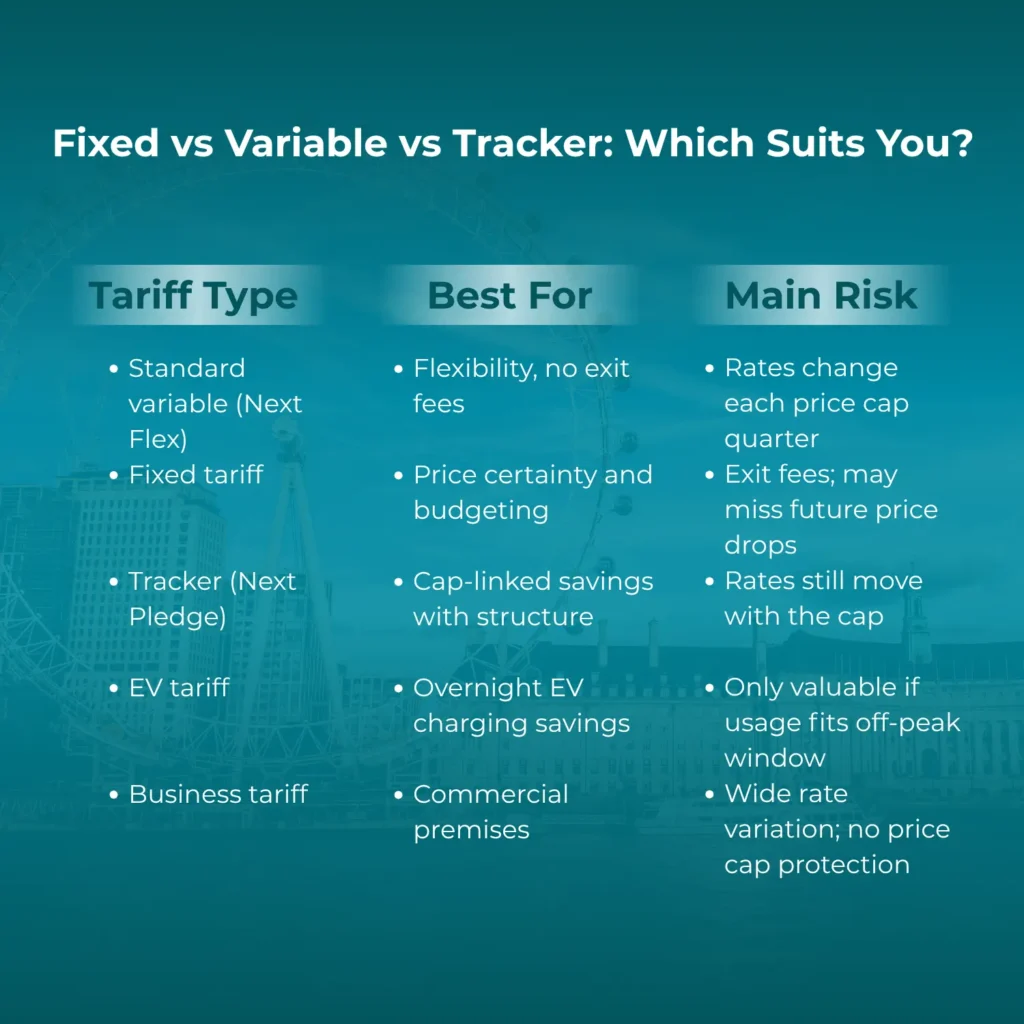
Fixed vs Variable vs Tracker: Which Suits You?
| Tariff Type | Best For | Main Risk |
| Standard variable (Next Flex) | Flexibility, no exit fees | Rates change each price cap quarter |
| Fixed tariff | Price certainty and budgeting | Exit fees; may miss future price drops |
| Tracker (Next Pledge) | Cap-linked savings with structure | Rates still move with the cap |
| EV tariff | Overnight EV charging savings | Only valuable if usage fits off-peak window |
| Business tariff | Commercial premises | Wide rate variation; no price cap protection |
E.ON Next Customer Reviews: What Do Real Customers Say?
Review scores for E.ON Next vary depending on where you look, and that variation is actually useful if you understand what each source measures.
Trustpilot
On Trustpilot, E.ON Next holds a rating above 4 stars from over 200,000 public reviews. That’s a substantial volume of feedback, and a strong public-facing score. Worth noting: Trustpilot reviews are self-selected. Customers who had a notably good or frustratingly bad experience are more likely to leave a review than someone with an unremarkable one.
What Customers Complain About
Across review sources, recurring issues from dissatisfied customers include:
- Billing errors and incorrect direct debit estimates
- Slow refund processing when accounts are in credit
- Difficulty reaching customer service during busy periods
- Smart meter communication issues
- Delays resolving account transfer problems from old E.ON accounts
What E.ON Next Does Well
On the positive side, consistently praised areas include:
- Digital account management and the E.ON Next app
- 100% renewable electricity supply backed by certificates
- Dedicated prepayment and emergency credit support
- Business account management tools
- Response quality when customers do reach support
E.ON Energy Reviews vs E.ON Next Reviews: Why It Matters
Many people search “eon energy reviews” and “eon next reviews” interchangeably. They’re connected but not the same thing.
E.ON Energy was the legacy UK retail brand before the transition. Reviews written during that period, especially complaints about billing system migrations, may appear under older brand pages on Trustpilot or Google. They don’t accurately reflect the current E.ON Next service experience.
When researching E.ON Next today, focus on reviews from 2023 onwards and specifically the dedicated E.ON Next Trustpilot page rather than older E.ON UK listings. The distinction matters if you’re trying to form an honest picture of what you’d actually experience as a customer right now.
E.ON Next Contact Numbers and Support Options
| Department | Contact |
| Home customers, phone | 0808 501 5200 |
| Home customers, email | hi@eonnext.com |
| Business customers, phone | 0808 501 5699 |
| Business customers, email | hellobusiness@eonnext.com |
| Emergency prepayment or credit | 0808 501 5088 |
Phone lines run Monday to Thursday, 9am to 5pm, and Friday, 9am to 4pm. Email and WhatsApp support are available with broader response windows.
If your query is urgent, no supply, a meter fault, emergency credit, or a vulnerable customer situation, contact E.ON Next directly.
If your query is about whether your tariff is still competitive, don’t call your supplier first. Compare the market first, then use any better offer as leverage when you speak to them.
One practical habit worth keeping: whenever you contact E.ON Next about a billing or tariff issue, note the date, the name of whoever you spoke to, any reference number given, and what was agreed. If a dispute comes up later, that record protects you.
E.ON Next vs Other UK Energy Suppliers
Choosing a supplier isn’t just about brand reputation. It’s about the specific tariff available to you right now, at your usage level, in your region.
E.ON Next vs Octopus Energy
Octopus Energy consistently scores higher in both Which? and Citizens Advice ratings. It’s known for strong customer service, innovative tariff structures, and competitive pricing. If service quality is your primary criterion, Octopus is worth comparing directly. It also offers time-of-use tariffs like Agile and Go, which can suit EV owners or households that can shift usage to off-peak hours. You can explore Octopus Energy tariffs on their official site for a direct comparison.
E.ON Next vs British Gas
British Gas is the largest UK energy supplier by customer numbers. It offers a wider range of home services, including boiler cover and home care, which suits customers who want to bundle services. On price, neither is consistently cheaper; it depends on current tariff offers at the time you’re comparing.
E.ON Next vs EDF Energy
EDF supplies both domestic and business customers and has historically offered competitive fixed tariffs. EDF also operates nuclear generation assets in the UK, giving it a different energy sourcing profile to E.ON Next’s renewable-focused supply.
Across all three, go beyond the brand name. Compare unit rates, standing charges, exit fees, and estimated annual costs based on your actual kWh usage.
Is E.ON Next Good for Business Energy?
E.ON Next supplies business energy, but the pricing, risks, and experience differ substantially from domestic supply.
Business energy contracts aren’t covered by the Ofgem domestic price cap. Prices are agreed between supplier and business, typically for 12, 24, or 36-month fixed terms. When a contract ends, suppliers can move customers to out-of-contract rates, which are often significantly higher than contracted rates. This is one of the most common ways businesses overpay on energy, and it’s entirely avoidable.
E.ON Next categorises business customers into three tiers: small and medium businesses using under 100,000 kWh of electricity or 293,000 kWh of gas annually; businesses with multiple sites requiring bespoke pricing; and large corporate customers handled through nPower Business Solutions powered by E.ON.
For any business customer, four things matter most:
- Know your contract end date and renewal window. Many contracts require notice 30 to 90 days before expiry if you want to switch or renegotiate.
- Never accept an auto-renewed rate without comparing alternatives first.
- Compare unit rate, standing charge, contract length, and termination terms, not just the monthly estimate.
- Consider using an energy broker to get multiple supplier quotes simultaneously.
Scale matters here. For a business using 50,000 kWh of electricity annually, a difference of just 1p per kWh equals £500 per year before VAT. A small rate difference becomes a large cost difference quickly.
Should You Switch to E.ON Next in 2026?
E.ON Next is likely a good fit if you want a large, established supplier with strong digital tools, 100% renewable electricity backing, both home and business energy from one provider, and a range of tariff types including fixed, variable, tracker, EV, and prepayment.
You should compare alternatives before committing if your fixed tariff is ending and you haven’t checked the wider market, you’re an existing customer who hasn’t reviewed renewal terms recently, you’ve had billing or service issues and want a fresh start, you’re a business approaching your contract renewal window, or consistently high customer service ratings are your primary criterion.
The right question isn’t “is E.ON Next a good supplier in general?” It’s: “Is this specific tariff, at these rates, the best deal for my actual usage and situation right now?”
What You Actually Need to Compare Tariffs
For Home Customers
Before comparing, have these ready:
- Your postcode
- Your current supplier and tariff name
- Annual electricity usage in kWh, from your bill or online account
- Annual gas usage in kWh
- Your payment method and meter type
- Current unit rates, standing charges, and contract end date
For Business Customers
Before comparing, have these ready:
- Your latest energy bill
- MPAN (electricity meter point) and MPRN (gas meter point)
- Contract end date and notice period requirements
- Annual kWh usage for electricity and gas separately
- Current contracted rates and any termination clause
- Meter type and business address
Then compare the estimated annual cost, not the monthly payment:
Annual kWh x unit rate + (standing charge x 365) + VAT = true annual cost
For business customers, also factor in any climate change levy or half-hourly metering charges if applicable.
E.ON Next FAQs
Is E.ON Next a good supplier?
E.ON Next holds a strong Trustpilot score above 4 stars from over 200,000 reviews, but Which? rated it 66% in 2026 and Citizens Advice scored it 3.71 out of 5 for October to December 2025, placing it 5th among major suppliers. It’s a solid mid-tier supplier, not the highest-rated in the market for customer service. Whether it’s right for you depends on the tariff available and your priorities.
What tariffs does E.ON Next offer?
E.ON Next offers standard variable tariffs (Next Flex), fixed tariffs, tracker tariffs (Next Pledge), EV tariffs, prepayment tariffs, and business energy tariffs. Availability changes regularly, so always check current offers before deciding.
What’s the difference between E.ON and E.ON Next?
E.ON Next is the UK retail energy brand that replaced the old E.ON Energy customer-facing operation. If you were an E.ON customer, your account transferred to E.ON Next. For all practical purposes in 2026, E.ON Next is your supplier.
Does E.ON Next charge exit fees?
It depends on the tariff. Fixed tariffs have previously listed exit fees of £50 per fuel. Next Pledge carries an exit fee of £25 per fuel type. Standard variable tariffs typically have no exit fee. Always check before signing up.
What is E.ON Next Pledge?
A 12-month fixed-term tariff with variable rates designed to stay below the Ofgem price cap. The contract period is fixed; the rates can move when the cap changes. An exit fee of £25 per fuel type applies.
What is the E.ON Next contact number?
Home customers: 0808 501 5200. Business customers: 0808 501 5699. Emergency prepayment or credit: 0808 501 5088.
Final Verdict: Should You Switch to E.ON Next or Stay?
E.ON Next is a well-established supplier with a broad tariff range, solid digital tools, renewable electricity sourcing, and both home and business options. For customers who want a large, stable provider and are comfortable managing their account online, it’s a reasonable choice.
But reasonable isn’t the same as best for you right now.
Before you switch to E.ON Next, renew with them, or stay without reviewing your current tariff, compare unit rates against the current Ofgem price cap, standing charges for both fuels, exit fees on any fixed or tracker deal, your estimated annual cost based on real kWh usage, and E.ON Next’s customer service record against the alternatives.
For existing customers, the single most valuable action you can take is checking your renewal offer against the full UK market before accepting it. For business customers, start that comparison at least 60 days before your contract end date.
Get your latest bill, find your annual kWh usage figures, and run a proper market comparison. If E.ON Next comes out on top, stay or switch with confidence. If something else is cheaper and better rated, you now have everything you need to act on it.