Author: Abdullah Shoaib | Energy Markets Analyst, 10+ years in the energy industry
Table of Contents
If you’ve ever stared at your electricity bill wondering why the number looks nothing like what you expected, you’re not alone. Most people search for British Gas electricity rates because they want one simple thing: a straight answer about what they’re actually paying, and whether they’re getting a decent deal.
So let’s give you exactly that.
This guide covers the current unit rates and standing charges for 2026, every tariff British Gas offers (including EV and smart options), an honest look at how it compares to competitors, and a clear verdict on who it suits best.
Quick Answer: British Gas standard variable tariff customers in Q2 2026 pay approximately 24.67p per kWh for electricity, with a standing charge of 57.21p per day. These figures sit in line with the Ofgem price cap. Fixed and specialist tariffs can offer better value depending on how you use energy at home.
What Are British Gas Electricity Rates, Really?
Your British Gas electricity bill is built around two charges. Understanding both makes everything else click into place.
The unit rate is what you pay per kilowatt-hour (kWh) of electricity you actually use. The standing charge is a fixed daily fee that covers maintaining the national energy network and your connection to it. It applies every single day, whether you use a lot of electricity or almost none.
Think of it like a taxi. The standing charge is the meter fare that starts the moment you get in. The unit rate is what ticks up as you travel. Even a short trip still starts the meter.
Why does this matter? Because a tariff with a temptingly low unit rate can still cost you more annually if the standing charge is high. That’s one of the most common traps people fall into when comparing deals, and it’s entirely avoidable once you know to look.
Your total bill also depends on:
- Where you live in the UK (network costs vary by region)
- Which tariff you’re on: fixed, variable, tracker, EV, or smart
- Whether you have a smart meter (required for several tariffs)
- When you use electricity, not just how much
- How you pay: Direct Debit, standard credit, or prepayment
One practical habit that makes a real difference: always compare estimated annual costs rather than just the headline unit rate. Most energy comparison tools will show you this figure automatically.
Current British Gas Electricity Rates UK (2026)
British Gas standard variable tariff rates move with the Ofgem energy price cap, which is reviewed every three months. Here’s how rates have shifted across recent quarters, all based on Ofgem’s official price cap data:
| Period | Avg Electricity Unit Rate | Daily Standing Charge | Typical Annual Bill |
| Oct to Dec 2025 | 26.35p/kWh | 53.68p/day | approx. £1,755/yr |
| Jan to Mar 2026 | 27.69p/kWh | 54.75p/day | approx. £1,758/yr |
| Apr to Jun 2026 | 24.67p/kWh | 57.21p/day | approx. £1,641/yr |
National averages for Direct Debit customers across England, Scotland and Wales, including 5% VAT.
From 1 April 2026, energy bills fell by 7%, saving a typical dual-fuel household around £117 per year or roughly £10 per month. Part of this drop came from the UK Government’s Autumn 2025 Budget restructuring, which removed several green policy levies from energy bills entirely.
That said, context matters here. Despite the welcome reduction, UK electricity prices are still around 35% higher than they were before the energy crisis in 2021. According to analysis from the House of Commons Library, almost 60% of the electricity standing charge in Q2 2026 goes directly towards network infrastructure costs, including a 65% jump in transmission charges to fund upgrades to the National Grid. In other words, bills have come down, but we’re not back to where we were.
Every British Gas Electricity Tariff Explained (2026)
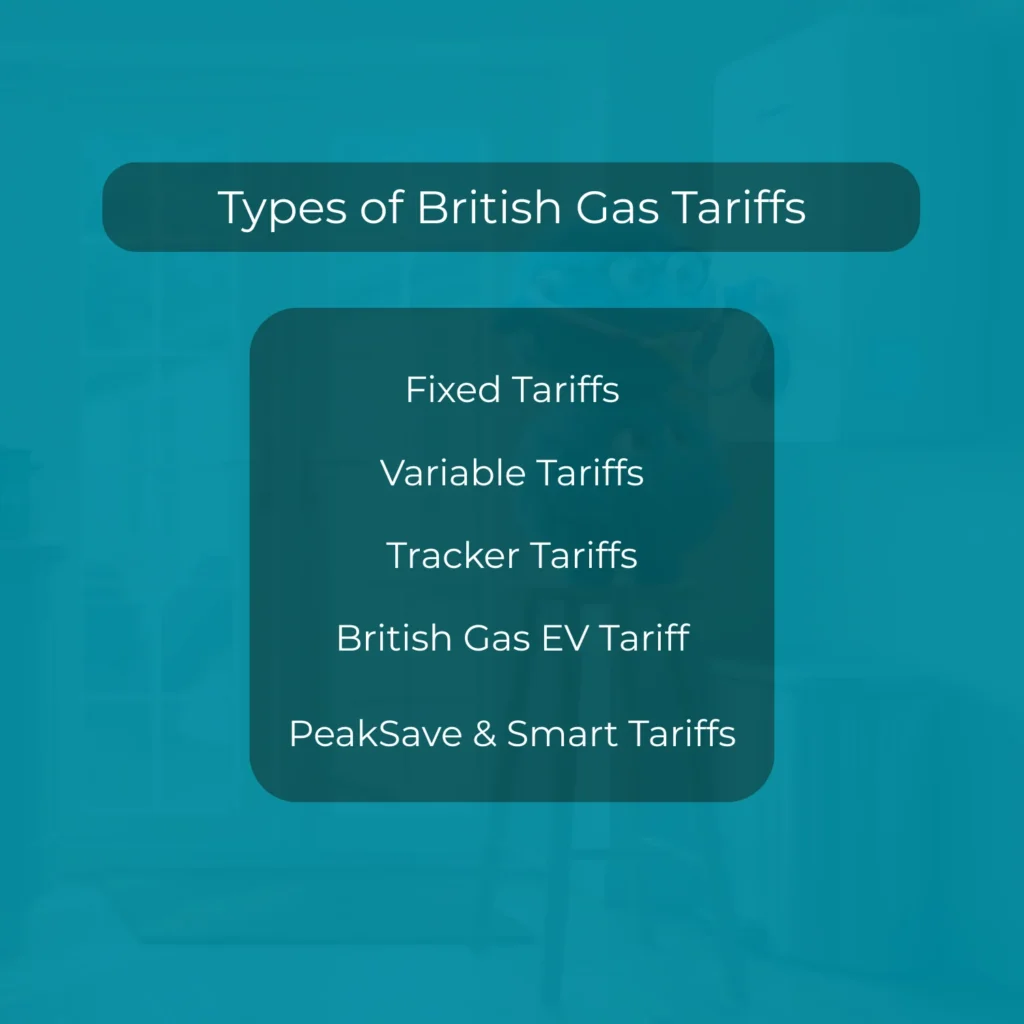
British Gas offers a wider range of tariffs than most UK suppliers. Here’s a complete breakdown:
| Tariff Type | Unit Rate (est.) | Standing Charge (est.) | Best For |
| Standard Variable (SVT) | approx. 24.67p/kWh | approx. 57.21p/day | Flexibility, no contract |
| Fixed Tariff (1 to 2 yr) | approx. 25p to 32p/kWh | approx. 45p to 60p/day | Budget certainty |
| Tracker Tariff | Follows price cap | £50 below cap per year | Savings with flexibility |
| EV Tariff (Off-Peak) | approx. 9p/kWh (12am to 5am) | approx. 50p to 55p/day | EV overnight charging |
| PeakSave / Smart | 50% off Sundays 11am to 4pm | approx. 50p/day | Smart meter households |
| Heat Power Tariff | 50% off 70 hrs per week | Standard rate | Heat pumps, batteries |
| Charge Power (Battery) | 50% off 12am to 5am daily | Standard rate | Home battery owners |
| PAYG / Prepayment | Cap rate + PeakSave eligible | Standard rate | Pay-as-you-go users |
| Business Tariff | Quote-based | Region-dependent | SMEs and businesses |
Rates are estimates and vary by postcode, payment method, and tariff version. Always get a personalised quote at britishgas.co.uk.
Fixed Tariffs: For People Who Want to Know What’s Coming
A fixed tariff locks both your unit rate and standing charge for a set period, usually 12 months or up to two years. If the Ofgem price cap rises during that time, your bill stays the same.
What most people overlook is that British Gas lets you switch between its own fixed tariffs at any time without paying exit fees. Exit fees only kick in if you move from a fixed deal to the Standard Variable tariff before your renewal window opens. That flexibility makes fixed tariffs less of a commitment than they might initially seem.
Good for families budgeting month to month, or anyone who’d rather not watch the energy news every quarter.
Tracker Tariff: Following the Market With a Built-In Saving
The Tracker tariff moves with the Ofgem price cap every three months, so your rate can go up or down. The notable detail: British Gas guarantees your standing charges will always sit £50 per year below the price cap (£25 for single fuel customers). That’s a guaranteed saving baked into the structure, regardless of where the cap lands.
It suits customers who are comfortable with some price movement but want a defined edge over the cap rather than sitting on the standard variable rate.
Standard Variable Tariff: Flexible but Not Particularly Sharp
The SVT is British Gas’s default tariff and what you’ll be moved onto automatically if your fixed deal expires without a new choice. Rates sit at or very close to the Ofgem cap ceiling, so you’re not getting any discount. There’s no lock-in, which is useful, but most customers are better served by a fixed or specialist tariff if one fits their usage.
Think of the SVT as a short-term base to sit on while you decide, not a long-term plan.
British Gas EV Tariff: Where the Real Savings Are
For electric vehicle owners, this is arguably the most valuable tariff British Gas offers. According to British Gas’s own EV tariff page, the overnight rate is 9p per kWh between midnight and 5am, with standard daytime rates outside those hours.
The maths here is striking. A standard tariff charges around 24p to 27p per kWh. Charging a typical 60kWh EV at the overnight rate costs roughly £5.40. The same charge at the daytime rate would cost between £14 and £16. For someone charging daily, that gap adds up to close to £600 in annual savings.
A smart meter is required, and the tariff works with most home chargers. For households with a Hive-compatible EV charger, pairing it with the Power+ feature drops the effective rate even further, to around 6.75p per kWh for all home charging.
If you own an EV and aren’t on a specialist tariff, you’re almost certainly leaving money on the table.
PeakSave: Half-Price Electricity Every Sunday
PeakSave gives all British Gas electricity customers with a smart meter 50% off their unit rate every Sunday from 11am to 4pm, regardless of which tariff they’re on. The average saving is around £24 per year, but that figure rises meaningfully for households who deliberately time their washing, dishwashers, or EV charging to fall within that window.
Samsung device owners get an added bonus: half-price electricity every Saturday too, through a British Gas partnership with Samsung SmartThings.
Heat Power Tariff: For Heat Pumps and Electric Heating
The Heat Power tariff gives customers 70 hours of half-price electricity per week. It’s designed specifically for households running heat pumps, electric heating systems, home batteries, or EVs. For high-consumption electric heating users, particularly those who’ve moved away from gas, the savings here can be substantial.
Charge Power Tariff: Built Around Your Battery
The Charge Power tariff gives home battery owners 50% off the unit rate every night from midnight to 5am. The idea is simple: you charge the battery cheaply overnight and draw from it during the day instead of paying full daytime rates. It’s essentially arbitrage built into a tariff.
Pay As You Go (PAYG)
Over a million British Gas customers pay as they go, topping up credit before using energy. Smart prepayment meters have made this significantly easier, with app top-ups, real-time usage tracking, and low-balance notifications. PAYG customers also have full access to PeakSave, which wasn’t always the case with older prepayment setups.
British Gas vs Other UK Energy Suppliers
This is the honest question most people actually want answered.
| Factor | British Gas | Typical Challenger (e.g. Octopus) |
| Brand Heritage | 200+ years, UK’s oldest supplier | Newer, tech-first model |
| Market Share (Electricity) | 20.9% (2nd largest) | Smaller but growing fast |
| Fixed Tariff Availability | Yes, up to 2 years | Yes, competitive rates |
| EV Tariff | 9p/kWh overnight | Yes, competitive overnight rates |
| Smart Tariff Perks | PeakSave: 50% off Sundays | Varies by supplier |
| Exit Fees | None between fixed tariffs | Varies by tariff |
| Customer Rating (Trustpilot) | 4.4/5 (333,000+ reviews) | Varies |
| Awards | Uswitch Best Improvement 2024 and 2025 | Varies |
| Bundled Services | Hive, HomeCare, EV charger install | Limited bundled extras |
| Charity/Support | British Gas Energy Trust | Varies |
British Gas is rarely the outright cheapest on pure unit rate. Challenger suppliers like Octopus Energy sometimes offer lower headline rates on fixed deals, and it’s worth checking a comparison site before committing either way.
Where British Gas holds its ground is breadth. The smart tariff range, bundled services, nationwide engineer network, and the fact that everything from your boiler cover to your EV charger can sit under one account, that combination is hard to match. For households whose energy needs are straightforward, the price gap may occasionally favour a smaller supplier. For EV owners, heat pump users, and anyone with solar panels or a battery, British Gas’s specialist tariffs frequently deliver better total value.
What Real Customers Think
British Gas holds a 4.4 out of 5 on Trustpilot from over 333,000 reviews. Sixty-four percent are five stars; 21% are one star. That spread tells you something useful: it’s a supplier where experience varies, often based on whether things go smoothly or require a conversation with customer service.
Positive reviews consistently mention engineer responsiveness and reliability, the app experience, and the simplicity of the EV tariff overnight charging window. First-time switchers tend to feel comfortable with British Gas precisely because of its size and familiarity.
Complaints cluster around billing disputes, estimated reading errors, and slow handling of complex account issues. These aren’t unusual for a supplier at this scale, but they’re worth being aware of.
What’s encouraging is the trajectory. British Gas won Best Overall Improvement at the Uswitch Energy Awards in both 2024 and 2025, which reflects measurable progress in customer satisfaction rather than a static reputation.
Who Is British Gas Actually Right For?
It works well for:
- First-time switchers who want the confidence of dealing with a well-established supplier while they get used to the process.
- EV owners who can charge overnight and want to significantly cut running costs. This is probably the strongest use case of all.
- Smart home users with Hive thermostats, solar panels, home batteries, or heat pumps. The specialist tariff range fits this profile well.
- Households wanting stability who’d rather pay a known amount each month than watch the quarterly cap announcements.
- Anyone wanting everything in one place: boiler cover, EV charger, smart thermostat, HomeCare package, and energy supply under one login.
It’s less suited to:
- Price-hunters whose main strategy is moving to the cheapest available tariff every few months. Smaller suppliers may occasionally offer lower unit rates on standard fixed deals.
- Frequent switchers who should check exit fee terms on any fixed tariff carefully before signing up.
How to Switch to British Gas: Step by Step
Switching energy supplier is genuinely straightforward, and your electricity is never interrupted during the process.
- Check your current tariff. Pull out your latest bill and note your unit rate, standing charge, contract end date, and any exit fees. This is your comparison baseline.
- Compare British Gas deals. Head to britishgas.co.uk with your postcode and estimated annual usage. EV owners should use the EV tariff savings calculator specifically.
- Get a personalised quote. You’ll need your postcode, meter number, and annual consumption in kWh. Using your actual consumption from a recent bill gives a much more accurate quote than a household size estimate.
- Start the switch. British Gas manages the transfer with your current supplier. It typically takes 3 to 5 days, and there’s a 14-day cooling-off period if you change your mind.
- Submit a meter reading on the day you switch. This one step prevents the vast majority of billing disputes between your old and new supplier.
After that, expect a smart meter appointment if you need one, a final bill from your previous supplier, and access to your new British Gas account online or through the app.
British Gas Business Electricity Rates
British Gas’s business energy offering covers contracts lasting up to five years, with pricing customised around:
- Your annual electricity consumption
- Business location and regional distribution costs
- Meter type and setup
- Contract length, whether fixed or flexible
- Peak versus off-peak usage patterns
Fixed business contracts give you rate certainty for the contract term, which most SMEs find easier to work with from a budgeting perspective. Flexible contracts follow wholesale market movements and can benefit larger businesses with dedicated energy procurement. Microbusinesses tend to get standardised tariff options; larger commercial customers can access negotiated pricing.
To get a business quote, have your postcode, current supplier details, estimated annual usage, and contract end date ready. Using accurate usage figures rather than rough estimates makes a real difference to the quality of the quote you’ll receive.
How to Get the Best Deal From British Gas
A few things that genuinely move the needle, rather than the usual generic advice:
Don’t wait for your contract renewal letter. British Gas typically contacts fixed-tariff customers about a month before expiry. By then, you’re already close to rolling onto the Standard Variable tariff. Log in and check available deals proactively, ideally two to three months before your deal ends.
Get a smart meter if you haven’t already. This isn’t just about accurate billing. It unlocks access to PeakSave, the EV tariff, the battery and heat pump tariffs, and real-time usage data. British Gas installs them for free.
Shift heavy usage to off-peak windows. Sunday afternoons for PeakSave (11am to 4pm), and midnight to 5am for EV charging and battery top-ups. Running your dishwasher or washing machine during these periods instead of the evening genuinely adds up over a year.
Think about bundled value before switching out. If you’re considering a Hive thermostat, boiler cover, or EV charger installation, the total cost of staying with British Gas versus switching to a slightly cheaper tariff elsewhere often looks different once you factor in bundled discounts.
Compare annual cost, not just unit rates. At 57.21p per day, the Q2 2026 standing charge alone adds around £209 to your bill annually before a single kWh is used. A tariff with a lower unit rate but a higher standing charge is not automatically cheaper for lower-usage households.
Mistakes That Quietly Cost People Money
Comparing unit rates without checking payment method. Direct Debit, standard credit, and prepayment rates are set differently. Comparing a Direct Debit rate against a prepayment rate gives you a misleading picture.
Assuming the advertised rate is your rate. Rates vary by region. Someone in the South East may see different figures from someone in northern Scotland or Yorkshire. Always use your postcode.
Ignoring exit fee terms on fixed deals. Most British Gas fixed tariffs carry no exit fees when switching to another British Gas fixed deal, but moving to the SVT early does trigger a charge. Worth reading before signing.
Using a household size estimate instead of actual usage. A quote based on “medium household” usage assumptions can be significantly off from what you’d actually pay. Find your kWh figure on your current bill and use that instead.
Staying on a standard tariff as an EV owner. This is probably the costliest oversight in this list. The gap between daytime and overnight EV tariff rates is large enough to make hundreds of pounds of difference per year.
FAQ: British Gas Electricity Rates
What is the British Gas electricity unit rate in 2026?
For Q2 2026 (April to June), the standard variable electricity unit rate averages 24.67p per kWh for Direct Debit customers, in line with the Ofgem price cap. Fixed and specialist tariff rates differ.
What is the British Gas electricity standing charge in 2026?
The Q2 2026 electricity standing charge averages 57.21p per day nationally. This applies every day regardless of how much electricity you use.
Is British Gas cheaper than Octopus Energy?
Not always on headline unit rates. Octopus and other challengers occasionally undercut on standard fixed deals. British Gas tends to offer better total value for EV owners, smart home users, and those who want bundled services. The right answer depends on your usage profile.
Does British Gas charge exit fees?
No, not when switching between British Gas fixed tariffs. Exit fees apply only if you move from a fixed tariff to the Standard Variable tariff before your renewal window.
What is the British Gas EV tariff overnight rate?
The off-peak rate is 9p per kWh between midnight and 5am. A smart meter is required. Standard daytime rates apply outside those hours. Paired with a Hive Power+ charger, the effective rate drops to approximately 6.75p per kWh.
How much is a typical British Gas electricity bill in 2026?
A typical dual-fuel household on the standard variable tariff pays approximately £1,641 per year from April 2026, down 7% from Q1. Electricity-only bills vary by usage, region, and tariff.
Can I switch to British Gas if I have a smart meter?
Yes. Smart meters don’t block switching. If your current smart meter temporarily loses some functionality after the switch, you can submit manual readings while British Gas reconnects it to the network.
Should You Choose British Gas in 2026?
British Gas won’t always win on the cheapest headline rate. That’s just the honest reality of a large, established supplier operating at scale. But cheapest unit rate and best value are not the same thing, and for a significant portion of UK households, British Gas delivers the better outcome overall.
The Q2 2026 price cap drop to approximately 24.67p/kWh is a genuine reduction, and if you’re currently on a fixed deal set before April 2026, it’s worth logging in and checking whether the Tracker tariff or a new fixed deal would now be cheaper for you.
For EV owners especially, the overnight rate of 9p per kWh is one of the strongest deals in the market. Add the smart tariff range covering heat pumps, home batteries, solar panels, and PeakSave, and British Gas has built a genuinely compelling offering for households with modern energy setups.
The bottom line: pull up your latest bill, check your annual kWh usage, and compare the total estimated annual cost across tariff options rather than just the unit rate. For most households, British Gas will be competitive. For EV and smart home users, it’s often the clear leader.