Last updated: 20 September 2026
Author: Abdullah Shoaib | Energy Markets Analyst, 10+ years in the energy industry
Table of Contents
British Gas and Scottish Power are not universally better or cheaper. The right choice depends on your tariff, energy usage, meter type and priorities. Based on the latest available data in September 2026, ScottishPower has the higher Citizens Advice customer-service score and iPhone App Store rating, while British Gas has a slightly higher proportion of smart meters operating in smart mode and offers a broad range of fixed, tracker, smart and EV tariffs.
For price, there is no reliable overall winner without comparing live quotes using the same postcode, annual kWh usage, meter type and payment method. A headline “average annual bill” can be misleading because your actual cost depends on your circumstances and the tariff available to you.
If you are comparing the two, look beyond the unit rate and consider total annual cost, standing charges, contract length, early-termination terms, renewal conditions and other contract charges.
In short: compare the specific British Gas and ScottishPower tariffs available to you rather than choosing a supplier based on a single rating or headline price.
British Gas vs ScottishPower at a Glance
| Compare | British Gas | ScottishPower |
| Cheapest overall | Live quote required | Live quote required |
| Main tariff options | Fixed, Fix & Fall, Fixed Tracker, Standard Variable | Cap Tracker, 1 Year Fixed, Green Fixed, Standard Variable |
| Citizens Advice score | 2.61/5 | 2.94/5 |
| Citizens Advice rank | 13th | 10th |
| Trustpilot | 4.4/5 | 4.4/5 |
| iPhone app rating | 4.5/5 | 4.8/5 |
| Smart meters in smart mode | 91.7% | 89.2% |
| EV/smart tariffs | Yes | Yes |
| Green tariff options | Yes | Yes |
| Standard variable exit fee | Normally none | None |
| Business energy | Yes | Yes |
The latest Citizens Advice comparison available at the time of writing covers January to March 2026. ScottishPower scored 2.94 out of 5 and ranked 10th, while British Gas scored 2.61 and ranked 13th.
That does not automatically make ScottishPower the better supplier. It tells us ScottishPower performed better on that particular independent service assessment. Price, tariff type, smart-energy requirements and how you use energy still need to be considered separately.
How We Compared British Gas and ScottishPower
For something as changeable as energy, I do not think it is responsible to compare two suppliers using figures collected months apart.
For this comparison, I have prioritised:
- Ofgem for the energy price cap, switching rules and smart-meter performance
- Citizens Advice for independent customer-service scores
- British Gas and ScottishPower’s own current tariff pages for product terms
- supplier fuel-mix disclosures for renewable-energy claims
- Apple App Store data for current app ratings
- Trustpilot only as a measure of public review sentiment
The important distinction is between evidence and opinion.
A Trustpilot review tells you about somebody’s experience. Citizens Advice combines measurable service information from several sources. Ofgem tells you what the regulatory rules are. A supplier tariff page tells you the terms of a product currently being sold.
Those are different forms of evidence, and they should not be mixed together.

Is British Gas or ScottishPower Cheaper?
There is no reliable answer without running a like-for-like quote. Both suppliers can change fixed-tariff pricing and eligibility and your rates can vary by region, payment method and meter type.
One mistake I see repeatedly in energy comparisons is taking one supplier’s estimated annual bill and putting it beside another supplier’s figure produced under different assumptions. That tells you very little.
The comparison that matters is:
same postcode + same annual kWh usage + same meter + same payment method + same quote date.
Current Ofgem price-cap rates
For a household paying by Direct Debit, the current July to September 2026 national averages are:
| Rate or charge | 1 July–30 September 2026 | 1 October–31 December 2026 |
| Electricity unit rate | 26.11p/kWh | 26.32p/kWh |
| Electricity standing charge | 57.19p/day | 54.83p/day |
| Gas unit rate | 7.33p/kWh | 7.97p/kWh |
| Gas standing charge | 29.04p/day | 29.68p/day |
| Typical dual-fuel illustration | £1,663/year | £1,723/year |
Ofgem has confirmed that the price cap rises by 4% from 1 October 2026. The October figure is based on its revised typical consumption benchmark of 2,500 kWh of electricity and 9,500 kWh of gas per year.
There is also an unusual change from October: VAT on domestic electricity will be removed until 31 March 2027, while gas continues to include 5% VAT.
What the price cap actually means
The £1,723 figure is not the maximum bill you can receive.
Ofgem caps the unit rates and standing charges on qualifying standard variable tariffs. Use more energy and you will pay more. Use less and you should pay less. Your exact rates also depend on where you live, how you pay and your meter type.
That is why I would focus on:
Annual energy cost = annual kWh × unit rate + 365 × standing charge
rather than the headline annual figure alone.
For a low-use household, the standing charge matters more than many people realise. For a large family or a high-use home, the unit rate normally becomes much more important.
British Gas vs ScottishPower Tariffs
Both suppliers now offer more than a simple choice between “fixed” and “variable”.
British Gas tariffs
British Gas currently advertises:
- a standard fixed energy tariff
- Fix & Fall, which fixes prices for two years but can reduce them in July 2027 if prices fall under its stated terms
- a Fixed Tracker tariff that tracks Ofgem’s price cap and which British Gas says is guaranteed to be £50 below the cap
- a Standard Variable tariff
- smart time-of-use products
- EV-specific tariffs
- PeakSave products
What I like here is the range of structures. A customer who wants certainty is not being offered exactly the same solution as someone willing to follow the price cap.
But product names should never make the decision for you. Check the actual unit rates, standing charges, contract length and exit conditions.
ScottishPower tariffs
ScottishPower currently lists:
- Cap Tracker Sep 2027
- 1 Year Fixed Price
- Green Fixed Sep 2027
- Standard Variable
Its current Cap Tracker has a £50 exit fee per fuel and a daily standing charge that ScottishPower says is £15 a year lower than its Standard tariff.
The Standard Variable tariff has no exit fee or end date. ScottishPower’s fixed products also include 100% green-electricity options.
Fixed or variable?
The decision comes down to risk.
A fixed tariff gives you more certainty. If market prices rise, your contracted rates remain protected according to the tariff terms.
The trade-off is that prices could fall while you remain fixed.
A standard variable tariff gives you more flexibility but your rates can change when Ofgem updates the cap.
A tracker sits somewhere between the two. It follows another benchmark under the supplier’s tariff rules.
I would not choose one simply because forecasts say prices are going up or down. Forecasts change. The question is how much certainty is worth to your household and what it would cost you to leave the deal early.
Which Has Better Customer Service?
On the latest available independent data, ScottishPower has the advantage.
Citizens Advice scored the suppliers for January to March 2026 as follows:
| Measure | British Gas | ScottishPower |
| Overall | 2.61/5 | 2.94/5 |
| Fewer complaints | 1.0/5 | 1.5/5 |
| Contact waiting time | 4.2/5 | 4.0/5 |
| Billing and metering | 2.0/5 | 2.8/5 |
| Customer commitments | 5/5 | 5/5 |
| Overall rank | 13th | 10th |
Citizens Advice says its ratings use information from several sources, including Citizens Advice itself, the Energy Ombudsman and suppliers.
This is more useful to me than simply asking which company has the higher review score.
British Gas actually performed slightly better for contact waiting time in this dataset. ScottishPower did better for complaints and billing/metering. That tells you the difference is more nuanced than “one has good service and one has bad service”.

What do customer reviews say?
At the time of checking, both British Gas and ScottishPower had a Trustpilot score of 4.4/5.
British Gas had roughly 355,000 reviews, compared with around 206,000 for ScottishPower.
I would not use that to declare a tie on customer service.
Online reviews are useful for spotting recurring themes, but they are self-selected experiences. Both suppliers also invite customers to leave reviews.
Use reviews to understand what customers complain about. Use independent performance data to compare suppliers more fairly.
Which Has the Better App and Smart Meter Support?
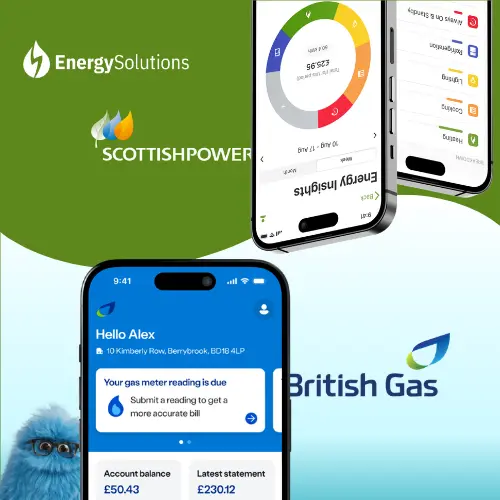
If the app matters to you, ScottishPower currently has the stronger iPhone rating.
At the time of checking:
- British Gas: 4.5/5 from around 14,000 Apple App Store ratings
- ScottishPower YourEnergy: 4.8/5 from around 88,000 ratings
Both apps cover the basics such as account management, meter readings, payments and energy usage.
British Gas also supports features including tariff changes, smart-meter bookings, Direct Debit management and PeakSave information through its app. ScottishPower’s app supports tariff changes, Direct Debit management, meter readings, consumption information and EV-related features.
What about the smart meters themselves?
This is where I would look beyond the app rating.
Ofgem reported that, as of 30 June 2026, the proportion of each supplier’s smart meters operating in smart mode was:
- British Gas: 91.7%
- ScottishPower: 89.2%
So ScottishPower currently has the stronger iOS app rating, but British Gas has the slightly stronger smart-meter operating figure.
Those are two different questions.
Which Is Better for EV Owners?
Both now have credible EV options, so older comparisons that say neither supplier offers smart EV tariffs are out of date.
British Gas EV tariffs
British Gas currently advertises an EV tariff with a 50% discount on the tariff electricity unit rate between midnight and 5am.
A smart meter is important. British Gas says customers can remain on the tariff if a smart meter cannot be fitted, but they will not receive the cheaper night rate.
It also offers Power+, which can give a 25% credit on electricity used for EV charging with a compatible charger and qualifying setup. British Gas currently illustrates an equivalent charging rate of around 6.75p/kWh when Power+ is paired with its EV tariff under the stated assumptions.
ScottishPower EV tariffs
ScottishPower’s EV Saver provides a five-hour night period for most customers, generally midnight to 5am in winter, with timings shifting for some meters during British Summer Time.
It also offers EV Optimise, which ScottishPower currently advertises at 8p/kWh for smart charging and says can be added to most of its tariffs, subject to eligibility and exclusions.
Which is better?
I would compare the whole household tariff, not just the attractive EV rate.
A cheap five-hour charging window can be wiped out by a poor daytime rate if most of your household electricity is used outside that window.
That is the kind of detail that gets missed when people compare one number.
Which Is Better for Green Energy?
This needs more care than simply asking which company calls itself greener.
There are three separate things:
- the supplier’s overall fuel mix;
- the fuel mix of the tariff you choose;
- the renewable generation owned by the wider company.
They are not the same.
British Gas renewable energy
British Gas’ latest published supplier fuel mix, covering April 2024 to March 2025, was:
- 35% renewable
- 55% nuclear
- 8% natural gas
- 1% coal
- 1% other
Its overall electricity mix was therefore 90% zero-carbon under its disclosure, largely because of the high nuclear share.
British Gas separately reports 100% renewable electricity for its Renewable Energy residential products.
British Gas also explains the point clearly: the electricity from different generators becomes mixed once it enters the grid. Renewable tariffs are therefore generally supported through mechanisms such as Renewable Energy Guarantees of Origin, or REGOs.
ScottishPower renewable energy
ScottishPower’s most recent supplier-specific disclosure currently available covers the same 2024–25 period.
It says its domestic green tariffs are backed by 100% renewable energy generated by its own UK wind farms.
Its non-green tariffs had a very different mix: 3% renewable, 73% gas, 14% coal, 4% nuclear and 6% other fuels.
This is exactly why I would not judge a supplier purely by the corporate brand.
If renewable electricity is important to you, compare the specific tariff you are buying and how the supplier supports its renewable claim.
ScottishPower has an obvious advantage if you value a green tariff explicitly linked to renewable generation from its own group wind assets. British Gas, however, has a much higher zero-carbon share in its wider published supplier mix because of nuclear electricity.
Those are different environmental preferences.
Does Your Meter Type Affect Which Supplier Is Better?
Yes.
A household with a standard single-rate meter is not making the same tariff decision as someone with Economy 7, an EV, battery storage or solar panels.
Ofgem confirms that multi-rate tariffs such as Economy 7 can charge different peak and off-peak unit rates, with the regulated rates considered together under the price-cap framework.
If you have a smart meter, the more useful question is what the supplier allows you to do with it.
For example:
- shift EV charging overnight;
- access time-of-use pricing;
- use half-hourly consumption data;
- take part in demand-shifting offers;
- manage solar export.
What if you have solar panels?
Export rates can also change the calculation.
British Gas currently publishes:
- Export Premium: 12p/kWh for qualifying systems under 15kW
- Export Extra: 8p/kWh for larger qualifying systems
Its page was updated on 27 August 2026.
ScottishPower currently lists:
- SmartGen: 6p/kWh
- SmartGen Premium: 12p/kWh
- SmartGen Premium Plus: 15p/kWh for qualifying ScottishPower installation customers
If you export a meaningful amount of solar electricity each year, the export tariff can matter just as much as a small difference in the import tariff.
British Gas vs ScottishPower: Pros and Cons
British Gas pros
- Wider publicly advertised mix of fixed, tracker, smart and EV tariff structures.
- Smart-meter performance was 91.7% in smart mode in Ofgem’s June 2026 data.
- EV tariff includes discounted midnight-to-5am electricity.
- Latest published overall fuel mix is heavily zero-carbon because of renewables and nuclear.
- Large established app with extensive account-management features.
British Gas cons
- Lower current Citizens Advice overall customer-service score than ScottishPower.
- Lower current Apple App Store rating.
- The variety of tariff structures means you need to read the terms rather than assuming “fixed” or “tracker” tells the whole story.
ScottishPower pros
- Higher latest Citizens Advice customer-service score.
- Higher current Apple App Store rating.
- EV Saver and EV Optimise provide clear options for EV charging.
- Domestic green tariffs are backed by renewable generation from ScottishPower Group wind farms.
- Several fixed, tracker and renewable products are currently available.
ScottishPower cons
- Slightly lower proportion of smart meters operating in smart mode in Ofgem’s latest data.
- Cap Tracker currently carries a £50 exit fee per fuel.
- ScottishPower’s latest published non-green tariff fuel mix remains heavily gas-based.
British Gas vs ScottishPower: Who Owns Them?
British Gas and ScottishPower are separate companies.
British Gas is part of Centrica. Centrica maintains the British Gas retail brand and operates British Gas Energy within its retail business.
ScottishPower is part of Iberdrola. Iberdrola’s corporate structure identifies Scottish Power Ltd as its UK country subholding company, with retail, networks and renewable-energy businesses underneath it.
This ownership difference matters more when looking at generation assets and long-term energy strategy than when comparing this month’s household bill.
Which Supplier Is Better for You?
This is how I would make the decision.
| If you care most about… | What I would compare |
| Lowest bill | Run both quotes using the same annual kWh |
| Customer service | ScottishPower currently has the stronger Citizens Advice score |
| App experience | ScottishPower currently has the higher iOS rating |
| Smart-meter reliability | British Gas currently leads slightly on Ofgem smart-mode performance |
| EV charging | Compare both EV products against your real charging pattern |
| Green tariff | Compare tariff-specific renewable evidence, not company slogans |
| Flexibility | Check exit fees and contract length |
| Solar export | Compare SEG/export rates and eligibility |
| Price certainty | Compare current fixed tariffs |
| Following the price cap | Compare tracker terms and discounts |
The real issue usually is not “Which supplier is better?”
It is:
Which supplier is offering the better contract for the way I actually use energy?
That is a much better question.
British Gas vs ScottishPower for Business Energy
This is where the comparison changes completely.
If you run a business, do not use domestic price-cap figures to judge a commercial contract.
Ofgem’s domestic energy price cap does not protect customers with business energy contracts.
Business contracts can also run for several years and Ofgem notes that most suppliers will not normally allow businesses to switch suppliers before the contract ends.
I’ve seen businesses focus heavily on a headline unit rate and then discover later that the contract structure mattered just as much.
For a business, I would compare:
- annual consumption;
- unit rate;
- standing charge;
- contract term;
- renewal date;
- meter type;
- non-energy and pass-through charges;
- renewable product terms;
- out-of-contract or deemed rates.
British Gas Business
British Gas Business currently offers fixed, variable and bespoke products, including British Gas Lite for qualifying smaller businesses and flexible products for larger users. It states that its fixed and flexible contract options can extend across several years.
ScottishPower Business
ScottishPower currently advertises one-, two- and three-year business contracts.
One important detail is that its current “For Business” and “Renewable for Business” products split pricing into a fixed energy component and a variable component for industry charges, which ScottishPower reviews quarterly.
That is exactly the sort of contract detail I would want a business owner to understand before signing.
A contract described as fixed does not automatically mean every cost component in every supplier product is frozen.
If you’re comparing British Gas Business and ScottishPower Business, compare the total annual cost and contract terms, not just the cheapest-looking pence-per-kWh figure.
How to Switch Between British Gas and ScottishPower
For a household, the process is normally straightforward.
- Check your current tariff. Find the tariff name and end date.
- Check any exit fee. Do not give away £100 to save £40.
- Find your annual usage. Use kWh from your bill, not just your monthly Direct Debit.
- Run like-for-like quotes. Use the same postcode, meter and payment method.
- Check the new tariff terms. Look at unit rates, standing charges and contract length.
- Submit the switch. Your new supplier normally handles the transfer.
- Take a meter reading if requested. This helps make sure the final bill is accurate.
Ofgem says a domestic supplier switch should take up to five working days, although you can request a later date. New domestic contracts also have a 14-day cancellation period.
Your gas and electricity do not need to be physically disconnected during a normal supplier switch.
What Are the Alternatives to British Gas and ScottishPower?
You do not have to choose either.
That sounds obvious, but comparison articles often forget it.
If both suppliers’ current quotes are poor for your usage, look at other available suppliers and compare them using the same assumptions.
Do not switch simply because one company wins this article.
Switch because the actual tariff available to you gives the right balance of:
- total annual cost;
- contract flexibility;
- service;
- smart features;
- renewable requirements;
- exit terms.
That is the decision.
British Gas vs ScottishPower: Final Verdict
If I were comparing British Gas and ScottishPower today, I would not name an overall winner without seeing the two actual quotes.
ScottishPower currently has the stronger independent customer-service score and the higher Apple App Store rating. British Gas currently has slightly better smart-meter operating performance and a broad selection of fixed, tracker and smart products. Both have credible EV and renewable-energy options.
Price remains personal to the property and tariff.
My advice is simple: take your latest bill, find your annual gas and electricity consumption in kWh, get current quotes from both suppliers and compare the total annual cost alongside the contract terms.
For a business, use a commercial comparison instead. Domestic price-cap figures will not tell you whether British Gas Business or ScottishPower Business is offering the better contract.
FAQs
Is British Gas cheaper than ScottishPower right now?
Not universally. Current rates can vary by postcode, usage, meter type, tariff and payment method. Run both quotes using identical annual consumption before deciding. Ofgem’s price cap provides a benchmark for qualifying standard variable tariffs, not a universal supplier price.
Is ScottishPower better than British Gas?
It depends on your priorities. ScottishPower currently has the higher Citizens Advice customer-service score and iPhone app rating. British Gas currently has slightly stronger smart-meter operating performance. Price needs to be compared using a live quote.
Are British Gas and ScottishPower the same company?
No. British Gas is part of Centrica, while ScottishPower is part of Spain-based Iberdrola.
Which has better customer service?
On the latest Citizens Advice data currently available, ScottishPower performs better overall: 2.94/5 versus British Gas at 2.61/5 for January to March 2026.
Which is better for green energy?
Both offer 100% renewable electricity products. ScottishPower says its domestic green tariffs are backed by renewable energy generated from its own UK wind farms. British Gas reports 100% renewable electricity for its Renewable Energy residential products. Compare the specific tariff rather than the supplier name alone.
Which is better for smart meters or EV tariffs?
Both have smart and EV options. British Gas currently offers discounted electricity from midnight to 5am on its EV tariff, while ScottishPower offers EV Saver and EV Optimise, with EV Optimise currently advertised at 8p/kWh for qualifying smart charging.
Should I switch from British Gas to ScottishPower?
Switch only if the new ScottishPower tariff gives you a better overall outcome after considering annual cost, exit fees, service and tariff conditions. Do not switch based on a generic annual-cost example.
Can I switch from British Gas to ScottishPower?
Yes, provided there is no contractual or account issue preventing the switch. Ofgem says a normal domestic supplier switch should take up to five working days.