Whether EDF Energy is worth switching to in 2026 genuinely depends on what you need from a supplier. If you drive an EV and charge overnight, the numbers stack up fast. If you just want the cheapest fixed rate on the market, you might find better elsewhere. That nuance matters, and this review covers it honestly.
EDF is one of the UK’s Big Six suppliers, formed in 2003 when the French state-owned Electricite de France acquired Seeboard, London Energy, and SWEB Energy. Today it supplies electricity and gas to over 3.7 million homes and businesses across Great Britain, holds 10.5% of the UK electricity market, and runs eight nuclear stations alongside more than 33 wind farms. That makes it the country’s single largest low-carbon electricity generator, which is worth knowing if green credentials factor into your decision.
This guide covers every current tariff, what you will actually pay versus the Ofgem price cap, what over 223,000 Trustpilot reviewers say, and a clear verdict on who should switch and who should keep comparing first.
EDF Energy at a Glance
| Key Information | Details |
| Founded | 2003 (UK operations) |
| Parent company | Electricite de France (French state-owned) |
| Customers | 3.7 million+ homes and businesses |
| Electricity market share | 10.5% |
| Gas market share | 8.7% |
| Trustpilot score | 4.8 out of 5 (223,000+ reviews, April 2026) |
| Low-carbon generation | 8 nuclear stations, 33+ wind farms |
| Smart meter | Yes, with In-Home Display |
| EV tariff | Yes, GoElectric at 6.49p/kWh off-peak |
| Business tariffs | Yes, fixed contracts up to 4 years |
Who Is EDF Actually Good For?
EDF works well for households that want predictable billing on a fixed deal, EV owners who can shift charging to overnight hours, smart-meter users who want detailed tracking through the EDF Home Hub, and small businesses that need fixed-price contracts for up to four years.
It is a weaker pick if you are a low-usage household where standing charges matter more than unit rates, or if you tend to drift on a standard variable tariff without regularly checking whether a better deal has appeared. That last point catches more people than it should.
Quick Verdict: Pros and Cons
| Pros | Cons |
| Trustpilot score of 4.8 from 223,000+ reviews | Exit fees on fixed and tracker tariffs |
| GoElectric off-peak rate: 6.49p/kWh | Value-for-money scores lag behind newer suppliers |
| Tracker tariff saves around £50/yr vs the cap | Heat pump tariff still in trial phase |
| Free smart meter with In-Home Display | Some customers report contact delays |
| Fixed business contracts up to 4 years | Economy 10 not currently offered |
| Smart Export Guarantee up to 18p/kWh | Standard variable offers no saving over cap |
| Boiler cover, EV charger install, heat pump fitting | Not always the cheapest fixed rate available |
What Tariffs Does EDF Currently Offer?
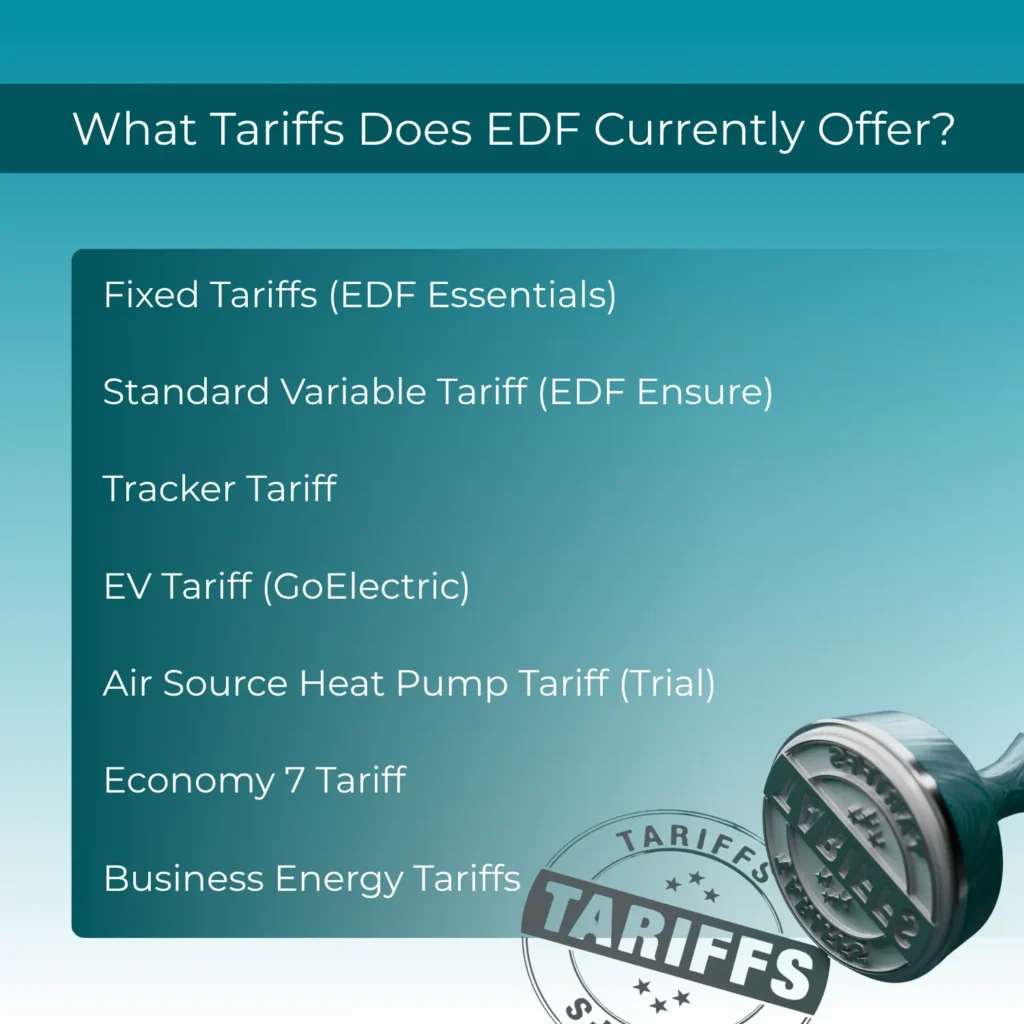
EDF divides its home tariffs into fixed, tracker, and standard variable options, with specialist products for EV owners, heat pump homes, solar exporters, and Economy 7 customers. Businesses get separate fixed and variable contracts.
Fixed Tariffs (EDF Essentials)
A fixed tariff locks your unit rate and standing charge for the full contract length. That means your bill cannot rise mid-contract because of wholesale price shifts or Ofgem cap changes. Worth knowing: EDF states that fixed prices are not covered by the energy price cap, so they stand on their own terms against whatever the cap is doing when you sign.
Multiple contract lengths are available, and you will need a smart meter to qualify for EDF Essentials. The trade-off is straightforward: billing certainty and protection against price spikes, offset by exit fees if you want to leave early, and the risk of being locked above the market if prices fall.
Exit fees range from £50 to £250 depending on the specific deal and when you try to leave. Always read the key facts document before you sign.
Best for: Households that want a predictable monthly Direct Debit and are not planning to move home during the contract.
Standard Variable Tariff (EDF Ensure)
EDF’s SVT tracks the Ofgem price cap, adjusting every three months in April, July, October, and January. The current cap for a typical household paying by Direct Debit is £1,641 a year for April to June 2026.
Current cap rates for this quarter are 24.50p/kWh for electricity (57.21p/day standing charge) and 6.24p/kWh for gas (29.09p/day standing charge). These are UK averages; your actual rates vary by region and meter type.
The SVT carries no exit fee and no contract end date, which makes it a useful short-term fallback. It is not, however, a deal in any meaningful sense. Use it as a benchmark to judge whether a fixed or tracker tariff saves you money, not as your long-term plan.
Best for: Customers who have just ended a fixed contract and want flexibility while comparing new deals.
Tracker Tariff
This is arguably EDF’s most interesting domestic product, and it is consistently underused. The tracker is designed to sit below the price cap, not just match it. EDF advertises savings of £50 a year for dual-fuel customers, or £25 per fuel if you switch only one.
Like the SVT, tracker rates adjust quarterly in line with Ofgem cap revisions. The difference is that tracker unit rates are set below cap level by a fixed margin. An exit fee of £25 per fuel applies if you leave early.
What most people overlook here is that this is a genuinely better option than sitting on SVT, and you do not need to predict where prices are heading. If you can accept quarterly movements in exchange for guaranteed below-cap pricing, the tracker beats a standard variable rate every time.
Best for: Households comfortable with quarterly price changes who want automatic savings below the cap without committing to a long fixed deal.
EV Tariff (GoElectric)
GoElectric is one of EDF’s clearest differentiators and one of the most competitive EV rates from any major UK supplier right now. The off-peak rate is 6.49p/kWh between 11pm and 6am, seven days a week.
You will need a smart meter capable of half-hourly readings to qualify. EDF also offers a Smart Charging bolt-on, and the company claims that an average EV driver using GoElectric with Smart Charging could save £1,181 a year versus running a petrol car. That figure is striking, but it is grounded in a real gap: overnight electricity at 6.49p/kWh is dramatically cheaper than a daytime rate near 24p/kWh.
Standard daytime rates apply to the rest of your home energy use, so this functions as a full home energy tariff, not just a charging add-on.
Best for: EV owners with a smart meter who can reliably charge overnight.
Air Source Heat Pump Tariff (Trial)
EDF offers a dedicated tariff for homes with air source heat pumps, featuring two discounted electricity periods aligned with when a heat pump typically runs most efficiently. Rates track the Ofgem cap quarterly, so they are not fixed.
This tariff is still in trial phase, meaning availability is limited. If you have a heat pump or are planning an installation, contact EDF directly or check the trial sign-up page. Worth checking even if you are not sure you will qualify.
Best for: Homes with, or planning to install, an air source heat pump.
Economy 7 Tariff
Economy 7 gives you seven hours of cheaper overnight electricity (generally 10pm to 8am, though the window varies by region) and a higher daytime rate. EDF’s Economy 7 sits within the price cap framework, so rates adjust quarterly.
It suits homes with storage heaters, which charge overnight and release heat during the day. As a rough guide, Ofgem recommends using at least 40% of your total electricity during the off-peak window to make it worthwhile. Below that threshold, a single-rate tariff is usually cheaper overall.
EDF does not currently offer Economy 10, which spreads ten off-peak hours across the day.
Best for: Homes with storage heaters or systems that concentrate electricity use overnight.
Business Energy Tariffs
EDF’s business range is genuinely competitive for SMEs that want price certainty. Two core options:
Fixed Business Online locks unit rates on contracts up to four years, paid by Direct Debit, with free smart meter installation for eligible sites. For small businesses that want to budget energy costs years ahead, EDF’s four-year fixed option is one of the longer lock-ins available in the UK market.
Variable Business offers flexibility for firms that cannot commit to a fixed term.
EDF Energy Prices in 2026
Current Ofgem Price Cap Rates (April to June 2026)
| Utility | Unit Rate | Daily Standing Charge |
| Electricity | 24.50p/kWh | 57.21p/day |
| Gas | 6.24p/kWh | 29.09p/day |
These are UK averages. Your actual rates depend on region, meter type, and payment method. Prepayment meter customers face slightly different rates under the cap.
How EDF Tariffs Compare to the Cap
EDF’s SVT sits at cap level, so you pay cap rates. The tracker sits below it, delivering the advertised £50 dual-fuel saving. Fixed tariffs set their own rates independently, meaning they could be above or below the cap depending on when they were priced and where wholesale markets have moved since.
The practical rule: always compare any EDF fixed tariff quote against current cap rates before committing. If the fixed rate is materially above the cap, you are essentially betting that cap prices will rise before the deal is worthwhile.
Real-World Cost Examples by Usage
| Household type | Annual electricity | Annual gas | Estimated annual bill |
| Small flat (1-2 people) | 1,800 kWh | 8,000 kWh | ~£1,100-£1,200 |
| Average home (3-4 people) | 2,900 kWh | 11,500 kWh | ~£1,641 (cap benchmark) |
| Larger home (4+ people) | 4,200 kWh | 17,000 kWh | ~£2,200-£2,500 |
Estimates use April to June 2026 cap unit rates. Your bill will differ based on region, insulation, heating type, and metering.
Exit Fees: What You Need to Know
Exit fees apply on fixed tariffs (£50-£250 depending on the deal) and on the tracker (£25 per fuel). The SVT carries no exit fee. One thing many switchers miss: if you are leaving a fixed tariff inside the last 49 days before it ends, suppliers cannot legally charge an exit fee. Timing your switch around that window is worth doing.
EDF Energy Reviews: What Do Customers Actually Say?
EDF holds a Trustpilot score of 4.8 out of 5 from over 223,000 reviews, making it one of the highest-rated major UK energy suppliers by both volume and score.
What customers praise most
The most consistent positives centre on three things: the quality of the EDF app and Home Hub for tracking daily usage and spend, the helpfulness of customer service staff when issues are resolved on first contact, and the smoothness of the switching process. Smart-meter users tend to rate EDF particularly highly because the combination of half-hourly data, the In-Home Display, and the app gives a genuinely useful picture of where energy money is going each day.
Common complaints
The most frequent criticisms involve billing errors on initial setup, contact delays during busy periods (typically when cap changes kick in), and the need to chase resolution more than once on complex queries. Some customers also flag that EDF’s tariffs are competitive but not always the absolute cheapest on a comparison site, which is a fair observation.
What the review picture means for a switcher
A 4.8 score from 223,000 reviews is a large and reliable signal. It does not mean EDF is flawless, but it does mean the service experience is consistently good enough that the vast majority of customers are satisfied. The more important question for a switcher is whether EDF will handle your account setup, billing, and meter support cleanly. The evidence strongly suggests it will.
EDF App and Online Account (Home Hub)
EDF’s digital tools are a genuine competitive advantage. The app and MyAccount portal share a single login and let you make payments, submit meter readings, track energy use, switch tariffs, and contact support in one place.
The Energy Hub inside MyAccount uses smart-meter data to show your usage and costs over time. EDF says over half a million customers actively use it. For anyone new to smart meters, the hub makes the transition from estimated to actual billing considerably easier and helps you spot whether any usage habits are quietly costing more than they should.
The In-Home Display that comes with a free smart meter installation shows live usage in pounds and pence, which is a more intuitive way to understand energy spend than reading a bill after the fact.
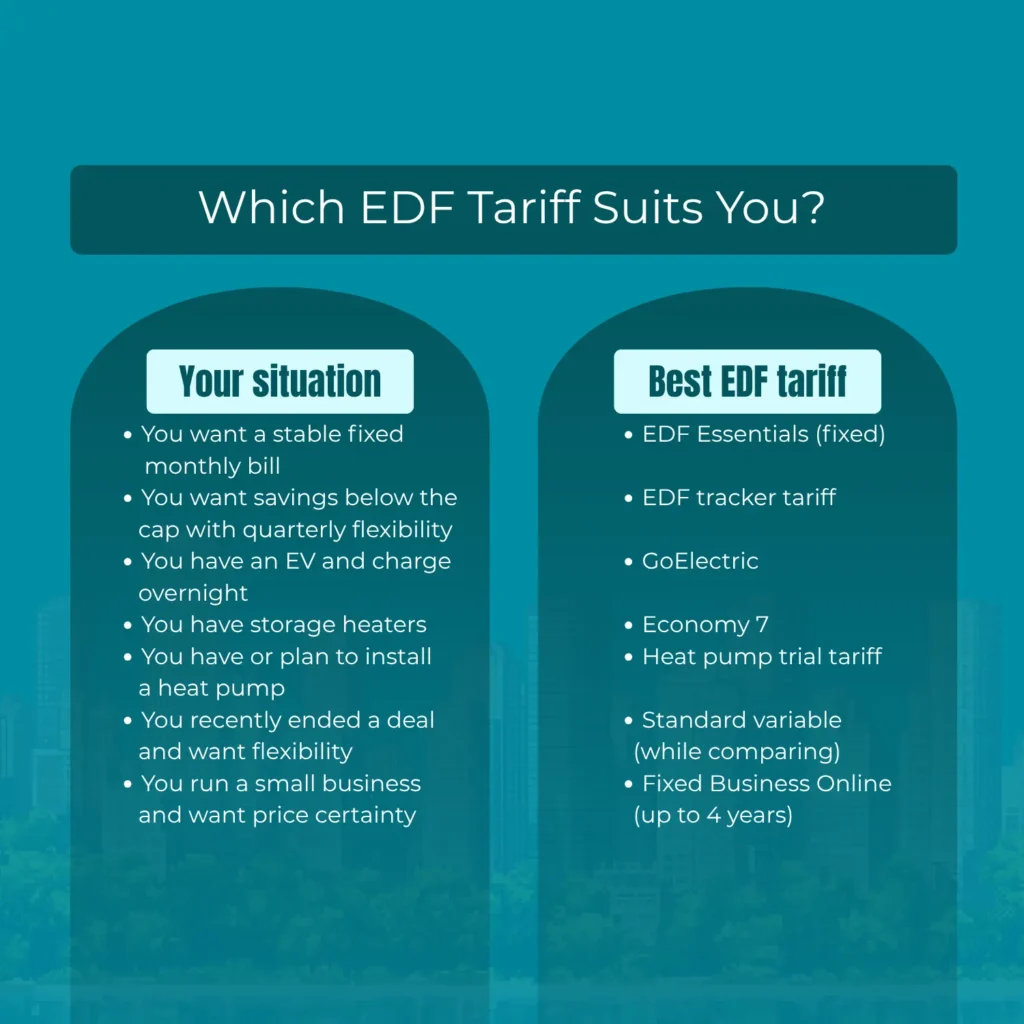
Which EDF Tariff Suits You? A Quick Decision Guide
| Your situation | Best EDF tariff |
| You want a stable fixed monthly bill | EDF Essentials (fixed) |
| You want savings below the cap with quarterly flexibility | EDF tracker tariff |
| You have an EV and charge overnight | GoElectric |
| You have storage heaters | Economy 7 |
| You have or plan to install a heat pump | Heat pump trial tariff |
| You recently ended a deal and want flexibility | Standard variable (while comparing) |
| You run a small business and want price certainty | Fixed Business Online (up to 4 years) |
Is EDF Energy Good Value in 2026?
EDF is good value when you match the right tariff to your actual usage pattern. The tracker tariff is underused and underappreciated: it delivers guaranteed savings below the cap without requiring you to guess where prices are heading. The GoElectric rate at 6.49p/kWh off-peak is among the most competitive overnight rates from any major supplier. The four-year fixed business contracts offer SMEs a level of price certainty that very few rivals can match.
Where EDF is less compelling is on headline unit rate comparisons. Smaller or newer suppliers sometimes undercut EDF on fixed deals for straightforward household usage. Run a full market comparison rather than checking EDF’s site in isolation and you may find a cheaper deal, though weigh that against EDF’s much larger review base and proven service track record.
EDF Energy vs Other UK Suppliers
EDF vs British Gas
Both are Big Six suppliers with broad tariff ranges and national coverage. EDF edges ahead on Trustpilot and on low-carbon generation credentials. British Gas has a broader home services and boiler cover range, which matters if you want everything with one provider. On tariff pricing, the gap is typically small and comparison-site dependent.
EDF vs Octopus Energy
Octopus is EDF’s closest competitor for tech-savvy and EV-focused households. Octopus Intelligent Octopus matches EDF’s GoElectric on overnight EV pricing and sometimes beats it. Octopus also tends to score slightly higher on value-for-money perception in independent surveys. EDF counters with stronger nuclear generation credentials, a bigger review base, and longer business contract options. For most household switchers, the choice usually comes down to personal preference on app experience and tariff structure.
EDF vs E.ON Next
E.ON Next has improved its customer service scores meaningfully in recent years. On tariff range, EDF offers more specialist options including EV, heat pump, Economy 7, and SEG, plus the tracker product. E.ON Next competes well on fixed tariff pricing for straightforward dual-fuel households. If your setup is more complex, EDF’s specialist range gives it a clear edge.
Supplier Comparison Table
| EDF Energy | British Gas | Octopus Energy | E.ON Next | |
| Trustpilot score | 4.8 | Lower (varies) | 4.9 | 4.7 |
| EV-specific tariff | Yes, 6.49p/kWh off-peak | Yes | Yes | Yes |
| Tracker tariff | Yes (below cap) | No | Yes | No |
| Free smart meter | Yes | Yes | Yes | Yes |
| Business fixed contracts | Up to 4 years | Yes | Limited | Yes |
| Exit fees (fixed) | £50-£250 | Varies | Varies | Varies |
| SEG tariff (solar export) | Yes, up to 18p/kWh | Yes | Yes | Yes |
EDF Energy’s Green Credentials
EDF is the UK’s largest low-carbon electricity generator. Its eight nuclear stations and more than 33 wind farms, including offshore sites, produce zero-carbon electricity at the point of generation. EDF Renewables is also developing solar and battery storage projects as part of the company’s wider net-zero commitment.
For households with solar panels or battery storage, EDF’s Smart Export Guarantee is worth noting. EDF pays up to 18p/kWh for electricity exported from new solar panel or battery installations and 15p/kWh for existing panels. That rate is competitive against other major supplier SEG tariffs, as tracked by Ofgem’s SEG register.
EDF Energy Additional Products and Services
EDF is not purely a tariff provider. Alongside energy supply it offers:
Boiler and home cover: BoilerCare plans start from £11.60 a month for the first year and cover boiler servicing, repairs, and home emergency support. The Easy Online + BoilerCare Gold tariff combines a fixed energy deal with boiler maintenance, useful for households that want both under one Direct Debit.
EV home charger installation: EDF installs home charging points and offers EV leasing, making it a convenient option if you are moving to electric driving and want to sort the tariff and charger in one go.
Heat pump installation: EDF offers air source heat pump installation alongside its heat pump tariff.
Home electrics cover: Available as a standalone add-on beyond boiler and heating.
Smart Export Guarantee: Rates up to 18p/kWh for eligible solar customers exporting back to the grid.
How to Get the Best Deal with EDF Energy
When is the right time to switch?
The best moments are: when your current fixed deal is inside its last 49 days (no exit fee applies in that window), when your bill has just rolled onto a standard variable tariff after a fixed deal ended, or when your usage pattern has changed significantly due to a new EV, heat pump, or solar installation and your current tariff no longer fits.
What to check before signing
Before committing to any EDF tariff, verify four things: the contract length and what happens at the end; the exit fee and exactly when it applies; the standing charge, not just the unit rate; and whether the tariff requires a smart meter you do not yet have. The key facts document for each tariff contains all of this and suppliers are required to provide it.
How to Switch to EDF: Step by Step
- Gather your current annual usage in kWh from your most recent bill or your current supplier’s online account.
- Compare EDF’s available tariffs against your current deal and against the price cap benchmark.
- Check the exit fee on your current tariff and confirm whether you are inside the 49-day switch window.
- Request a quote from EDF directly or through a comparison tool.
- Confirm the switch. Under the Energy Switch Guarantee, EDF and your old supplier handle the technical switch within five working days with no interruption to your supply.
Running a comparison across multiple suppliers at once is faster than checking each individually and often surfaces deals that are not prominently featured on EDF’s own site. A good comparison tool will also factor in your usage profile, meter type, and payment method for a more accurate projected annual cost than a headline rate alone.
Frequently Asked Questions
What tariffs does EDF Energy offer?
EDF offers fixed tariffs (EDF Essentials), a standard variable tariff (EDF Ensure), a tracker tariff with guaranteed savings below the Ofgem cap, an EV off-peak tariff (GoElectric at 6.49p/kWh overnight), an air source heat pump tariff currently in trial, Economy 7, and separate business tariffs including fixed contracts up to four years.
Is EDF Energy cheaper than the Ofgem price cap?
The standard variable tariff sits at cap level. The tracker tariff sits below it, saving around £50 a year for dual-fuel customers. Fixed tariffs may be above or below the cap depending on market conditions when the deal was priced.
Does EDF Energy charge exit fees?
Yes. Fixed tariffs carry exit fees of £50 to £250. The tracker charges £25 per fuel. The standard variable has no exit fee. No supplier can charge an exit fee if you switch within the final 49 days of a fixed contract.
Is EDF Energy any good?
EDF holds a Trustpilot score of 4.8 from over 223,000 reviews, placing it among the highest-rated major UK suppliers. Praise centres on the app, Home Hub, and first-contact resolution. The main criticisms involve billing issues on setup and contact delays during busy periods.
Does EDF have an EV tariff?
Yes. GoElectric offers 6.49p/kWh off-peak between 11pm and 6am. A smart meter with half-hourly readings is required. EDF says an average EV driver on GoElectric with Smart Charging could save £1,181 a year versus running a petrol car.
Does EDF offer business energy?
Yes. Fixed Business Online offers fixed unit rates on contracts up to four years, paid by Direct Debit, with free smart meter installation available. Variable Business is also available for firms needing flexibility.
Can I get a smart meter with EDF?
Yes, EDF installs smart meters free of charge for eligible customers, including an In-Home Display. A smart meter is required for GoElectric and the heat pump trial tariff.
How do I contact EDF Energy?
Phone: 0333 006 9950 (Monday to Thursday 8am-6pm, Friday 8am-4pm) for Direct Debit, cash, and cheque customers. Prepayment customers: 0333 200 5100 (Monday to Friday 8am-6pm). Email: hello@edfenergy.com. WhatsApp/text: 07480 589 950.
What is EDF’s Smart Export Guarantee rate?
EDF pays up to 18p/kWh for electricity exported from new solar panel or battery installations, and 15p/kWh for existing solar installations.
Final Verdict: Is EDF Energy Worth It in 2026?
EDF is a strong choice for the right customer. Its biggest advantages are the tracker tariff (guaranteed below-cap savings without a long commitment), the GoElectric rate (6.49p/kWh overnight, one of the best from any major supplier), an exceptional Trustpilot score backed by 223,000 reviews, and four-year fixed business contracts that most rivals simply cannot match.
It is not always the cheapest on a pure unit-rate comparison, and households that rarely shop around risk drifting on SVT while better deals go unnoticed.
Switch to EDF if you own an EV and can charge overnight, your fixed deal is ending and you want a tracker or new fixed rate, you are a small business needing multi-year price certainty, or you want a mainstream supplier with a strong digital account experience.
Keep comparing first if you use very little energy and standing charges matter more than unit rates, your current fixed deal remains cheaper than EDF’s available tariffs after exit fees, or you want to check whether a newer supplier undercuts EDF’s fixed pricing for your specific usage and region.
The smartest move in 2026 is not to pick EDF because it is familiar. It is to compare the tariff that fits your meter, your usage, and your budget and switch only when the numbers genuinely work in your favor.