Author: Abdullah Shoaib | Energy Markets Analyst, 10+ years in the energy industry
Rising energy bills are one of the most pressing costs for UK small business owners, but most of the overspending isn’t caused by market prices. It comes from inside the building.
Inefficient lighting, forgotten standby devices, poorly managed heating, and contracts that quietly rolled over to higher rates after auto-renewal are the four most common culprits. According to the Energy Saving Trust, SMEs can cut energy use by up to 30% through operational changes alone, no major investment required.
This guide covers exactly how to do that: no-cost quick wins, smarter upgrades, and government funding schemes available depending on where in the UK your business is based.
What SME Energy Savings Actually Means
It’s not about using less energy for the sake of it. It’s about getting the same output for less money.
Every sale you make, every hour your team works, every piece of equipment running in the background: all of that has an energy cost. When that cost is higher than it needs to be, it quietly eats into your margins month after month.
UK energy prices have been volatile in recent years, partly tied to movements in Ofgem’s price cap, and that uncertainty makes forward planning genuinely difficult for small businesses. When bills rise faster than revenue, something has to give. For most SMEs, that means profit.
Treating energy efficiency as a business performance issue, not just a green initiative, tends to produce much better results.
Why SMEs Overspend on Energy
The waste usually comes from several directions at once, which is why it’s easy to miss.
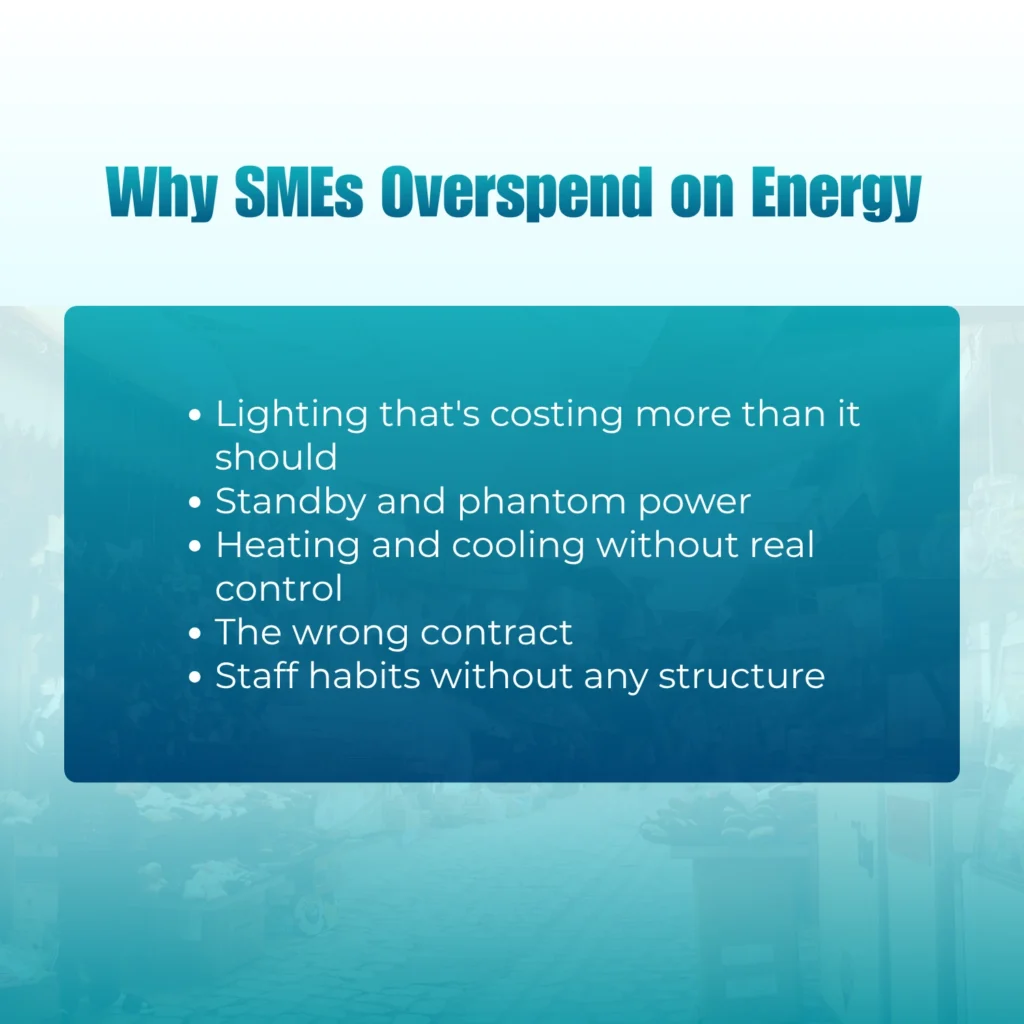
Lighting that’s costing more than it should
Older halogen or fluorescent fittings use significantly more power than modern LEDs and tend to produce more heat than light. For a shop or office running those fittings across long hours, the difference in running costs is substantial.
Standby and phantom power
Printers, monitors, chargers, kitchen equipment, and IT peripherals often keep drawing electricity even when nobody’s using them. It’s one of those losses that feels negligible in isolation but adds up considerably over a full year.
Heating and cooling without real control
A thermostat set a degree or two too high, rooms being heated when nobody’s in them, radiators fighting open windows: these aren’t unusual situations. They’re just very common sources of controllable waste.
The wrong contract
This is the one most businesses overlook entirely. You can run a tight ship operationally and still overpay because your contract rolled over, your unit rate is uncompetitive, or the tariff structure doesn’t match how your business actually uses energy. Business energy contracts aren’t protected by Ofgem’s domestic price cap, so the variation between suppliers can be significant.
Staff habits without any structure
When there’s no clear policy, energy use becomes inconsistent. Lights stay on in empty rooms, equipment runs overnight, and small losses accumulate because nobody’s been asked to do anything differently.
How Much Can You Realistically Save?
For most small businesses, somewhere between 10% and 30% is achievable, depending on the building, existing equipment, and current habits.
To put that in practical terms: a business spending £1,200 per month on energy could save around £240 monthly, or close to £2,900 a year, with a 20% reduction. That’s not a number that requires a major overhaul. In many cases, it comes from a combination of small changes done consistently.
The businesses that see the strongest results tend to do two things well: they fix obvious waste quickly, and then they lock in longer-term savings through targeted upgrades and smarter procurement.
Step-by-Step SME Energy Savings Plan
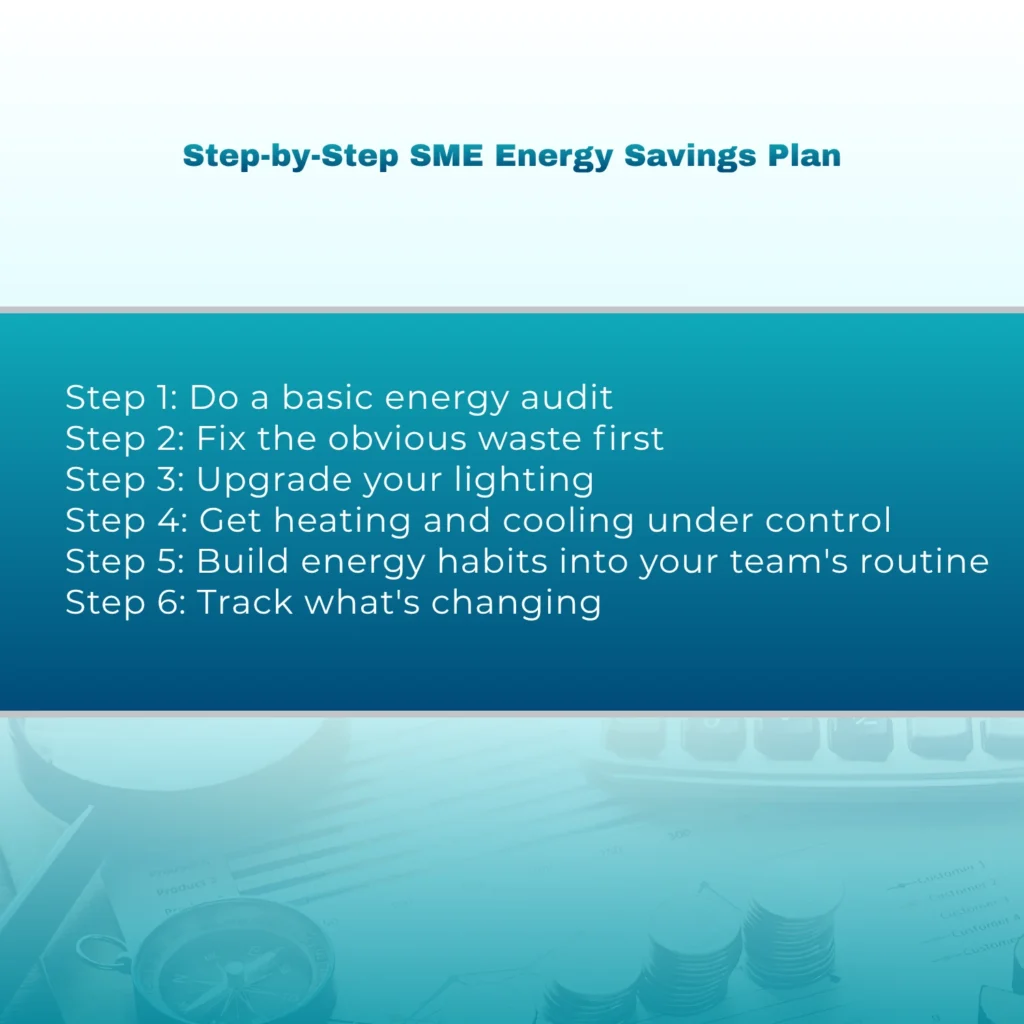
Step 1: Do a basic energy audit
Before spending anything, find out where the money is going. Walk through your premises with your last few bills in hand and look at lighting, heating, IT equipment, appliances, and anything that runs continuously.
This SME energy guide can help you identify the biggest waste areas without bringing in a consultant. The key question to ask yourself: which rooms, habits, or machines are costing the most?
Step 2: Fix the obvious waste first
Turn off devices fully at the end of the day. Get standby equipment on timers or smart plugs. Reduce lighting in rooms that aren’t regularly occupied. These cost very little and often produce the fastest measurable drop in usage.
Step 3: Upgrade your lighting
LED lighting is one of the most straightforward upgrades available to SMEs. It can cut lighting energy use by up to 75% compared to older fluorescent or halogen fittings, based on figures from Business Energy Scotland, and the bulbs last considerably longer, which also reduces maintenance.
Motion sensors and timers in corridors, toilets, and storage rooms add another layer of savings with minimal disruption.
Step 4: Get heating and cooling under control
Dropping your heating by just 1 degree Celsius in winter can trim bills noticeably over a full season. Thermostatic radiator valves in individual rooms give you more precise control without requiring a full system overhaul.
The goal isn’t to make the building uncomfortable. It’s to stop paying to heat or cool spaces that don’t need it.
Step 5: Build energy habits into your team’s routine
Technology helps, but people drive most of the results. Assign someone as an energy lead, even informally, and create a simple checklist for opening and closing the premises. When expectations are clear, the changes actually stick.
Step 6: Track what’s changing
Smart meters and monthly usage reviews help you see whether the changes are working. Without monitoring, you’re guessing. With it, you know exactly what’s improving and where there’s still room to act.
Energy Savings by Business Type
Different businesses waste energy in different ways.
Retail stores tend to carry heavy lighting loads across long opening hours. Lighting upgrades and door management, particularly in premises with frequent customer footfall, are usually the fastest starting points.
Offices typically have significant standby loads from screens, printers, and chargers. Power-down routines and smart plugs are especially effective here. On hybrid or remote working days, heating and lighting demand can also be reduced significantly.
Hospitality businesses use energy across kitchens, refrigeration, guest areas, and laundry. Kitchen practices, equipment maintenance, and temperature control tend to offer the broadest opportunities, though a site-specific plan usually gives better results than a generic one.
Small manufacturing units often have high equipment loads and longer operating hours. Reviewing machine scheduling, reducing idle time, and maintaining compressed air systems can produce meaningful savings alongside the standard lighting and heating improvements.
Hidden Waste Most SMEs Miss
A few sources of energy loss that don’t always show up in an initial walk-through:
Phantom load from plugged-in electronics is one of the most common. Devices that don’t need 24/7 power should be switched off at the wall or controlled with smart plugs.
Overcooling or overheating is another. Many businesses compensate for short-term discomfort by going too far in either direction, which consistently pushes bills up without meaningfully improving how the space feels.
Poor equipment maintenance is probably the most underrated. Dirty filters, faulty seals, and worn parts make equipment work harder to deliver the same output. Routine servicing protects both efficiency and equipment lifespan.
Efficiency and Procurement: Both Matter
A lot of SME energy advice focuses entirely on usage. That’s only half the picture.
Reducing how much energy you use is important. But if you’re still buying that energy on a poor contract, the savings you see on your bill will be smaller than they should be.
Fixed rates, contract lengths, standing charges, and renewal timing all affect your final cost. An energy broker can help compare offers, identify hidden charges, and match your contract structure to your actual usage patterns. For businesses that haven’t reviewed their contract recently, this alone can produce meaningful savings without changing a single operational habit.
Government Support Across the UK
Support varies depending on where your business is based, so it’s worth checking what’s available in your nation before planning any investment.
England: The gov.uk SME energy guide provides practical low-cost guidance. The Boiler Upgrade Scheme supports businesses replacing fossil fuel heating, and the Industrial Energy Transformation Fund offers grants for carbon-reducing technologies.
Wales: Business Wales provides sustainability and energy efficiency support through regional centres. The Development Bank of Wales runs a Green Business Loan Scheme covering consultancy and financing for efficiency improvements.
Scotland: Business Energy Scotland offers free, impartial advice including energy audits and zero-interest finance for upgrades such as LED lighting and heating controls.
Northern Ireland: Invest NI provides energy assessments, advice, and access to financing for businesses looking to improve resource efficiency.
The Carbon Trust and Energy Saving Trust also offer UK-wide tools and guidance that are useful before committing to any equipment purchase or contract change. Many local councils run their own business support programmes too, so it’s worth checking with yours alongside the national schemes.
Frequently Asked Questions
How can SMEs reduce energy costs in the UK?
The most effective approach combines operational changes, targeted upgrades, and smarter procurement. LED lighting, better heating controls, power-down routines, and a regular contract review are all reliable starting points. The Energy Saving Trust suggests SMEs can cut energy use by up to 30% without significant capital investment.
What’s the fastest way to save energy in a small business?
Fix obvious waste first, at no cost. Turning off standby devices, shutting equipment down fully at the end of the day, and reducing unnecessary lighting are typically the quickest ways to see a measurable drop in usage.
How much can LED lighting save?
Up to 75% on lighting energy costs compared to older fluorescent or halogen fittings, based on figures from Business Energy Scotland. The actual saving depends on usage hours, the number of fittings, and what you’re replacing.
Do smart meters help SMEs save money?
Yes. They show exactly when and where energy is being used, which makes it much easier to spot waste and confirm whether changes are actually making a difference.
Is switching energy supplier worth it?
Often, yes. If your contract has rolled over onto a deemed rate, you’re very likely overpaying. Since business energy isn’t covered by Ofgem’s domestic price cap, rates vary considerably between suppliers. Comparing offers before renewal is worth the time, or using a broker if you’d rather not manage it yourself.
Can SMEs get a free energy audit in the UK?
In some cases. Business Energy Scotland offers free audits to eligible Scottish businesses, and similar support exists through Business Wales and Invest NI. England-based businesses can use the gov.uk SME guide as a free starting point, though a formal on-site audit may carry a cost depending on the scheme.
A Final Word
The businesses that make the biggest gains on energy costs aren’t usually the ones that overhaul everything at once. They’re the ones that identify their biggest losses, fix the easy wins first, and then build a plan that fits their actual situation.
Lower bills, better cash flow, less waste: the opportunity is real for most UK small businesses. The key is treating energy as something you control, not something that just happens to you.
Start with a basic audit, remove obvious waste, check what support is available in your area, and then work through the upgrades and procurement improvements that make sense for your sector and budget.