
Author: Abdullah Shoaib | Energy Markets Analyst, 10+ years in the energy industry
Key Takeaways
- Global energy demand growth is slowing to roughly 1 to 2% a year.
- Electricity demand is expected to grow around 3.6% annually through 2030.
- Solar PV is on track to become the largest source of new power generation.
- Fossil fuels remain important but face increasing price volatility.
- Businesses should prioritize efficiency, procurement strategy, and energy risk management now, not later.
Intro
Something has shifted in global energy markets this year, and it’s not subtle. Electricity demand is climbing fast, fossil fuel growth is losing steam, and renewables are scaling at a pace that would have seemed optimistic just a few years ago. For businesses, the practical effect is messier budgets: energy costs are harder to predict, supply chains carry more risk, and investment decisions now have to account for swings that used to be rare.
This article walks through what’s actually happening in the 2026 energy market, based on data from the IEA’s Global Energy Review 2026 and the EIA’s Short-Term Energy Outlook, and what it means if you’re trying to plan ahead rather than just react.
What Is the 2026 Energy Market Outlook? (Definition & Overview)
In short: the 2026 outlook describes a global energy system where total demand growth is cooling to somewhere around 1 to 2% a year, electricity demand is rising several times faster than that, and low emissions sources, solar in particular, are supplying most of the new growth the world actually needs.
Global Energy Market at a Turning Point
A few numbers tell the story better than any summary could. According to the IEA’s Global Energy Review 2026, low emissions sources accounted for nearly 60% of global energy demand growth in 2025. Electricity demand itself is forecast to grow at an average of 3.6% a year through 2030, which is 50% faster than the previous decade managed, per the IEA’s Electricity 2026 report. And the generation mix is shifting underneath all of it: low emissions electricity is set to climb from 42% of generation in 2025 to half by 2030.
Statistics at a Glance
| Metric | 2025 | 2030 Forecast |
| Global Electricity Demand Growth | 3.0% | 3.6% CAGR |
| Renewable Generation Share | 42% | 50% |
| Solar + Wind Share | 17% | 27% |
| Coal Generation Share | 34% | 27% |
Source: IEA Electricity 2026
Key Drivers Shaping 2026 Market Conditions
A handful of forces are doing most of the work here. Industry, EVs, air conditioning, and data centres are pushing electricity consumption up quickly. At the same time, slower growth in major economies like China, where energy demand growth dropped to about 1.7% in 2025 from 2.7% the year before, is keeping a lid on total demand. Cost declines in renewable technology are accelerating adoption almost everywhere, and ongoing geopolitical friction continues to rattle oil and gas supply chains in ways that ripple through pricing for months afterward.
Global Energy Demand Forecast 2026 (Core Trend Analysis)
Quick answer: demand growth overall is slowing down, low emissions sources are picking up most of the slack, and electricity demand is wildly outpacing total energy demand, a gap that’s expected to widen through 2030 rather than close.
Overall Energy Demand Growth
Natural gas covered roughly 17% of global demand growth in 2025, with oil adding around 15%, according to IEA data. Coal, meanwhile, barely grew at all: 0.4% in 2025, down from 1.4% the year before, largely because of declines in China and India.
Electricity Demand vs Total Energy Demand
Global electricity demand grew 3% in 2025 after a stronger 4.4% jump in 2024, per the IEA’s Electricity 2026 report. Here’s the part worth pausing on: in 2024, global electricity demand outpaced economic growth for the first time in three decades outside a crisis period. That’s not a one off blip either. EVs, AI infrastructure, and industrial electrification are expected to keep pushing this trend further in the years ahead.
Regional Demand Differences
China saw demand growth slow to about 1.7% in 2025, well under its GDP growth, as renewables expansion chipped away at coal use.
The US told a different story. Energy demand grew more than 2% in 2025, the second fastest increase since 2000 outside a post recession rebound, according to EIA figures. A mix of gas to coal switching, a brutal winter, and surging data centre electricity use drove this, and the US alone accounted for nearly a quarter of all global demand growth last year.
India’s growth slowed to around 1%, among its lowest rates in recent memory, thanks to an early monsoon and fast renewables growth squeezing coal consumption.
Emerging markets broadly kept expanding their fossil and renewable mix together, though weather and industrial swings still cause noticeable regional variation.
Global Energy Supply Trends in 2026
Renewable Energy Dominance Expansion
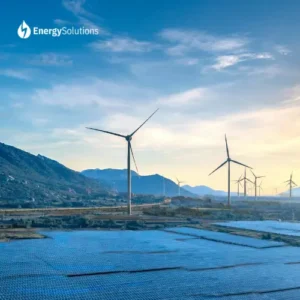
Solar PV alone is set to add more than 600 TWh a year on average through 2030, per IEA projections. It’s expected to overtake wind and nuclear generation by 2026, and hydropower by 2029, which is a faster overtaking than most forecasts predicted even two years ago. Combined, solar and wind are set to climb from 17% of total generation in 2025 to 27% by 2030, with renewable output overall growing by roughly 1,000 TWh a year, an 8% annual growth rate.
Fossil Fuel Market Transition Phase
Global oil demand is now forecast to actually shrink by 1.1 million barrels a day over 2026, though a rebound of 2.5 million barrels a day is expected in 2027 once disrupted supply flows settle back down, according to EIA’s STEO.
Gas fired generation is on track to grow 2.6% a year through 2030, faster than the roughly 1.4% average of the last five years, driven mainly by rising US demand and oil to gas switching in the Middle East.
Coal’s share of the generation mix is expected to drop to 27% by 2030 from 34% in 2025. Worth noting: it will still be the single largest electricity source through that whole period. Coal isn’t disappearing, it’s just losing ground gradually.
Supply Chain & Geopolitical Risks
Disrupted shipping through the Strait of Hormuz has cut Middle East crude production by more than 11 million barrels a day versus pre conflict levels, a shock that’s pushed diesel, jet fuel, and gasoline price forecasts sharply higher for 2026, per EIA estimates. Beyond that single chokepoint, ongoing energy security policy shifts keep reshaping import and export flows, especially around LNG and the Middle East’s pivot from oil to gas.
World Energy Outlook 2026: Key Scenarios
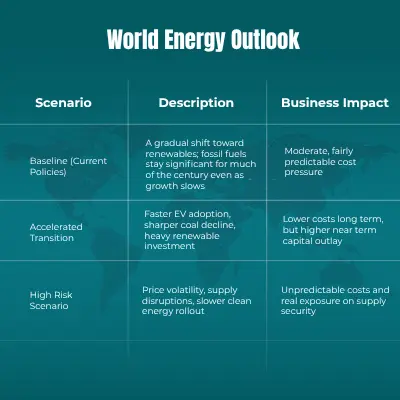
| Scenario | Description | Business Impact |
| Baseline (Current Policies) | A gradual shift toward renewables; fossil fuels stay significant for much of the century even as growth slows | Moderate, fairly predictable cost pressure |
| Accelerated Transition | Faster EV adoption, sharper coal decline, heavy renewable investment | Lower costs long term, but higher near term capital outlay |
| High Risk Scenario | Price volatility, supply disruptions, slower clean energy rollout | Unpredictable costs and real exposure on supply security |
The IEA’s own modelling doesn’t support either extreme people often expect: neither a rapid abandonment of fossil fuels nor a sustained rebound in their consumption. The more realistic path, across nearly every scenario, is a plateau followed by a slow decline.
Major Risks in the 2026 Global Energy Market
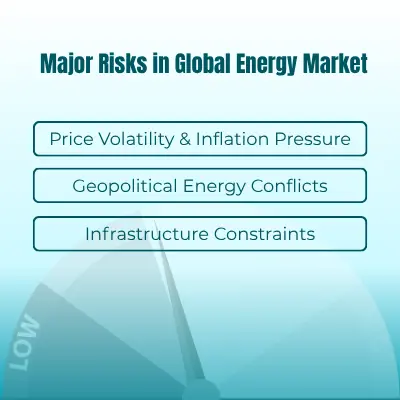
Price Volatility & Inflation Pressure
US wholesale diesel prices are forecast to rise more than 60% in 2026, with gasoline up around 50%, compared to what was expected before the recent disruptions, per EIA’s STEO. That kind of swing shows just how quickly fuel costs can move when supply gets squeezed, and it continues feeding into broader inflation and cost instability for businesses trying to plan budgets.
Geopolitical Energy Conflicts
Oil shipments through the Strait of Hormuz are only assumed to resume gradually from the third quarter of 2026, with traffic not expected back to pre conflict levels until early 2027. Layer on top of that the usual churn of trade restrictions and sanctions, and global energy flows look set to keep shifting in ways that are hard to fully plan around.
Infrastructure Constraints
Grid capacity and transmission bottlenecks are increasingly the bottleneck, not generation capacity itself, limiting how fast renewables can actually scale to meet rising demand. And here’s something a lot of people miss: even as wholesale energy prices ease from crisis peaks, network charges, taxes, and levies still make up a large, often growing chunk of electricity bills. Cheaper power doesn’t always mean a cheaper bill.
Expert Insight: What UK Businesses Often Miss About Energy Forecasts
Many businesses focus exclusively on wholesale energy prices when budgeting for the year ahead. In practice, network charges, standing charges, capacity costs, and policy levies often have a greater long-term impact on total energy spend than commodity pricing itself. I’ve seen procurement teams negotiate hard on the wholesale rate and then get caught out a year later when non-energy costs quietly climb. If you’re only watching the headline price per unit, you’re only watching part of the bill.
– Abdullah Shoaib
Business Energy Market Impact
The Problem: Rising and Unpredictable Energy Costs
Electricity and fuel pricing keep swinging, amplified by shocks like the Hormuz disruption, and that volatility creates real budget uncertainty for SMEs and industrial users alike. Making it worse, non energy charges add a layer of cost that doesn’t track wholesale markets at all, so even falling energy prices don’t always show up on the bill.
The Fix: Energy Efficiency Strategies
Smart usage optimisation and demand side management can absorb a surprising amount of cost volatility. Shifting toward renewable procurement, through power purchase agreements for example, locks in more predictable pricing. And load shifting, moving consumption away from peak demand windows, matters more now than it used to, since electricity systems are becoming far more time sensitive.
The Fix: Strategic Energy Planning
Long term contracts help manage price swings. Diversifying energy sourcing across fuel types and suppliers spreads out risk. And building hedging strategies around actual, accurate consumption data, rather than rough estimates, tends to make the biggest difference for businesses trying to get ahead of this.
How Businesses Should Prepare for 2026 Energy Changes
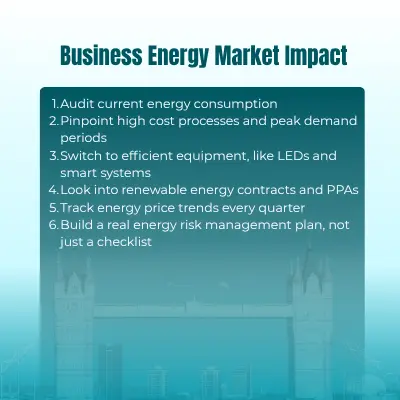
- Audit current energy consumption
- Pinpoint high cost processes and peak demand periods
- Switch to efficient equipment, like LEDs and smart systems
- Look into renewable energy contracts and PPAs
- Track energy price trends every quarter
- Build a real energy risk management plan, not just a checklist
Future Outlook: What Comes After 2026?
Electrification of Everything
Transport, heating, and industry keep moving toward electricity as the dominant energy source worldwide. This isn’t a niche trend anymore, it’s the direction nearly every major economy is heading.
AI Driven Energy Demand Growth
Data centres are getting most of the headlines, but they’re only one piece of the 3.6% average annual electricity demand growth expected through 2030. Industry, EVs, and air conditioning all play a role too. Here’s the part that surprises people: rising demand for cooling, especially in regions where air conditioning penetration is still low, is actually a bigger long term driver of electricity growth than AI on its own, per IEA analysis.
Long Term Decarbonization Trend
The IEA’s projections suggest fossil fuels will stay significant for much of this century rather than fading quickly, even as their growth flattens out. If there’s one lever that could speed things up meaningfully, it’s coal. It offers the single largest opportunity for faster emissions cuts, if the world chooses to push harder on the transition.
FAQ
What is the global energy demand forecast for 2026?
Growth is moderating to roughly 1 to 2%, with low emissions sources, led by solar, driving most of the new growth, while electricity demand rises several times faster than total energy demand.
Will energy prices increase in 2026?
It depends heavily on the fuel and region. Oil and refined products have jumped sharply due to Middle East supply disruption, with diesel and gasoline wholesale prices up significantly versus pre disruption forecasts. Natural gas, by contrast, is staying relatively flat thanks to strong supply growth.
Is renewable energy replacing fossil fuels in 2026?
Renewables are meeting most of the new demand growth, but not replacing fossil fuels outright. The IEA’s modelling shows fossil fuels remaining significant for much of the century, plateauing and declining gradually rather than collapsing.
What industries will drive energy demand growth in 2026?
Industry, electric vehicles, air conditioning, and data centres are the main drivers, alongside ongoing industrial electrification.
How does geopolitics affect the global energy market?
Disruptions like reduced Strait of Hormuz shipping can cut regional oil production by millions of barrels a day and push global fuel prices sharply higher within months.
What is the difference between energy demand and energy consumption?
Energy demand covers the total energy required across an economy, including losses and conversion. Energy consumption usually refers to what end users, households, businesses, and industry actually use.
Why is electricity demand growing faster than energy demand?
Electrification of industry, transport, and data centres is pushing electricity demand up by an average of 3.6% a year through 2030, well ahead of total energy demand growth, as more of the economy shifts to running on electricity instead of direct fossil fuel use.
Conclusion
The 2026 energy market comes down to three things happening at once: demand growth cooling off, electrification accelerating, and renewables steadily taking a bigger share of supply, all while fossil fuels stay structurally important but increasingly unpredictable. Businesses that start adjusting now, through efficiency measures and more diversified sourcing, will be in a far better position to handle the cost swings ahead.
If you haven’t reviewed your energy strategy this year, now’s a reasonable time to start.