
Author: Abdullah Shoaib | Energy Markets Analyst, 10+ years in the energy industry
Table of Contents
Someone’s asked you to sign a letter of authority. Maybe it was an energy broker who reached out, or a consultant promising to find you a better deal. Either way, you’re right to pause and ask what exactly you’re agreeing to.
Most business owners who hesitate aren’t being difficult. They’ve just never been shown a clear explanation. An LOA is one of those documents that gets handed over quickly, signed without much thought, and occasionally regretted. This guide is here to make sure that doesn’t happen to you.
Quick answer: A letter of authority (LOA) is a signed document that lets a third party, usually an energy broker, access your business energy account information and speak to suppliers on your behalf. It does not give them permission to sign contracts or switch your supply unless you’ve specifically agreed to that.
LOA Meaning in Business Energy
LOA stands for Letter of Authority. In the context of business energy, it’s the document that unlocks the door between your broker and your suppliers.
Without it, a broker can’t find out your current rates, your contract end date, or how much energy you actually use. Suppliers won’t release that data to anyone without your written permission. So if you want professional help comparing deals, an LOA is how you make that happen.
Think of it like giving someone permission to speak to your bank on your behalf. They can ask questions, gather information, and come back to you with options. What they can’t do is move your money around. Same principle here.
Why This Matters More in 2026
Business energy costs are still painful. Average fixed-rate electricity for SMEs sits around 27.4p per kWh in 2026, which works out to roughly £2,866 a year for a small business using about 10,000 kWh. That’s still well above pre-2022 levels, even though wholesale markets have calmed down.
What doesn’t get talked about enough is the out-of-contract trap. If your fixed deal has expired and you haven’t switched or renewed, you’re almost certainly paying 50 to 80% more per unit than you would on a properly negotiated contract. Unlike domestic customers, businesses have no Ofgem price cap protecting them. There is no ceiling on what a supplier can charge you once your contract runs out.
At the same time, the rules around energy brokers are changing in ways that directly affect how LOAs are used and what protections you have. More on that shortly.
When Would You Actually Sign One?
The most common situation is simply this: a broker or energy consultant has offered to find you better rates, and they need your permission to do it properly.
You might also be asked to sign an LOA if you’re coming up to contract renewal and want an independent view of what’s available, or if you’re managing multiple sites and tendering energy across several suppliers at once.
The key thing to check before signing is what level of access you’re granting. Some LOAs are narrow, data-access-only documents. Others quietly include permission for the broker to issue renewal notices or take broader actions on your behalf.
Tip: Read the scope section of any LOA before anything else. That’s where most of the important detail is buried.
Why Brokers Need One in the First Place
Energy suppliers operate under strict data protection obligations. Under UK GDPR, they cannot share your account information with a third party unless you’ve given explicit written consent. That means your usage history, your contract terms, your current unit rates, none of it can be passed on without your say-so.
So a broker who genuinely wants to help you is stuck without an LOA. They can’t get accurate data, which means they can’t get accurate quotes. They’d essentially be guessing, and a quote based on estimated consumption could be meaningfully wrong.
Once you sign, the broker can contact suppliers directly, pull your actual usage figures, request live pricing, and compare deals across their panel. What used to take a business owner several days of calls and emails can happen in a couple of hours.
One thing most people overlook: just because a broker has your LOA doesn’t mean they’re showing you every available deal. Ask directly how many suppliers are on their panel. A broker working with only a handful of suppliers will have a narrower picture of the market than one comparing 20 or more.

Practical note: Before signing, check your broker is registered with an ADR scheme such as the Energy Ombudsman. This is now a requirement for all legitimate brokers operating in the UK market.
What an LOA Actually Lets a Broker Do
Here’s where it’s worth being precise, because there’s a meaningful difference between what most brokers need and what some LOAs quietly allow.
| Action | Allowed With Standard LOA |
| Request quotes from suppliers | Yes |
| Speak to suppliers about your account | Yes |
| Review your usage data and contract details | Yes |
| Issue renewal or termination notices on your behalf | Yes (Level 1) |
| Sign a new energy contract | No (Level 1) |
| Switch your supplier without your approval | No |
| Share your data with parties not named in the LOA | No (unless stated) |
| Exit a contract with fees without your consent | No |
There are two levels of LOA recognised in the UK energy market:
Level 1 (Soft LOA) covers information access, usage data, contract details, and the ability to issue renewal or termination notices. This is all a legitimate broker needs to compare the market and present you with options.
Level 2 (Full LOA) goes further. It includes everything in Level 1, plus the ability to enter into new supply agreements and switch your supplier entirely without seeking further approval from you. This is significant. A Level 2 LOA can permit auto-renewals to be signed on your behalf without any notification.
The Energy Ombudsman recorded a 112% rise in complaints about energy broker conduct in 2024. Level 2 misuse was among the contributing factors. If a broker is asking for Level 2 and can’t clearly explain why they need it, that’s a genuine red flag.
For most comparison and switching work, Level 1 is all that’s needed. Resist pressure to go beyond that unless you have a very good reason.
What Should Be in the Document
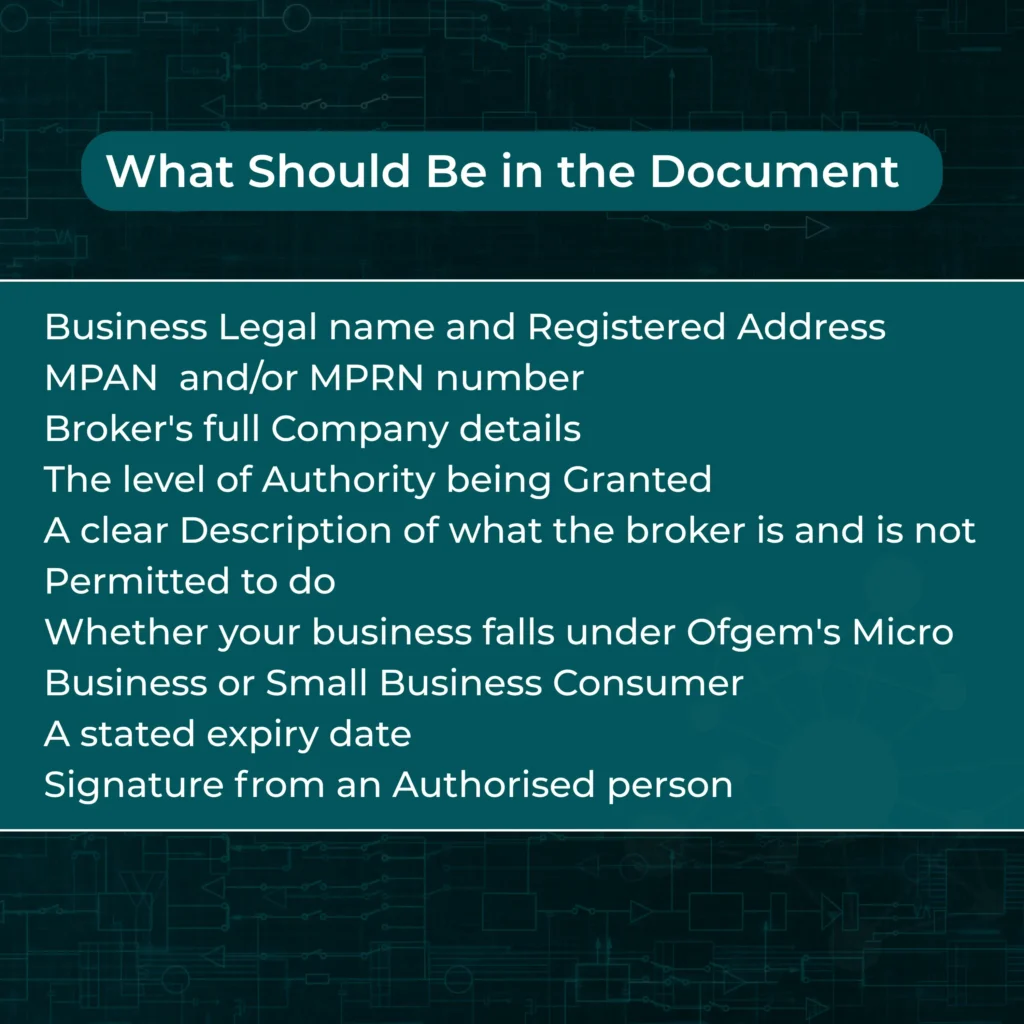
A properly written LOA isn’t a one-liner. If someone hands you a vague half-page document with few specifics, ask for a revised version before signing.
A well-drafted LOA should clearly show:
- Your business legal name and registered address
- MPAN number (electricity meter) and/or MPRN number (gas meter)
- The broker’s full company details
- The level of authority being granted (Level 1 or Level 2)
- A clear description of what the broker is and is not permitted to do
- Whether your business falls under Ofgem’s micro business or Small Business Consumer definitions
- A stated expiry date, typically 6 to 12 months from signing
- Signature from an authorised person, usually a director
That last point matters more than people realise. Only a director or formally authorised signatory should be signing an LOA. If a broker is happy for any employee to sign, that’s a problem.
Is It Legally Binding?
Yes, but only for what it actually says.
Signing an LOA doesn’t commit you to buying energy from anyone. It doesn’t lock you into a contract, trigger any financial obligation, or prevent you from changing your mind. What it does is make the permissions you’ve granted legally enforceable. If your LOA says the broker can issue a renewal notice on your behalf, they can.
The confusion comes from the fact that it requires a signature. A lot of people treat “signed document” and “financial commitment” as the same thing. They’re not. Think of the LOA as the key that opens the door. The contract itself is the door.
One phrase to look for in any LOA: something along the lines of “this document does not authorise the signing of supply agreements.” If that clarity is missing, ask for it to be added.
LOA vs Energy Contract: The Simple Version
People mix these up more than you’d think, especially if they’ve been handed both documents at the same time by a broker in a hurry.
| LOA | Energy Contract | |
| What it does | Grants data access and communication rights | Commits you to a supply deal |
| Financial commitment | None | Yes, including potential exit fees |
| Can you cancel it? | Yes, anytime in writing | Only per the contract terms |
| How long does it last? | 6 to 12 months typically | 1 to 5 years typically |
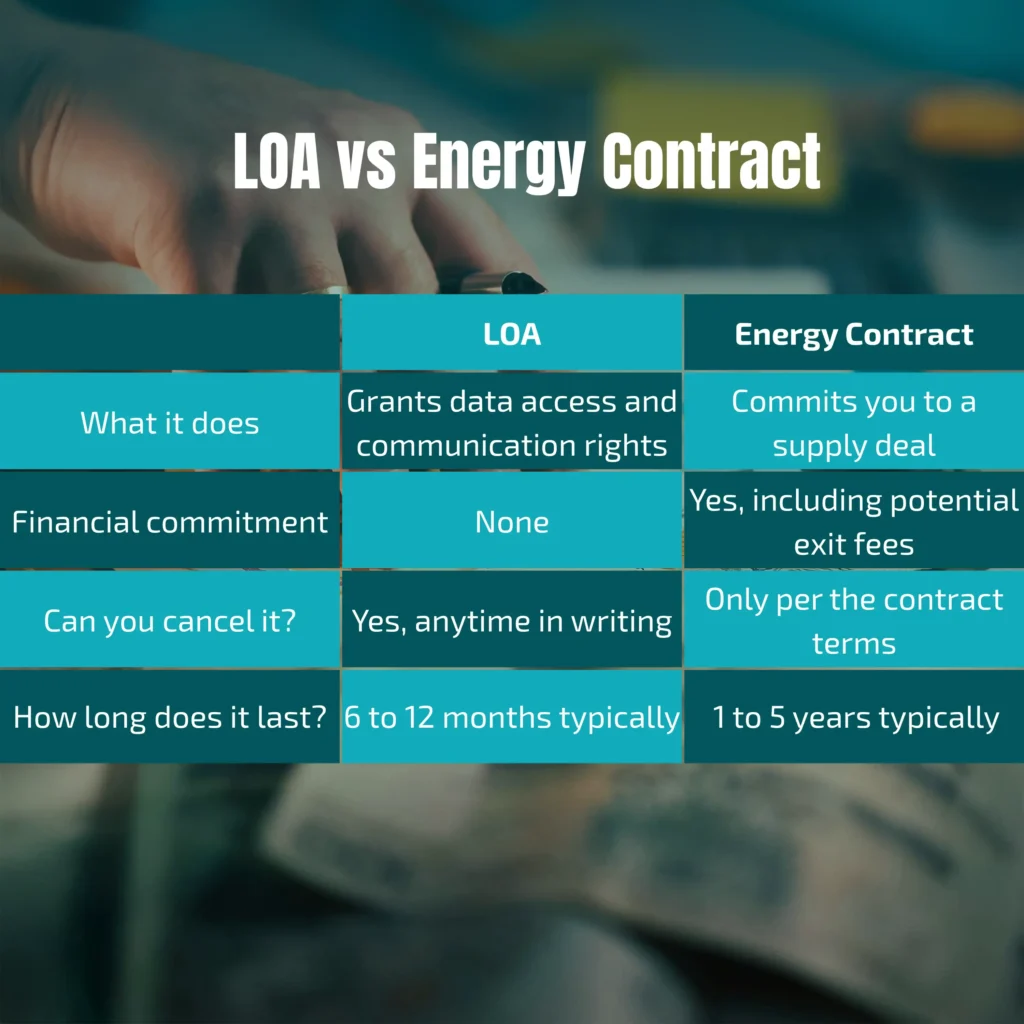
The LOA is what lets the broker shop around. The contract is what you sign when you decide to buy. Never confuse the two, and never let a broker treat signing the LOA as equivalent to agreeing to a deal.
How the Process Actually Works
Once an LOA is in place, a standard broker engagement tends to follow a predictable sequence.
You sign the LOA. The broker contacts your current supplier and gathers your actual usage data, contract end date, and current rates. They approach multiple suppliers for quotes based on that real data. They present you with a comparison. You decide whether to proceed, and only if you do, a separate contract is signed.
That final step matters. Nothing should be committed without your explicit approval of the actual contract terms.
A useful real-world example: a small Midlands retailer whose fixed deal expired in late 2025 didn’t notice and rolled onto their supplier’s variable rate at 38p/kWh. A few months later, a broker ran a comparison using a Level 1 LOA and found a 24-month fix at 23p/kWh. The saving worked out to roughly £3,300 a year. The whole process took about 30 minutes of the owner’s time.
That kind of outcome isn’t unusual. The gap between what out-of-contract customers pay and what’s available on the open market is consistently the biggest financial lever most SMEs haven’t pulled.
The Regulatory Shift Happening Right Now
This is the part that’s changed most significantly since 2025, and it’s worth understanding.
In October 2025, the government confirmed that Ofgem will become the formal regulator of Third-Party Intermediaries, the category that includes energy brokers. This is the most significant structural change to the UK business energy brokerage market in years.
The expected timeline looks like this. Through 2026, Ofgem surveys the broker market and designs the regulatory framework. From 2027, broker registration opens. From 2028 onwards, only registered and compliant brokers will be permitted to operate.
There’s a voluntary Code of Practice already in place, administered by the Retail Energy Code Company (RECCo). It sets standards for transparency, fair treatment, and dispute resolution. Here’s what most people don’t know: as of early 2026, only around 52 companies out of an estimated 2,700+ UK energy brokers have signed it. That’s less than 2% of the market.
What is already in force and worth knowing:
All legitimate brokers must now be registered with a qualifying ADR scheme. This has been a supplier licence condition since December 2022. Brokers must also disclose commission uplifts in their quote documents, a rule extended to all non-domestic businesses from October 2024. And from December 2024, businesses consuming up to 200,000 kWh of electricity or 500,000 kWh of gas annually gained access to the Energy Ombudsman for complaints about both suppliers and brokers.
The honest summary: you have more protection than you did two years ago. But the full mandatory framework isn’t here yet. Independent verification of your broker’s credentials still matters.
The Real Risks When Signing an LOA
Most LOA risks come down to not reading carefully enough before signing. Here’s what to watch for.
The scope being too wide is the most common issue. Some LOAs are vague about what they authorise, which gives a broker significant room for interpretation. If it doesn’t explicitly state what they cannot do, that’s a gap worth closing before you sign.
Hidden commission is still a problem despite the October 2024 rules. The Barings Law group action running from 2024 into 2026 covers undisclosed commissions charged between 2021 and 2023. In some cases, the hidden uplift exceeded 1.5p/kWh on large contracts, worth tens of thousands of pounds over the contract term. Always confirm commission disclosure is part of any quote you receive.
LOAs with no expiry date should be declined outright. Most suppliers cap them at 12 months regardless, but an open-ended LOA is a structural risk you don’t need to accept.
Before You Sign: A Quick Check
- Is the broker registered with the Energy Ombudsman, DRO, or UIA?
- Is this a Level 1 LOA only?
- Is there a clear expiry date?
- Does it explicitly state what the broker cannot do?
- Will commission be disclosed in any quote?
- Is an authorised signatory signing, not just any employee?
If a broker won’t revise the document when you raise a concern, that tells you something useful.
You Can Cancel Any Time
This is worth knowing upfront. Signing an LOA doesn’t lock you in. You can revoke it whenever you want by writing to both the broker and your energy supplier.
Do it by email rather than phone. You want a timestamped record. Ask both parties to confirm receipt in writing. Some suppliers also ask for a short formal letter stating that the previous authority is cancelled.
If your review is finished before the LOA expires, cancel it proactively rather than leaving it running. There’s no reason to leave access open beyond when it’s needed. Set a reminder when you sign so you don’t forget.
Broker or Direct: Which One Is Right for You?
The honest answer is that it depends on your situation, and neither option is universally better.
Going through a broker with a Level 1 LOA makes sense for most businesses. The time saving is real. A broker with a large supplier panel will run quotes across 20 or 30 suppliers simultaneously. That comparison would take most business owners the better part of a week to replicate. The savings potential is also significant: businesses switching from out-of-contract rates onto a fixed deal typically reduce their unit rate by 30 to 50%. Even businesses renewing on time but switching away from their incumbent’s renewal quote tend to save 10 to 20%.
Going direct makes more sense if you use very little energy, say under 5,000 kWh a year, where the savings are modest. It also works if you have someone in-house with procurement experience who can negotiate confidently, or if you already have a strong relationship with a supplier offering genuinely competitive loyalty pricing.
One tip regardless of which route you take: get at least two or three quotes before deciding anything. Even if you’re planning to stay with your current supplier, a competing quote gives you negotiating leverage.
What a Good LOA Template Looks Like
If your broker provides their own template, you should still review it against this list before signing.
A well-structured Level 1 LOA for business energy in the UK includes your business legal name, registered address, and company number. It lists your MPAN and MPRN meter reference numbers. It names the authorised broker and their company details. It specifies the level of authority as Level 1. It states what the broker is not authorised to do. It includes an expiry date of 6 to 12 months from signing. And it carries a signature from a director or formally authorised person.
If any of those elements are missing, ask for a revised version. Any broker who resists that request is worth reconsidering.
Frequently Asked Questions
What is a letter of authority LOA in business energy?
It’s a signed document that gives a broker permission to access your energy account information and communicate with suppliers on your behalf. It does not, on its own, allow them to sign contracts or switch your supply.
Is an LOA legally binding in the UK?
Yes, but only for the specific permissions it grants. It carries no financial commitment and doesn’t lock you into any energy deal.
Can an LOA be misused?
It can be, particularly if the scope is too broad or the broker operates in bad faith. Mandatory Ofgem regulation is coming but won’t be fully enforceable until 2028 at the earliest. Until then, checking your broker’s ADR registration and reading the document carefully is your best protection.
Do I need an LOA to switch business energy?
Not if you go direct to a supplier. But if you want a broker to manage the process on your behalf, yes, they need an LOA to access your data and act for you.
How long does an LOA last?
Typically 6 to 12 months. Some suppliers cap validity at 6 months regardless of what the document says. Always check the expiry date is clearly stated, and decline anything open-ended.
Can I cancel an LOA at any time?
Yes. Write to both your broker and your current supplier, ask for written confirmation, and the authorisation ends.
What’s the difference between an LOA and an energy contract?
The LOA is permission to look. The contract is the commitment to buy. You need to explicitly sign and agree to a separate contract before any supply agreement is in place. An LOA alone cannot create a financial obligation.
What is a microbusiness, and does it matter for my LOA?
Ofgem defines a micro business as one using fewer than 100,000 kWh of electricity or 293,000 kWh of gas per year, or employing fewer than 10 people with turnover under €2 million. In 2026, a new Small Business Consumer category also protects businesses just above that threshold: up to 200,000 kWh of electricity or 500,000 kWh of gas, or fewer than 50 employees with a turnover under £6.5 million. A well-drafted LOA should identify which category applies to your business.
What is the TPI Code of Practice, and should my broker have signed it?
It’s a voluntary set of conduct standards for energy brokers, administered by RECCo and overseen by Ofgem. Signatories commit to fee transparency, fair treatment, and dispute resolution. As of early 2026, fewer than 2% of UK brokers have signed it. Not signing doesn’t automatically mean a broker is untrustworthy, but signing is a meaningful signal of intent. All legitimate brokers must at minimum be registered with an ADR scheme regardless.
Ready to Compare Business Energy?
Understanding your LOA is step one. Using it to find a better deal is step two.
In 2026, the gap between what out-of-contract businesses pay and what’s available on the open market remains substantial. Unit rates 50 to 80% higher than a negotiated fixed contract. No regulatory cap to soften the blow. No automatic notification when your deal runs out.
The good news is that acting on it costs nothing but a small amount of your time.
At EnergySolutions, we use a limited-scope Level 1 LOA that clearly defines what we can and cannot do. Our consultants compare across a wide panel of UK suppliers and present every option with full commission disclosure, in line with Ofgem’s current requirements.
Compare Business Energy quotes today. No obligation, no pressure.