Author: Abdullah Shoaib | Energy Markets Analyst, 8+ years in the energy industry
Table of Contents
Key takeaways
- A half-hourly meter records electricity consumption every 30 minutes.
- A traditional 00 meter is not necessarily the same thing as a modern MHHS arrangement.
- HH metering does not automatically mean cheaper electricity.
- Businesses should compare the complete contract cost, not only the p/kWh rate.
- MHHS is changing how electricity supplies are settled across the United Kingdom.
A half-hourly meter records how much electricity a business uses every 30 minutes, rather than giving you one lump total. That level of detail matters more than most business owners realise.
In my experience, the businesses that get the best value from their electricity contracts are the ones that understand exactly what their consumption looks like across the day, not just what it adds up to at the end of the month.
These meters have traditionally been linked to larger or higher demand sites, and you will often hear them called 00 meters. Because of that history, a lot of business owners assume having one automatically means a better deal.
It does not. What a half-hourly meter gives you is data. What you do with that data and how your contract is structured around it, is what actually decides whether it works in your favour.
This guide covers electricity arrangements in Great Britain: England, Scotland and Wales. Northern Ireland works under separate market rules, so if that is you, some of this will not apply directly.
In simple terms: A half-hourly meter shows when your business uses electricity, not simply how much it uses.
What Is a Half-Hourly Meter?
A half-hourly meter records how much electricity a business uses in 30-minute intervals, providing a detailed picture of when energy is being consumed. That data can be collected remotely and used for billing, settlement and, depending on your contract, how a supplier prices your electricity.
The difference between this and a standard meter is simple to explain but easy to underestimate. A standard reading tells you how much electricity a site used over a day, a month or a billing period. A half-hourly reading tells you when it was used.
Say a site uses 1,000 kWh in a day. On a standard bill, that is just a number. With half-hourly data, you can see whether that usage was spread evenly across the day or whether it was concentrated into two or three demand spikes, maybe when machinery starts up or when a chiller cycle kicks in.
That distinction can matter commercially far more than people expect.
One thing worth being clear on early: half-hourly metering usually works through a communications connection, so a supplier does not need someone to come and read the meter. But half-hourly does not mean live. It describes how detailed the data is, not how often it gets sent.
Used properly, that extra detail can help a business spot demand peaks, unexplained overnight consumption, or opportunities to shift flexible loads into cheaper or less congested periods.
What Is a 00 Meter?
A 00 meter is the traditional name for a settled half-hourly meter. On the older MPAN format, 00 appeared in the Profile Class position and was a reliable shorthand for half-hourly metering.
That used to be a safe assumption. It no longer is, and this is one of the things I think a lot of businesses will get caught out by in 2026 if nobody flags it.
As supplies move across to Market-wide Half-Hourly Settlement, some smart and advanced meters are also being reclassified to Profile Class 00. Government guidance confirms this is happening as part of the migration.
So here is the practical point:
Seeing 00 on your MPAN today does not automatically mean you have the traditional large-business HH arrangement.
Do not rely on a single code to tell you what kind of setup you have. Ask your supplier, broker or metering provider to confirm the full arrangement.
Does Your Business Need a Half-Hourly Meter?
Businesses with higher demand, more complex usage patterns or particular metering arrangements are more likely to be on half-hourly metering. Manufacturing sites, large offices, warehouses, hotels, supermarkets, hospitals, leisure facilities and multi-site operators are common examples.
But the type of business you run is not the whole story.
You will often hear the 100kW rule quoted as the deciding factor. It is relevant, but treating it as the only test will give you an incomplete picture. Under the Balancing and Settlement Code, a 100kW Metering System uses half-hourly equipment. Elexon also recognises half-hourly arrangements for sites below that threshold, so HH metering is not exclusive to large sites.
There is also a historical layer worth knowing about. Ofgem’s P272 changes required businesses in Profile Classes 5 to 8 to be settled on actual half-hourly consumption from April 2017. Those businesses were already required to have meters capable of recording that data.
Put those pieces together and you get several different situations, not one rule:
A high-demand site may need HH metering because of its classification. A different business may already be half-hourly settled because of P272. A smaller business under 100kW might have chosen half-hourly metering voluntarily, because the data is useful. And under MHHS, a growing number of ordinary electricity supplies are being settled half-hourly without becoming a traditional large-business HH site at all.
That last point is the one businesses miss most often:
Half-hourly metering and half-hourly settlement are related, but they are not the same thing.

How to Check Whether Your Business Has a Half-Hourly Meter
Start with a recent bill. Find your MPAN, sometimes called the electricity supply number. On older arrangements, 00 in the Profile Class position has traditionally pointed to a half-hourly supply.
In 2026, that is only the starting point, not the answer. As explained above, MHHS migration is making Profile Class 00 less reliable as a standalone check.
Look on your bill or contract for references to half-hourly or HH metering, advanced metering, maximum demand, Maximum Import Capacity or Available Supply Capacity, Meter Operator charges, data services and capacity related charges. On a larger or advanced metered site, consumption and network charges are often broken out differently than on a standard small-business bill.
Your supplier or broker should be able to tell you, clearly, whether the meter is traditional, smart or advanced, whether the site is physically half-hourly metered, whether the MPAN has migrated under MHHS, what metering and data services apply, and whether there is an agreed capacity arrangement in place.
Do not judge this by what the meter looks like on the wall. Different meter technologies can record or send detailed data, and MHHS is changing how supplies get classified for settlement regardless of the physical box.
What Does a Half-Hourly Meter Mean for Your Electricity Bill?
The real difference is not that an HH meter gives you a “more accurate” reading. It gives you and your supplier a far more detailed picture of your consumption profile.
Instead of one total, half-hourly data shows when demand rises, when the site is quiet, and whether high usage is bunched into particular parts of the day.
That detail feeds directly into pricing.
Depending on the site and contract, an HH bill or quote can include more than a unit rate and standing charge. You might see network charges, agreed capacity related charges, metering services, data services and other pass-through or contract-specific costs sitting alongside the energy price itself.
Traditional HH sites also tend to have a Meter Operator, or MOP, arrangement covering installation and maintenance, and often a separate data collection or aggregation service on top.
MHHS is renaming some of this. HH Meter Operator services are becoming Metering Services Advanced, and HH Data Collector or Data Aggregator services are becoming Advanced Data Services. The names are changing. The underlying question for your business is not.
Which charges are already built into your electricity price, and which ones are billed separately or passed through?
A half-hourly meter does not make electricity automatically cheaper. What it does is make your consumption measurable in a way that can create opportunities. Whether it actually saves you money still comes down to your contract and how the site uses power.
Why Your Consumption Profile Matters When Comparing Quotes
Here is a scenario I use with business owners a lot, because it makes the point better than any explanation on its own.
Two businesses each use 500,000 kWh a year. On paper, identical. In practice, very different.
Business A runs power fairly steadily from 8am to 6pm. Business B has large machinery that fires up at the same time every morning, creating sharp demand peaks, followed by much lower usage for the rest of the day.
Annual consumption alone will not show you that difference. Half-hourly data will.
That is exactly why suppliers price larger or more complex contracts on more than just how much electricity you use. They are also looking at when and how you use it.
Contract structure adds another layer. One quote might fold certain non-energy or metering costs into the headline rate. Another might list them separately, or pass some through at prevailing rates. Two quotes that look close on unit rate can end up very different once those costs are added back in.
This is why comparing HH electricity quotes purely on pence per kWh is one of the more common mistakes I see businesses make. The number that actually matters is the expected total cost, worked out on comparable assumptions across every quote you are looking at.
Are Half-Hourly Meters Cheaper or More Expensive?
There is no single answer, and I would be cautious of anyone who gives you one without asking about your site first.
The real cost of a half-hourly arrangement depends on your consumption profile, peak demand, agreed capacity where relevant, tariff structure, contract terms, metering services, data charges, standing charges and, of course, supplier pricing. If your business has any ability to shift when it uses electricity, that matters too, and is likely to matter more over time.

So the question worth asking is not:
Is an HH meter cheaper?
It is:
Does our current metering arrangement and electricity contract actually make sense for the way this site consumes power?
That second question is the one that leads to a decision. The first one just leads to guesswork.
When Can Half-Hourly Metering Work in Your Favour?
Detailed consumption data is only valuable if someone actually uses it.
We have seen businesses discover that equipment was running overnight for no operational reason, that several large loads were starting at exactly the same time and pushing demand higher than it needed to be, or that an energy-intensive process could be rescheduled to a cheaper or less congested period without affecting output.
Half-hourly data can also sharpen your budgeting, support energy-efficiency projects, and give suppliers better information to work with when pricing a more complex contract.
If your operation has any flexibility in when it uses power, that visibility can turn a half-hourly meter from a reporting tool into an actual cost-management lever.
When Can Half-Hourly Metering Create Additional Costs?
Traditional HH arrangements can carry costs that smaller business customers do not typically see broken out as separate items. These can include metering services, data services and, where relevant, charges linked to your agreed network capacity.
More detailed contract structures also make quotes harder to compare like for like. One supplier might bundle certain costs into the rate. Another might separate them out entirely. Put two quotes side by side without checking that and you can end up comparing the wrong thing.
None of this means half-hourly metering is inherently expensive. It means you need to see the full charging structure, not just the unit rate on the front page of the quote.
Half-Hourly Meter vs Standard Business Electricity Meter
| Area | Traditional HH / Advanced Arrangement | Standard Business Meter |
| Consumption data | Records electricity in 30-minute intervals | Traditional meters may provide less granular readings; smart meters can support half-hourly data |
| Typical users | Higher-demand or more complex commercial sites | Common across smaller and medium business premises |
| Meter readings | Usually remotely collected | Can be manual, automated or smart depending on meter type |
| Legacy MPAN indicator | Traditionally 00 | Historically commonly 03/04 or other Profile Classes |
| Metering services | Separate MOP/data arrangements are more common | Usually simpler from the customer’s perspective |
| Pricing | Detailed consumption profile can be relevant | Traditionally relied more heavily on broader consumption information |
| MHHS impact | Already closely associated with HH settlement | Increasingly moving to half-hourly settlement under MHHS |
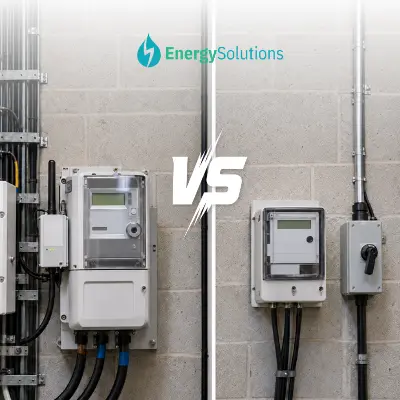
That line down the middle of the table is getting blurrier every year MHHS progresses. A standard smart business meter can now take part in half-hourly settlement without ever becoming the same type of traditional HH installation you would find on a large commercial site.
What Is Changing With Market-wide Half-Hourly Settlement?
Does MHHS mean my business now needs a half-hourly meter?
No, not in the traditional sense.
This is probably the single most important thing for a business owner to understand about MHHS in 2026, so it is worth being direct about it.
A half-hourly meter is the physical equipment capable of recording consumption in 30-minute periods. Half-hourly settlement is a market process that decides how consumption gets allocated and reconciled between suppliers and the wider electricity system. They sound similar. They are not the same thing.
Historically, many smaller supplies were settled on estimated consumption profiles rather than actual half-hourly usage. MHHS is moving the whole market towards using real half-hourly data and load shapes for settlement instead.
Elexon has described it as one of the biggest changes to Britain’s retail electricity market since competition began, and from what we have seen advising businesses through it, that is not an exaggeration.
The transition is already running. Suppliers began migrating MPANs into the new arrangements from 22 October 2025, and as of September 2026 the MHHS Programme reports the transition is on track. The key milestones ahead are:
28 October 2026, Milestone 14, when all relevant suppliers must be able to access MPANs under the MHHS Target Operating Model.
7 May 2027, Milestone 15, when meter migrations are scheduled to be complete.
2 July 2027, Milestone 16, when the market moves to the new, shorter settlement timetable.
This is exactly why you should stop assuming that half-hourly settled, Profile Class 00 and traditional HH meter all mean the same thing. They used to line up more neatly. They do not now.
For most businesses, MHHS is a market and data change, not a signal to rip out your current meter. Over time, though, more detailed settlement data is likely to support more sophisticated tariffs and flexibility pricing that pays more attention to when you use electricity, not just how much of it you use across the year.
What Should a Business Consider Before Switching or Renewing an HH Electricity Contract?
Before you sign anything, whether that is a renewal or a switch, go through the whole arrangement rather than just the headline rate.
Confirm the current meter type, the metering arrangement and its MHHS migration status. Review annual consumption and, if you can get it, the full half-hourly profile. Check maximum demand and agreed capacity where relevant.
Identify who provides the Meter Operator or metering service, and what data charges sit alongside it. Check your contract end date and termination position. Compare unit rates, standing charges and additional or pass-through charges on the same basis across every quote.
And ask whether any proposed change to your metering or capacity arrangement is actually justified by how the site operates now, not how it operated when the arrangement was first set up.
If your operations have changed, machinery removed, EV charging added, production expanded, opening hours shifted, the arrangement that made sense a few years ago may not be the right one today.
In my experience this is the single most overlooked reason businesses end up paying for a setup that no longer fits.
Don’t Compare HH Electricity Quotes on Unit Rate Alone
A lower unit rate does not guarantee a lower bill. I would go further than that: on half-hourly contracts specifically, it often does not.
Say Supplier A quotes the lowest pence per kWh but separates out several additional charges. Supplier B quotes a slightly higher unit rate but bundles more costs into that single price. Look only at the headline number and Supplier A looks like the better deal. Add everything up and it might not be.
At Energy Solutions, we assess an HH quote on the complete picture: expected consumption, usage profile, standing charge, metering and data costs, capacity related costs where they apply, contract structure and any pass-through charges. The goal is to find the contract that actually makes sense for the site, not the one with the smallest figure next to “unit rate.”
When Is a Half-Hourly Meter Worth Paying Attention To?
Your metering arrangement deserves a closer look when electricity is a significant cost for your business, when demand peaks are pronounced, when the site has substantial capacity, or when your contract is coming up for renewal.
It is also worth reviewing if you are not sure what MOP, data or capacity charges you are actually paying, if suppliers are presenting quotes in different formats that are hard to compare, if consumption has changed materially, or if you are considering any change to the meter or connection itself.
Half-hourly data earns its keep when a business genuinely wants to understand when electricity is being used and what is driving the peaks. It does not earn its keep just because it sounds more advanced than what you have now.
The objective is not to have a half-hourly meter for its own sake. It is to make sure your metering, capacity and electricity contract still fit how your business actually runs.
Half-Hourly Meter FAQs
What does “00” mean on an MPAN?
Historically, 00 in the Profile Class position identified a half-hourly supply. During MHHS migration, some smart and advanced supplies are also moving to 00, so check the full metering arrangement rather than relying on this code alone.
Who needs a half-hourly meter?
Traditional HH metering is associated with higher-demand sites, including 100kW Metering Systems, but half-hourly arrangements also exist below that threshold. Profile Classes 5 to 8 were moved to half-hourly settlement under P272. Your supplier or broker can confirm the arrangement on a specific MPAN.
Are half-hourly meters more expensive?
Not necessarily. Overall cost depends on usage patterns, contract structure, metering and data charges, capacity arrangements where applicable, and supplier pricing.
Can a half-hourly meter reduce business electricity costs?
The meter itself does not guarantee savings. The detailed consumption data can help you spot waste, manage peak demand and make better procurement decisions, which can create savings opportunities.
Do I need to read a half-hourly meter manually?
Normally, no. Half-hourly consumption data is collected remotely through the metering communications setup. A communications fault or a specific meter issue may still require manual intervention.
Does MHHS mean every business needs a half-hourly meter?
No. MHHS moves electricity supplies towards half-hourly settlement. It does not mean every business has to install the traditional type of HH meter used at larger commercial sites.