Author: Abdullah Shoaib | Energy Markets Analyst, 10+ years in the energy industry
Everything UK homeowners, tenants, and businesses need to know about finding, understanding, and using their energy supply identifiers.
Quick answer: Your MPAN is your electricity supply identifier. Your MPRN is your gas one. Both are tied permanently to your property, not your meter or supplier. You need them to switch energy providers, open new accounts, or dispute a billing error.
Table of Contents
What Is an MPAN Number?
MPAN stands for Meter Point Administration Number. It is a unique 21-digit reference that identifies your electricity supply point in the UK. Not your physical meter, not you as a customer. Just the property’s connection to the electricity grid.
You might also see it called a supply number, S number, or electricity supply number. On bills, it usually sits inside a boxed grid with an “S” printed above it.
One thing worth knowing early: even if your meter is upgraded or swapped out for a smart meter, your MPAN does not change. It is fixed to the property itself.
What Does Each Part of Your MPAN Mean?
Your MPAN is not just a random string of digits. Each segment carries specific information used for billing, network management, and tariff eligibility.
| MPAN Segment | What it represents | Example |
| S (prefix) | Identifies this as an electricity supply number | S |
| Profile Class (2 digits) | Type of customer and usage pattern | 01, 02, 03-08, 00 |
| Meter Time Switch Code (3 digits) | Single-rate vs. Economy 7 or multi-rate | 111 |
| Line Loss Factor (3 digits) | Distribution cost based on distance from grid | 222 |
| Distributor ID (2 digits) | Your regional network operator (DNO) | 10-23 |
| Meter Point ID (8 digits) | Unique identifier for your property’s supply | 12345678 |
| Check Digit (3 digits) | Verification of the above identifiers | 345 |
Profile Class: What Yours Means for Your Bill
The first two digits of your MPAN are the Profile Class. This determines how your electricity consumption is measured and which tariffs you are actually eligible for.
| Profile Class | Type | Who it applies to |
| 01 | Domestic Unrestricted | Standard home, single rate all day |
| 02 | Domestic Economy 7 | Home using night-time cheap rate |
| 03 | Non-Domestic Unrestricted | Small business, single rate |
| 04 | Non-Domestic Economy 7 | Business using off-peak night rates |
| 05 | Non-Domestic Max Demand (under 20% LF) | Medium business, variable peak load |
| 06 | Non-Domestic Max Demand (20-30% LF) | Higher demand business |
| 07 | Non-Domestic Max Demand (30-40% LF) | High-usage commercial sites |
| 08 | Non-Domestic Max Demand (over 40% LF) | Very high demand: factories, large sites |
| 00 | Half-Hourly Metering | Large commercial users above 100kW peak demand |
Common billing error: If your business is misclassified as domestic (01 or 02) when it should be commercial (03-08), your tariff structure will be wrong and you could be overpaying. Contact your supplier and request a profile class review if anything feels off.
Line Loss Factor: Why Rural Properties Pay More
The Line Loss Factor reflects electricity lost during transmission from the distribution centre to your property. The further your premises from the source, the higher the loss, and the more that cost is built into your tariff.
This is why rural homes and businesses often pay more per unit than urban properties on identical headline rates. You cannot change your LLF; it is a physical characteristic of your connection. What you can do is compare suppliers, since some prices LLF costs more competitively than others. Always provide your MPAN when requesting quotes so suppliers can price accurately.
Meter Time Switch Code: Single-Rate vs Economy 7
The Meter Time Switch Code defines how your meter records usage. Some codes indicate a single-rate meter where the same price applies all day. Others indicate multi-rate meters like Economy 7 or Economy 10, where off-peak hours (usually overnight) cost less.
If your meter is Economy 7 but you run heavy appliances during the day, you are missing the off-peak benefit and likely paying more than you should. Check your MTC and adjust usage accordingly, or ask your supplier whether a single-rate tariff would actually save you money.
Distributor ID: Your Regional Network Operator
The first two digits of the core MPAN identify your Distribution Network Operator (DNO), the company responsible for the cables and electricity infrastructure in your area.
| Distributor ID | Region | Network Operator |
| 10 | East of England | UK Power Networks |
| 11 | East Midlands | National Grid |
| 12 | London | UK Power Networks |
| 13 | Merseyside and North Wales | SP Energy Networks |
| 14 | West Midlands | National Grid |
| 15 | North Eastern England | Northern Powergrid |
| 16 | North Western England | Electricity North West |
| 17 | Northern Scotland | Scottish and Southern Electricity Networks |
| 18 | Southern Scotland | SP Energy Networks |
| 19 | South Eastern England | UK Power Networks |
| 20 | Southern England | National Grid |
| 21 | South Western England | National Grid |
| 23 | Yorkshire | Northern Powergrid |
Your DNO handles power cuts, infrastructure faults, and new meter connections regardless of who your energy supplier is. Knowing your distributor ID means you can report outages to the right organisation directly, which speeds things up considerably.
Find your DNO by postcode: Energy Networks Association postcode tool
What Is an MPRN Number?
MPRN stands for Meter Point Reference Number. It is a 6 to 10 digit number that identifies your gas supply point across the UK. Like the MPAN, it belongs to the property, not the meter, not the supplier, and not you personally.
You may also see it called an M number or gas supply number. Unlike the MPAN, it has a simpler structure with no encoded data segments. It functions mainly as a unique identifier, managed centrally by Xoserve, the company that handles UK gas data.
Format: 6 to 10 digits, sometimes prefixed with “M” (e.g. M1234567890). It stays the same regardless of how many times you switch gas supplier.
The 74/75 Prefix Warning: Are You on an Independent Gas Transporter?
This is one of the most important things about MPRNs that almost nobody talks about. If your MPRN starts with 74 or 75, your property is connected via an Independent Gas Transporter (IGT) network, not the main National Grid infrastructure. IGTs are private companies that own and operate local gas pipelines, typically found in newer housing developments, business parks, and some converted properties.
| What this means | Details |
| Fewer supplier options | Not all energy suppliers support IGT networks |
| Potentially higher rates | Standing charges and unit rates can be higher |
| Switching complexity | Some comparison sites and brokers exclude IGT properties |
| No automatic protection | IGT users are not always covered by standard supplier protections |
You cannot change the network itself, but you can find suppliers or energy brokers who specifically support IGT properties. Many IGT customers overpay simply because they assume standard comparison tools apply to them. They often do not. Always disclose your MPRN prefix when getting quotes.
How MPRN Differs from MPAN
| Feature | MPAN (Electricity) | MPRN (Gas) |
| Format | 21 digits in structured grid | 6-10 digits, simpler format |
| Encoding | Multiple data segments (PC, MTC, LLF, DNO) | Primarily a direct identifier |
| Managed by | Regional DNOs | Xoserve (national gas data) |
| Key prefix warning | “S” at the start is standard | 74/75 prefix means IGT network |
| Complexity | Higher, affects billing structure | Lower, mainly used for identification |
MPAN vs MPRN vs Meter Serial Number
These three identifiers get mixed up constantly, and confusing them causes real problems during switches and billing disputes.
| Feature | MPAN (Electricity) | MPRN (Gas) | Meter Serial Number (MSN) |
| What it identifies | Your electricity supply point | Your gas supply point | The physical meter device |
| Digit count | 21 digits (structured grid) | 6-10 digits | Variable (letters and numbers) |
| Tied to property? | Yes, permanent | Yes, permanent | No, tied to the meter itself |
| Changes when switching? | Never | Never | Only if meter is replaced |
| Changes with smart meter? | No | No | Yes, new meter means new MSN |
| Changes when you move? | Yes, new address means new MPAN | Yes, new address means new MPRN | Stays with the meter |
| Where to find it | Electricity bill or IHD display | Gas bill, meter box, or lookup tool | Printed on the meter and bill |
| Used for switching? | Yes, essential | Yes, essential | No, not required for switching |
The most common mistake: People hand over their meter serial number when asked for their MPAN or MPRN during a switch. This causes delays, rejected transfers, or incorrect billing. Before passing on any number, double-check: is this the MPAN/MPRN or the meter serial number? Your bill labels each one clearly.
Where to Find Your MPAN Number

In most cases you can track this down in under two minutes.
Method 1: Your Electricity Bill
Your MPAN appears on every electricity bill. Look for a box or grid labeled “Supply Number” or “Electricity Supply Number,” usually with an “S” above it.
| Supplier | Where to find your MPAN on the bill |
| British Gas | Under “Details of Charges,” usually page 2, in a labeled grid |
| Octopus Energy | Under “Your Electricity Details,” mid-page, labeled as supply number |
| OVO Energy | Section titled “Electricity Supply Number (MPAN)” near tariff details |
| EDF Energy | Boxed grid labeled “Supply Number,” typically on page 1 or 2 |
| ScottishPower | Under “Your Electricity Supply Details” near usage breakdown |
| E.ON Next | Listed as “Supply Number” in the account summary section |
| Shell Energy | Found in account or supply details section, mid-to-lower page |
| Utilita | Check the “Property Details” section, often at the bottom of the first page |
| Bulb / Octopus (transferred) | Under account details in the Octopus app or portal |
Tip: Your MPAN is always a 21-digit number split across two rows. If the number you are looking at does not follow that format or is not preceded by “S,” you are probably looking at your account number or meter serial number instead.
Method 2: Your Smart Meter In-Home Display (IHD)
If you do not have a bill to hand, your smart meter display can show part of your MPAN.
- Press the OK or Menu button on your IHD.
- Navigate to Meter Information.
- Scroll until you see a 13-digit Meter Point ID.
This gives you the core (bottom-line) MPAN. For most switching purposes, this 13-digit section is all your new supplier needs. If you need the full 21-digit number including the top line, contact your supplier directly.
Note: Chameleon and Pipit IHD devices use slightly different menu labels. Try “Settings” or “Info” if “Meter Information” is not visible.
Method 3: When You Have No Bill
| Method | How | Best for |
| Contact your current supplier | Phone, live chat, or online account. Provide your address. | Quickest if you know your supplier |
| Contact your previous supplier | They still hold your historical supply data. | If you recently moved or switched |
| Contact your DNO | Use the Energy Networks Association postcode tool to identify your DNO, then call them. | New builds or disputed supply records |
| Ask your landlord or agent | They should have supply details for the property. | Tenants or managed commercial properties |
If you have just moved in: You will not have a bill yet, but you still need the MPAN quickly to avoid being defaulted onto an expensive fallback tariff.
- Find out who the current supplier is (ask the previous occupant, your landlord, or check the fuse box for supplier labels).
- Call the supplier and say: “I have just moved into [full address] and need the MPAN to set up my account.”
- Provide your move-in date so they can set things up from the correct starting point.
- Take a meter reading on your move-in day. This is critical to avoid being billed for the previous occupant’s usage.
New builds: If you are moving into a brand-new property, there may not yet be a registered MPAN. Contact your developer or the local DNO directly. They manage MPAN registration for new connections and can confirm when yours will be active.
Where to Find Your MPRN Number
Your MPRN is simpler to find than your MPAN, but it is still easy to confuse with other numbers on your bill.
Method 1: Your Gas Bill
Look for a section titled “Meter Point Reference,” “MPRN,” or “Gas Supply Number.” It is usually in the “Charges in Detail” or supply details section, not the account summary at the top.
Do not confuse your MPRN with your customer account number. Your account number is assigned by your supplier and changes if you switch. Your MPRN is tied to the property and never changes.
Method 2: Your Gas Meter
Your MPRN is sometimes printed directly on or near the gas meter:
- Check the front panel of the meter box.
- Look for labels on the inside of the meter cupboard door.
- On smart meters: navigate to Meter Information on your IHD, then toggle to gas readings. Your MPRN may appear on screen.
Method 3: The Find My Supplier Tool (Best When You Have No Bill)
The fastest way to retrieve your MPRN without a bill is the official industry lookup tool at findmysupplier.energy.
- Enter your postcode.
- Select your exact address.
- Your MPRN, gas supplier, and gas transporter are displayed instantly.
This works because the tool pulls from Xoserve’s national gas data registry, the most authoritative source for UK gas supply information, covering virtually every registered supply point in Great Britain.
How MPAN and MPRN Are Used When Switching Energy Supplier
Your MPAN and MPRN are the two most important pieces of information in any supplier switch. They ensure your new supplier is connecting to the right supply points at your property and not an adjacent unit or a different meter entirely.
When you initiate a switch, your new supplier uses these numbers to identify your property in national energy databases, submit a formal transfer request to your current supplier, set up accurate billing from day one, and confirm the correct meter is being assigned to your account.
A real example of what goes wrong: A business in a multi-unit building provides only its address when switching. The supplier accidentally transfers the wrong unit’s supply. Billing disputes follow and the correct supply is not transferred for weeks. Providing both the MPAN and MPRN prevents this entirely.

Step-by-Step: Switching Energy Using Your MPAN and MPRN
- Locate your numbers. Find your MPAN on your electricity bill and your MPRN on your gas bill.
- Take a meter reading. Do this on the day you initiate the switch; it protects you in any billing dispute.
- Compare quotes. Use your MPAN and MPRN when comparing. Suppliers need them to give accurate pricing.
- Confirm supply details with your new supplier. They should repeat your MPAN/MPRN back to you before confirming.
- 14-day cooling off period. You can cancel without penalty within this window.
- Switch completes. Your supply transfers with no interruption to gas or electricity.
- Final meter reading. Your old supplier uses this to close out your final bill.
Your MPAN and MPRN do not change when you switch supplier, change tariff, upgrade to a smart meter, or make any other account changes. They only change when you move to a different property.
MPAN and MPRN for Businesses: The Complete UK SME Guide
If you run a business, these numbers are not just administrative details. They directly affect your tariff access, billing accuracy, and how much energy costs you each month.
How Business MPANs Differ from Domestic (Profile Classes 03-08)
Business electricity supplies are assigned profile classes 03-08, which reflect more complex usage patterns than domestic properties.
| Profile Class | Description | Typical business type |
| 03 | Non-Domestic Unrestricted | Small offices, shops, cafes on single-rate meters |
| 04 | Non-Domestic Economy 7 | Businesses using off-peak night-rate electricity |
| 05 | Non-Dom Max Demand (under 20% LF) | Small manufacturers, medium commercial sites |
| 06 | Non-Dom Max Demand (20-30% LF) | Larger commercial premises |
| 07 | Non-Dom Max Demand (30-40% LF) | Industrial sites, large warehouses |
| 08 | Non-Dom Max Demand (over 40% LF) | Heavy industry, data centres, large factories |
| 00 | Half-Hourly Metered | Any business with peak demand above 100kW |
Half-Hourly Meters and Profile Class 00
If your business consumes large amounts of electricity, you may be assigned Profile Class 00, which means you need a half-hourly (HH) meter. These record consumption every 30 minutes and send data directly to your supplier, enabling far more accurate billing and access to wholesale-linked or time-of-use tariffs.
| Aspect | Standard metering | Half-hourly metering (Class 00) |
| Data frequency | Monthly or quarterly reads | Every 30 minutes, automatically |
| Billing basis | Estimated or submitted reads | Actual consumption data |
| Tariff access | Standard rates | Time-of-use and wholesale-linked options |
| Monitoring | Limited visibility | Detailed usage analytics available |
| Who it suits | SMEs with stable usage | Businesses with variable or high demand |
Many SMEs are being migrated to half-hourly metering as the MHHS reform progresses. If your peak demand is approaching 100kW, speak to your supplier now about whether HH metering and contracts would benefit you.
Managing MPAN and MPRN Across Multiple Sites
If you operate multiple locations, each site has its own MPAN and MPRN. Without a structured approach, this gets expensive and time-consuming fast.
| Problem | Consequence | Solution |
| Missed contract renewal dates | Sites roll onto expensive out-of-contract rates | Maintain a central tracker with all renewal dates |
| Inconsistent tariffs | Overpaying at some sites | Review all sites together at renewal for multi-site deals |
| Incorrect MPAN records | Billing errors across multiple accounts | Audit all MPANs against physical meters annually |
| No single supplier view | Difficult to negotiate or compare | Consolidate where possible using an energy broker |
Best practice: Keep a central spreadsheet listing each site’s MPAN, MPRN, current supplier, contract end date, and renewal window. Group sites by contract end date to negotiate better multi-site deals, and work with a broker who specialises in commercial portfolios.
What Happens to Your MPAN/MPRN When Moving Business Premises
Your MPAN and MPRN belong to the property, not to you or your business. When you relocate:
- Your old premises keep their existing MPAN/MPRN.
- Your new premises come with completely different numbers.
- You are responsible for notifying your supplier and settling final bills at the old address.
- Your new premises may have an existing supplier you need to take over or switch away from.
Failing to manage this cleanly can result in deemed contract charges at either address, often the most expensive rates available. Give yourself at least 30 days before moving to ensure clean handovers at both locations.
Change of Tenancy: What Landlords and Managing Agents Need to Know
Energy admin is a critical part of tenancy transitions that often gets overlooked until it causes a problem.
- Record final meter readings on the move-out date and confirm with the departing tenant.
- Share the MPAN and MPRN with incoming tenants before their move-in date.
- Notify the current supplier of the tenancy change date in writing.
- Confirm the property does not revert to a deemed contract during any void period between tenancies. If it does, switch as soon as possible.
Keep a permanent record of each property’s MPAN, MPRN, and current supplier. Update this every time a tenancy changes. For HMOs or multi-unit properties, record the supply number for each unit separately.
MHHS and What It Means for Your MPAN in 2025-2026
What Is Market-wide Half-Hourly Settlement (MHHS)?
Market-wide Half-Hourly Settlement is an Ofgem-led reform that changes how electricity consumption is recorded and settled across all UK users, not just large businesses. Currently, only Profile Class 00 customers are billed based on half-hourly data. Under MHHS, this extends to homes and SMEs using smart meter data.
| Aspect | Before MHHS | After MHHS |
| Billing basis | Estimated or monthly reads for most users | Real 30-minute data for all |
| Who is affected | Only large businesses (Class 00) | All electricity users in Great Britain |
| Tariff options | Mostly fixed-rate | Opens the door to time-of-use and flexible pricing |
| Smart meter requirement | Optional for most users | Essential for accurate MHHS billing |
How MHHS Affects Your MPAN
MHHS does not change your MPAN number. But it does affect how some elements of it are interpreted:
- Profile Class: The traditional 01-08 classification becomes less relevant as all users shift toward direct half-hourly settlement.
- Meter Time Switch Code: Will evolve to support more dynamic, time-based pricing.
- Billing data: Suppliers will increasingly rely on smart meter reads rather than MPAN-encoded estimates.
Will MHHS Change My Energy Bills?
Not automatically, but it changes how costs are calculated.
| Usage pattern | Likely impact under MHHS |
| Flexible: can shift demand to off-peak | Potential savings through time-of-use tariffs |
| Fixed: mostly peak hours | Bills may rise under time-based pricing |
| Business with variable demand | More granular billing, greater opportunity to optimise |
| Home with no smart meter | Limited impact until smart meter is installed |
MHHS is rolling out in phases through 2025 and 2026. Make sure your smart meter is installed and working correctly. Without it, you cannot benefit from MHHS-enabled tariffs. For more detail, see Ofgem’s official MHHS guidance.
Regional Differences: Northern Ireland, Scotland, and Wales
Northern Ireland: A Completely Different System
Northern Ireland does not use the standard MPAN system. If you manage properties or businesses there, the identifiers and processes differ significantly.
| Energy type | Identifier | Managed by | Format |
| Electricity | MPRN (in NI, this identifies electricity) | ESB Networks | 11 digits |
| Gas | GPRN (Gas Point Reference Number) | Gas Networks Ireland | Variable |
The regulatory framework follows Irish energy market rules rather than Great Britain’s Ofgem system. Supplier switching processes, comparison tools, and contact routes all differ as a result.
- Electricity queries: ESB Networks
- Gas queries: Gas Networks Ireland on 1800 464 464 (Mon-Fri 8am-8pm, Sat 9am-5.30pm)
Scotland: Distribution Differences
Scotland uses the standard MPAN/MPRN system but is served by different DNOs.
| Area | Distributor ID | Network Operator |
| Central and southern Scotland | 18 | SP Energy Networks |
| Northern Scotland | 17 | Scottish and Southern Electricity Networks (SSEN) |
Businesses in northern Scotland, particularly on islands or in remote areas, may face higher line loss factors due to longer transmission distances. This affects unit rates even on otherwise comparable tariffs.
Wales: Key Operator
Wales is served primarily by SP Energy Networks (North Wales, Distributor ID 13) and National Grid (South Wales). The MPAN/MPRN system works identically to England. If you are unsure of your Welsh DNO, use the Energy Networks Association postcode tool.
Common MPAN and MPRN Problems and How to Fix Them
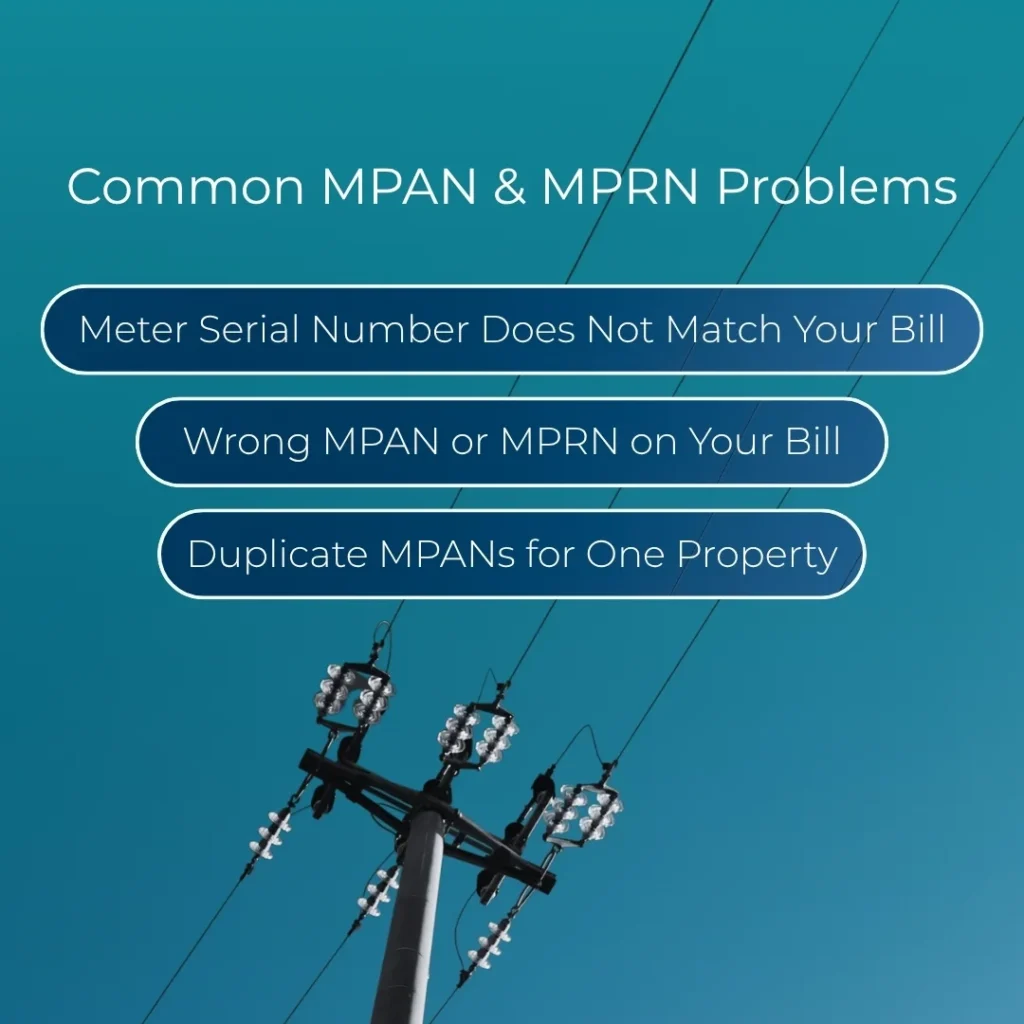
Problem 1: Meter Serial Number Does Not Match Your Bill
If the serial number on your physical meter does not match what your supplier holds on record, you may be getting billed for the wrong meter entirely.
Symptoms: Unexpectedly high or low bills, estimated readings that never match your actual usage, and billing disputes with a neighbor.
- Contact your supplier and say: “The meter serial number on my physical meter does not match my bill. Please verify my MPAN against the correct meter record.”
- Send photographic evidence: a photo of your meter showing the serial number alongside your bill reference.
- Request a backdated billing correction if you have been overcharged. You are entitled to this.
Typical resolution time: 5 to 21 working days depending on the complexity of the investigation.
Problem 2: Wrong MPAN or MPRN on Your Bill
This usually happens after moving into a new property, following a supplier error during switching, or due to a data entry mistake during account setup.
| How to spot it | What to do |
| MPAN/MPRN does not match your meter location | Contact supplier with your correct address and meter details |
| Usage looks unusually high or low | Request a supply point verification check |
| Bills arrive for the previous occupant’s usage | Provide your move-in date and meter reading as evidence |
| Switch failed or was rejected | Ask new supplier to confirm they have the correct supply number |
If your supplier cannot resolve this within 8 weeks, raise a complaint with the Energy Ombudsman or contact your DNO directly to verify your registered supply point.
Problem 3: Duplicate MPANs for One Property
Rare, but it does happen in new builds, converted properties, or following major infrastructure changes.
Consequences: Split billing, incorrect supplier assignments, confusing meter reads across two accounts.
- Contact your DNO directly using the Energy Networks Association tool.
- Request a meter point validation check. They will confirm the correct active MPAN and deactivate any duplicates.
- Notify your supplier once the DNO has confirmed the correct MPAN so they can update their records.
Emergency Checklist: Can’t Find Your MPAN or MPRN?
| Step | Action | What you need |
| 1 | Check your smart meter IHD (Meter Information section) | Your IHD device |
| 2 | Look at any old utility bill for the property | Previous bills or paperwork |
| 3 | Log into your supplier’s online account or app | Your account login |
| 4 | Contact your current or previous supplier | Your address and account details |
| 5 | For MPRN only: use findmysupplier.energy | Your postcode |
| 6 | Contact your DNO via Energy Networks Association tool | Your postcode |
| 7 | Ask your landlord, property manager, or developer | Their contact details |
Frequently Asked Questions About MPAN and MPRN
What is an MPAN number in the UK?
An MPAN is a unique 21-digit identifier for your electricity supply point. It is assigned to your property’s connection to the electricity grid and used by suppliers for billing, switching, and account management.
What is an MPRN number used for?
An MPRN identifies your gas supply point. It is used when switching gas suppliers, setting up new accounts, and ensuring correct billing. It is a 6 to 10 digit number tied permanently to your property.
Where can I find my MPAN without a bill?
Check your smart meter IHD (Meter Information section), contact your current supplier, ask your landlord, or contact your local DNO via the Energy Networks Association postcode tool.
Is an MPAN the same as a meter serial number?
No. Your MPAN identifies your supply point (the connection to the grid), while a meter serial number identifies the physical meter device. The MPAN stays the same even when your meter is replaced.
Will my MPAN change if I switch energy supplier?
No. Your MPAN is tied to your property and does not change when you switch supplier, change tariff, or modify your account in any way.
Will my MPAN change if I get a smart meter installed?
No. Installing a smart meter does not affect your MPAN. Only the meter serial number changes when you get a new meter.
Will my MPAN change if I move home or business?
Yes. Your MPAN is fixed to a property. When you move to a new address, that property has its own MPAN. You cannot take your current one with you.
What does a 74 or 75 prefix on my MPRN mean?
It means your property is connected via an Independent Gas Transporter network, a private pipeline rather than the main National Grid. This may limit your supplier options and result in higher standing charges. Seek brokers or suppliers who specifically support IGT properties.
How do I find my MPRN without a gas bill?
Use the official tool at findmysupplier.energy: enter your postcode, select your address, and your MPRN appears instantly. You can also contact your gas supplier or ask your landlord.
What is the MPAN top line and what does it mean?
The top line contains your Profile Class (usage type), Meter Time Switch Code (single or multi-rate), and Line Loss Factor (distribution cost). These determine your tariff eligibility and certain billing components.
What is MHHS and does it change my MPAN?
MHHS is an Ofgem reform that changes how electricity usage is measured across all UK users. It does not change your MPAN number, but it does affect how some elements like Profile Class and billing basis are used over time.
How long does it take to get a new MPAN or MPRN for a new build?
Registration typically takes a few days to several weeks depending on your DNO and site complexity. Contact your developer or the local DNO early to avoid delays in setting up supply.
What happens if my MPAN is wrong on my bill?
Contact your supplier immediately and ask them to verify your registered supply point. Provide your address, meter serial number, and bill references. They must investigate and correct the error, including backdating any billing adjustments if you have been overcharged.
How does my MPAN affect my electricity tariff eligibility?
Your Profile Class determines which tariff types you can access (single-rate, Economy 7, etc.). Your Meter Time Switch Code confirms whether your meter supports multi-rate billing. If either is misclassified, you may be blocked from cheaper tariffs you would otherwise qualify for.
Can I switch energy supplier without knowing my MPAN or MPRN?
Yes, but it can slow things down. Providing both numbers upfront ensures faster, more accurate switching and eliminates the risk of the wrong supply point being transferred.
Ready to Switch? Use Your MPAN and MPRN Now
You now have everything you need: you know what these numbers mean, where to find them, how they affect your tariff, and how to use them properly.
Key takeaways before you switch:
- Your MPAN (electricity) and MPRN (gas) are permanent to your property, not your supplier or meter.
- They never change when you switch. Providing them ensures accurate quotes and faster switching.
- If your MPRN starts with 74 or 75, seek IGT-specialist suppliers.
- If your profile class does not match your actual usage type, request a review before switching.
Compare energy rates now: enter your MPAN and MPRN to receive accurate, real-time quotes based on your exact supply point.
For business energy, speak to an energy broker who can audit your profile class, review multi-site contracts, and help you access half-hourly or wholesale-linked tariffs if eligible.