Author: Abdullah Shoaib | Energy Markets Analyst, 10+ years in the energy industry
If your energy bills feel unpredictable or higher than they should be, you’re not alone. And the reason is rarely what you think.
Most UK businesses fixate on the unit rate when comparing tariffs. But in 2026, that single number represents less than half of what you actually pay. The real story is buried in the parts of the bill most suppliers and comparison sites never bother to explain.
This guide covers all of it: how tariffs are structured, what drives the costs nobody talks about, how to compare deals properly, and how to avoid the mistakes that quietly cost UK businesses thousands every year.
Before you read further: pull out your latest energy bill and find two numbers, your unit rate (p/kWh) and your standing charge (p/day). You’ll use both as a reference throughout.
Table for content
- What Is a Business Energy Tariff?
- What Makes Up Your Business Energy Bill in 2026
- Current UK Business Electricity and Gas Rates (April 2026)
- The 5 Types of Business Energy Tariff
- Fixed vs Variable: Which Is Right for Your Business in 2026?
- The Hidden Costs No One Talks About
- How to Compare Business Energy Tariffs Properly
- How to Switch Business Energy Supplier
- Tariff Guidance by Business Size and Sector
- How to Reduce Your Business Energy Costs
- Working with Energy Brokers in 2026: What’s Changed
- Contract Exit, Break Clauses and Mid-Term Switching
- Frequently Asked Questions
What Is a Business Energy Tariff?
A business energy tariff is the pricing structure your supplier uses to charge you for electricity and gas. Simple enough. But unlike domestic energy, the rules are very different.
There is no government price cap for businesses. No equivalent of the domestic Ofgem price cap exists here. Your rates are entirely determined by the market and your negotiating position. Rates are also contract-based, typically locked in for 1 to 3 years, and custom-priced based on your consumption volume, location, credit profile, and the supplier’s current position in the market.
Every tariff, regardless of type, is built on two core numbers.
Unit rate (p/kWh): The variable charge for each unit of energy you consume. This is what most businesses focus on almost exclusively. It tells part of the story, but only part.
Standing charge (p/day): A fixed daily fee you pay regardless of how much energy you use. It covers your grid connection, metering, and infrastructure maintenance. In 2026, standing charges have risen sharply and deserve just as much attention as the unit rate.
Think of it like a mobile phone contract. The unit rate is your calls and data. The standing charge is the monthly line rental you pay whether you use the phone or not. That line rental adds up fast, especially on days your business is closed.
What Makes Up Your Business Energy Bill in 2026
This is the section most suppliers and comparison sites skip entirely. It’s also the most important thing to understand about business energy right now. Your electricity bill is not simply a unit rate multiplied by your consumption. It is built from two fundamentally different cost categories.
Commodity Costs: About 40% of Your Bill
This is the “raw” cost of energy itself. What your supplier pays to buy electricity or gas on the wholesale market and pass on to you. It’s the part that moves with geopolitical events, gas supply disruptions, and generation capacity. Following the 2022 to 2023 energy crisis, wholesale prices have partially softened but remain roughly double pre-2021 levels as of April 2026.
Non-Commodity Costs: About 60% of Your Bill
Here’s the part that genuinely surprises most business owners: approximately 60% of your electricity bill has nothing to do with the cost of energy itself. These non-commodity costs include:
| Cost Component | What It Covers | 2026 Status |
| DUoS (Distribution Use of System) | Local network delivery costs | Stable but elevated |
| TNUoS (Transmission Network Use of System) | National grid maintenance | Up to 90% increase in some regions (April 2026) |
| BSUoS (Balancing Services Use of System) | Grid balancing and frequency control | Variable |
| Climate Change Levy (CCL) | Government environmental tax per kWh | Standard rate applies to most businesses |
| Nuclear RAB Levy | Funds construction of Sizewell C nuclear plant | New from late 2025, now standard on most commercial bills |
| Capacity Market charges | Ensures enough generation capacity is available | Ongoing |
| VAT | 20% for most businesses vs. 5% for households | Fixed |
Why This Matters Right Now
In April 2026, TNUoS charges increased by up to 90% in certain UK regions to fund grid infrastructure upgrades needed for the energy transition. A business that locked in a great fixed unit rate twelve months ago may still see a significantly higher total bill because non-commodity costs kept climbing even as commodity costs stabilised.
The Nuclear RAB Levy is also worth knowing about. Introduced in late 2025 to fund construction of Sizewell C in Suffolk, it now appears as a separate line item on most commercial electricity bills. Many businesses have received bills with this unfamiliar charge and had no idea what it was.
Before signing any contract, ask your supplier for a full breakdown of what costs are “embedded” (fixed within the contract) versus “pass-through” (variable and subject to change during the contract). A tariff with pass-through non-commodity charges can increase even while sitting inside a so-called fixed-rate deal. That distinction matters enormously.
Current UK Business Electricity and Gas Rates (April 2026)
The benchmarks below reflect typical market offerings for new fixed-rate contracts in Q2 2026. These are realistic contracted rates, not out-of-contract or deemed rates, which are significantly higher.
Electricity Rates by Business Size
| Business Size | Annual Usage | Unit Rate (p/kWh) | Standing Charge | Gas Unit Rate (p/kWh) |
| Micro | Under 5,000 kWh | 28.0p to 30.5p | 45p to 55p/day | 8.2p to 9.5p |
| Small | 5,000 to 15,000 kWh | 26.5p to 28.5p | 50p to 65p/day | 7.5p to 8.5p |
| Medium | 15,000 to 25,000 kWh | 25.0p to 27.5p | 80p to 100p/day | 6.5p to 7.5p |
| Large | 25,000+ kWh | 24.0p to 26.5p | 150p+/day | 5.8p to 6.8p |
| UK Average (all businesses) | n/a | approx. 23.5p to 24.0p | n/a | n/a |
Sources: Government non-domestic energy price data (Q4 2025), supplier market benchmarks (April 2026). For the official government data, see the DESNZ quarterly energy prices publication.
Out-of-Contract vs Contracted Rates
This comparison is essential reading. Businesses that allow contracts to lapse can pay dramatically more:
| Supplier | Contracted unit rate (approx.) | Deemed/out-of-contract unit rate | Difference |
| British Gas | 26p to 30p | 38.04p | +40% to 50% |
| EDF Energy | 25p to 29p | 37.72p | +30% to 50% |
| E.ON Next | 25p to 29p | 46.88p | +60% to 90% |
| Clear Business | 25p to 29p | 54.00p | +80% to 115% |
| Octopus Energy | 25p to 29p | 24.50p | Lower than most, an exception |
If you are not actively on a contracted tariff right now, getting onto one should be your immediate priority. Deemed and out-of-contract rates are typically two to three times what you would pay on a negotiated fixed deal. There is no more valuable single action in business energy.
The 5 Types of Business Energy Tariff
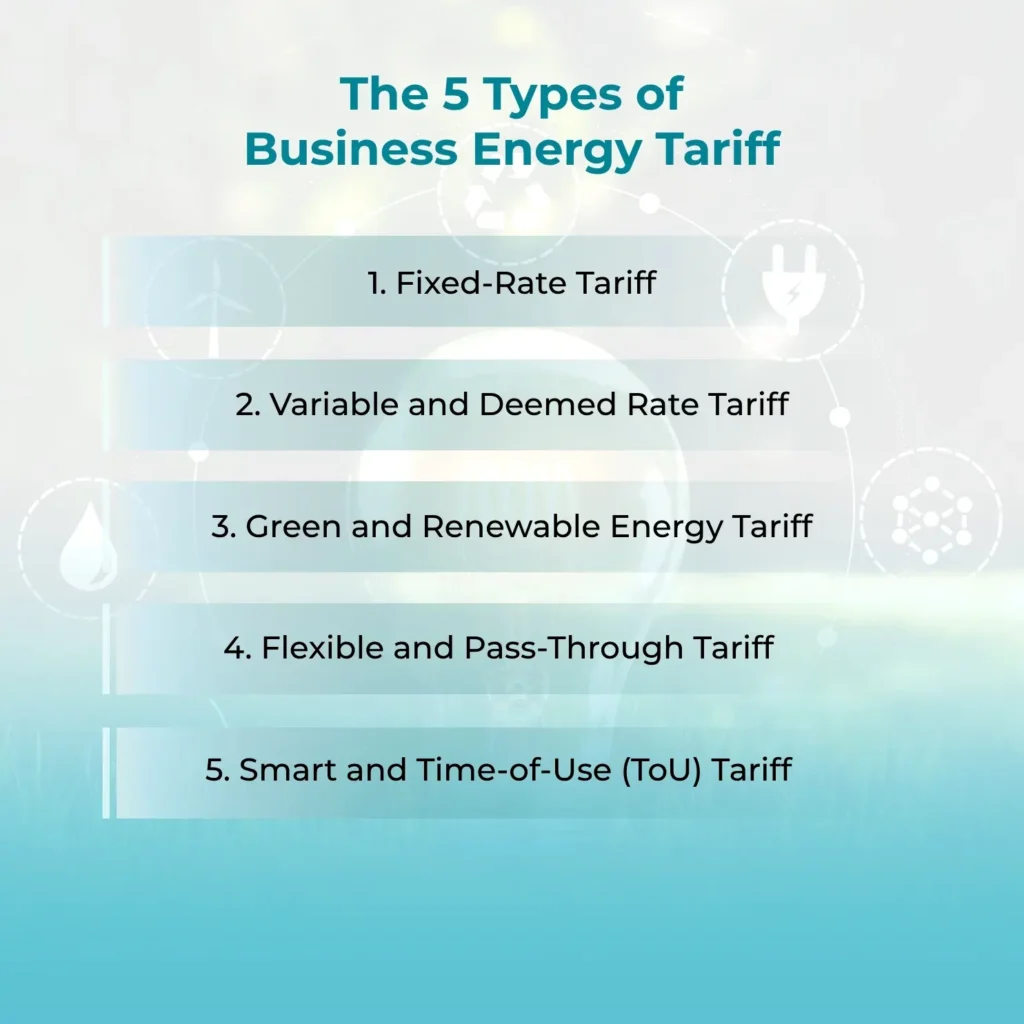
1. Fixed-Rate Tariff
Your unit rate and standing charge are locked in for the duration of the contract, typically one to three years, though some suppliers such as EDF offer up to four years for SMEs.
This suits businesses that need budget certainty: cafes, restaurants, retail, offices, healthcare, and anywhere energy is a significant, predictable cost. The risk is straightforward. If wholesale prices fall during your contract, you won’t benefit from the drop. In a volatile market, most businesses find that predictability is worth paying a small premium for.
One point many businesses miss in 2026: if your fixed tariff embeds non-commodity costs rather than passing them through, you’re also protected from the TNUoS surges that have been hitting bills hard this year. Always ask which costs are genuinely fixed and which remain variable.
Lock into a fixed tariff when you believe market prices are at or near a cyclical low. Start comparing three to six months before your current contract ends so you have time to act properly.
2. Variable and Deemed Rate Tariff
Your rates move with the wholesale energy market. Deemed rates specifically apply when a business receives supply without an active contract, either because you’ve moved into new premises or your previous contract has expired.
In theory, this sounds flexible. In practice, it’s almost universally the most expensive tariff type for UK businesses. Deemed rates in particular can run two to three times higher than contracted rates. This isn’t a flexible deal. It’s a financial penalty for inactivity.
In 2026, staying on a variable or deemed rate means absorbing both wholesale market volatility and the sharp non-commodity cost increases simultaneously. There’s no upside to justify it for most businesses.
If you’re currently on a variable or deemed rate, switch. You are never truly locked into a deemed rate, and you can negotiate a new contract at any time.
3. Green and Renewable Energy Tariff
A green tariff means your supplier matches your electricity consumption with energy from renewable sources, verified by Renewable Energy Guarantees of Origin (REGOs). Green gas tariffs, using biomethane, are also increasingly available.
These tariffs suit businesses with net zero commitments, those pursuing sustainability certification such as ISO 14001 or B Corp status, or those in sectors where environmental credentials carry commercial weight.
What most businesses don’t check: not all “green” tariffs are equal. Some suppliers market energy as green based on their overall generation mix rather than dedicated REGO matching to your actual consumption. Before signing, ask directly: “Do you hold REGO certificates equal to 100% of my contracted consumption?” A vague answer is a red flag.
The price gap between green and standard tariffs has narrowed significantly in 2026. In many cases, a certified renewable tariff costs no more than 0.5 to 1.5p/kWh above a comparable standard deal, making it a commercially sensible choice rather than purely an ethical one.
4. Flexible and Pass-Through Tariff
Instead of agreeing a single fixed price upfront, you buy energy in tranches over time, taking advantage of lower prices when the market dips. Sometimes called “portfolio” or “structured” purchasing. Non-commodity costs are typically passed through at actual cost rather than embedded.
This works well for large businesses consuming 25,000+ kWh per year with dedicated energy managers or contracted consultants who can actively monitor and act in the market. Without that active management, a flexible tariff can easily cost more than a straightforward fixed deal.
The pass-through of non-commodity costs is an important detail. Your bill can rise even when commodity prices are flat, as businesses are discovering with TNUoS charges in 2026. TotalEnergies is the major supplier most associated with flexible industrial contracts. For SMEs without specialist energy management resources, this tariff type is largely unsuitable.
5. Smart and Time-of-Use (ToU) Tariff
Your unit rate varies depending on the time of day: cheaper during off-peak hours, higher during peak demand periods. Requires a smart or half-hourly meter. Octopus Energy’s “Shape Shifters” product (available in Trio and Agile versions) is the best-known example in the business market.
This suits businesses with genuine flexibility in when they use electricity: those with battery storage systems, electric vehicle fleets, refrigeration-heavy operations such as cold storage or logistics, and manufacturing facilities that can shift loads to overnight hours.
The opportunity is real. Businesses that shift even 20 to 30% of their consumption from peak to off-peak periods can achieve savings of 20 to 40% on the variable portion of their bill. Smart tariffs are gaining genuine commercial traction in 2026 for the first time, particularly for businesses that have recently invested in battery storage or EV fleet infrastructure.
A practical threshold: if your business can shift heavy loads such as manufacturing processes, charging cycles, or refrigeration outside of 4pm to 7pm, a ToU tariff is worth modelling. If your consumption is evenly spread across the day with no flexibility at all, a standard fixed tariff will serve you better.
Fixed vs Variable: Which Is Right for Your Business in 2026?
| Factor | Fixed Tariff | Variable Tariff |
| Price stability | High, rates locked for contract term | Low, changes with market |
| Budget predictability | Easy and reliable | Uncertain month to month |
| Risk level | Low | Medium to high |
| Market benefit | No benefit if prices fall | Gains if prices fall |
| Market downside | Locked in if prices fall significantly | Fully exposed to price spikes |
| Non-commodity cost exposure | Depends on contract structure | Usually fully exposed |
| Best fit | SMEs prioritising cash flow certainty | Large businesses with energy management |
| 2026 recommendation | Preferred for most businesses | Only with specialist advice |
Market Timing in 2026
The current energy landscape looks like this: wholesale costs are roughly double pre-2021 levels but softer than the 2022 to 2023 crisis peak. Non-commodity costs are rising sharply, particularly TNUoS which has increased by up to 90% in some regions. The Nuclear RAB levy adds another incremental cost. Geopolitical uncertainty, including recent Middle East events, is keeping wholesale markets unsettled.
In this environment, the case for fixing is strong for most SMEs. The potential downside of locking in if prices fall is outweighed, for most businesses, by the operational value of budget certainty and by the fact that no variable rate shields you from rising non-commodity costs anyway.
If your business relies on stable cash flow, has slim margins, or lacks the resource to actively manage energy purchasing, fix your rate. If you have an energy manager, substantial consumption above 25,000 kWh per year, and can handle monthly bill volatility, a flexible approach may be worth exploring with a specialist.
The Hidden Costs No One Talks About
1. TNUoS Charges
TNUoS charges fund the maintenance and expansion of the national electricity transmission grid, set by National Grid ESO and passed through to businesses. In April 2026, these charges increased by up to 90% in some regions as a direct result of infrastructure investment required for the energy transition and the electrification of heat and transport.
Even if you are on a fixed-rate contract, check whether non-commodity costs are embedded or passed through. If they’re passed through, your total bill may still rise during the contract period regardless of what the unit rate says.
Medium and large businesses are most affected, along with those in regions with significant grid investment, particularly Scotland, parts of northern England, and offshore-connected areas. The National Grid ESO website publishes TNUoS tariff data annually if you want to dig into regional specifics.
2. The Nuclear RAB Levy
The Regulated Asset Base (RAB) charge was introduced in late 2025 to help fund the construction of Sizewell C. It appears as a separate line item on commercial electricity bills and is government-mandated, not a supplier add-on.
The individual per-unit amount is currently modest. But it is a new, permanent cost category that is expected to increase gradually as construction progresses. When you see a line referencing “Nuclear RAB,” “Sizewell C levy,” or similar, it is legitimate. It isn’t a billing error.
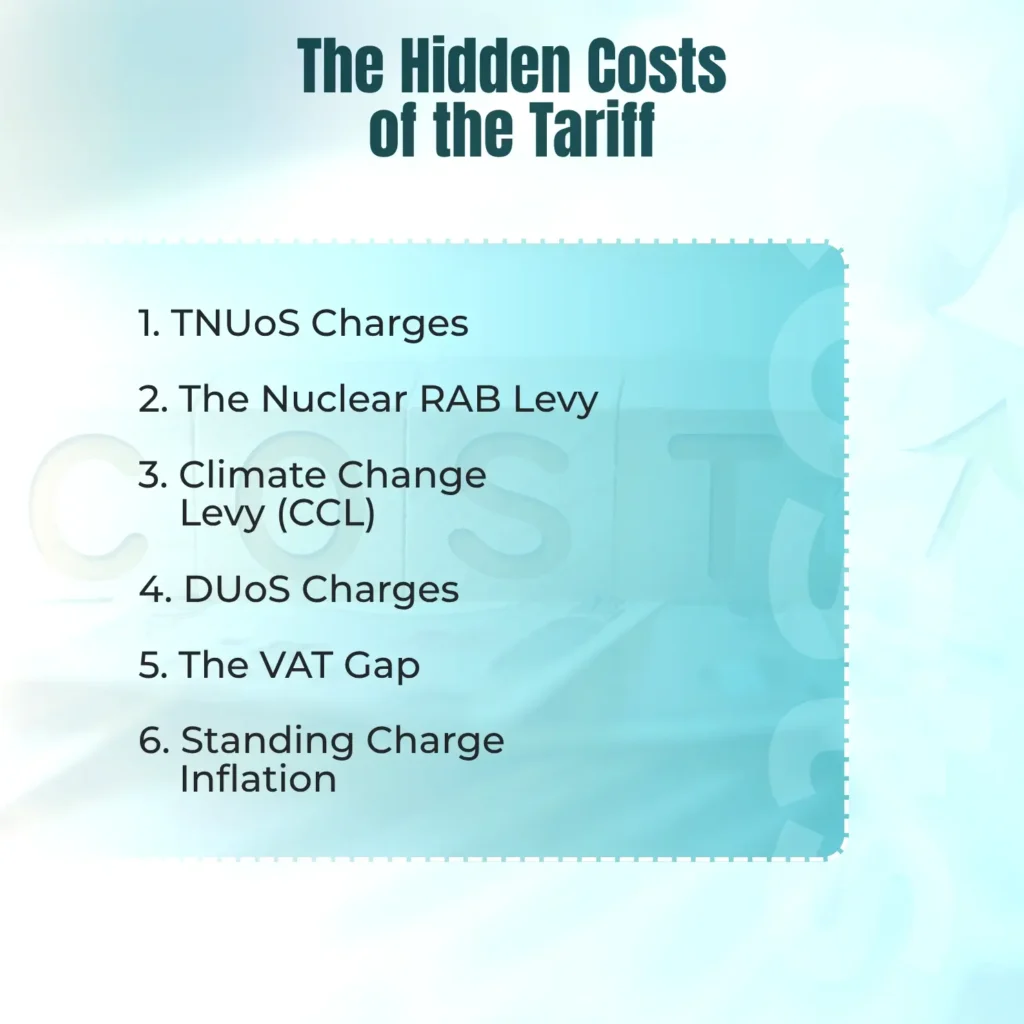
3. Climate Change Levy (CCL)
The CCL is a government environmental tax on business energy consumption, currently around 0.66p/kWh for electricity and 0.18p/kWh for gas (updated annually). It applies at the standard 20% VAT rate for most businesses.
What many businesses overlook: if your sector has a Climate Change Agreement (CCA) with its trade association, you may qualify for an 80 to 90% CCL discount on electricity and 65% on gas. Charities and businesses below the de minimis threshold may also qualify for reduced or waived CCL. Renewable electricity backed by REGO certificates is eligible for CCL exemption entirely.
If your business is energy-intensive, check whether your trade association has a CCA scheme. The savings can be substantial and the process to register is not as complex as it sounds.
4. DUoS Charges
DUoS covers the local electricity distribution network: the cables and substations that get electricity from the national grid to your door. Rates are set by regional Distribution Network Operators and vary by location.
DUoS often includes a red, amber, green time-banding structure. Consuming electricity during peak “red band” periods, typically late afternoon, carries a premium. For businesses with any flexibility in usage patterns, shifting consumption away from red-band periods can reduce this component meaningfully without changing your tariff at all.
5. The VAT Gap
Most UK businesses pay 20% VAT on energy. Domestic customers pay 5%. That four-times multiplier significantly amplifies any unit rate difference when comparing business and household energy costs. It also means that every efficiency improvement or rate reduction you achieve is worth proportionally more.
The exceptions: charities and very low-consumption businesses (below 33 kWh/day electricity or 145 kWh/day gas) typically qualify for the reduced 5% rate. If your business is a charity, or if your usage is particularly low, ask your supplier or an accountant about your eligibility. The annual difference between 5% and 20% on a full energy bill is material.
6. Standing Charge Inflation
Standing charges have risen significantly across most suppliers over the past two years as infrastructure and network costs are increasingly pushed through to business customers. Many SMEs now face standing charges of 50p to 175p per day in 2026, creating a substantial fixed-cost floor paid whether the business is operating or not.
For low-usage businesses such as small offices, seasonal operations, and pop-up retail, the standing charge can represent 40 to 60% of total cost. EDF Energy offers a zero standing charge option which, despite carrying a slightly higher unit rate, can work out cheaper for businesses with low or intermittent energy use. It is worth modelling with your own consumption figures before dismissing it.
How to Compare Business Energy Tariffs Properly
The most common mistake is comparing tariffs on headline unit rate alone. Here is a complete framework for finding the genuinely lowest total cost deal.
Step 1: Establish Your Baseline
Before requesting quotes, gather from your current bill:
- Annual electricity and gas consumption (kWh)
- Current unit rate (p/kWh) for each
- Current standing charge (p/day) for each
- Contract end date and notice period required
- Whether your current tariff has fixed or pass-through non-commodity costs
Step 2: Calculate Total Annual Cost
Use this formula for a like-for-like comparison:
Total Annual Cost = (Unit Rate x Annual kWh) + (Standing Charge x 365) + VAT + CCL
Two tariffs might look like this side by side:
| Tariff A | Tariff B | |
| Unit rate | 25.0p/kWh | 26.5p/kWh |
| Standing charge | 150p/day | 50p/day |
| Annual consumption | 10,000 kWh | 10,000 kWh |
| Unit cost | £2,500 | £2,650 |
| Annual standing charge | £547.50 | £182.50 |
| Total before VAT | £3,047.50 | £2,832.50 |
Tariff A looks cheaper on unit rate but costs £215 more per year. This is exactly how high standing charges silently erode savings that look good on paper.
Step 3: Clarify What Is Fixed and What Is Pass-Through
Ask each supplier explicitly: “Are non-commodity costs embedded in my quoted rates, or will they be passed through at actual cost during the contract?” A tariff with embedded non-commodity costs gives you genuine price certainty. A pass-through tariff can still change during the contract period even if the unit rate is technically fixed.
Step 4: Check Supplier Credentials
Beyond price, check Trustpilot score and review volume, Ofgem supplier register listing, track record on billing accuracy, and the quality of online account management. A cheap tariff with poor service can cost you far more in management time than the savings justify.
Step 5: Understand the Contract Terms
Know the minimum and maximum contract length, whether there is an auto-renewal clause and what the notice period is, what exit fees apply if you need to leave early, and what happens at contract end if you take no action. That last point is where most businesses get caught out.
How to Switch Business Energy Supplier
Switching is straightforward if you follow the right sequence. The critical variable is timing.

The Optimal Window
Start comparing three to six months before your contract end date. This gives you enough time to get multiple quotes, assess them properly, and complete the switch before your contract expires. Missing this window is how businesses end up on deemed rates.
The Process
- Check your contract end date and the notice period required to exit (typically 30 to 90 days)
- Gather your usage data: annual kWh for electricity and gas, available on your bill or from your current supplier
- Get at least three quotes, directly from suppliers and optionally via a broker
- Compare on total annual cost, not unit rate alone
- Sign your new contract. Your new supplier handles notifying your old one
- Submit a meter reading on the switch-over date for accurate final billing
- Confirm the new contract start date in writing
For out-of-contract businesses, the switch typically takes two to four weeks. For businesses switching at or near their contract end date, four to six weeks. There is no interruption to your energy supply. The change is entirely administrative.
The Mistakes That Cost Businesses Money
The auto-renewal trap is probably the most common. Many business energy contracts include an auto-renewal clause. Miss the notice window and your contract may roll over automatically, sometimes at significantly higher rates. Read your contract carefully. Set a calendar reminder well in advance.
Comparing unit rates only produces a misleading picture, as the example above shows.
Switching without checking exit fees. If you switch mid-contract, exit fees can be significant. Always calculate whether projected savings outweigh the exit cost before deciding.
Using estimates rather than actual usage. Quotes based on estimated consumption can look very different from what you actually end up paying. Always use real usage data from your most recent annual billing statement.
Contract Exit, Break Clauses and Mid-Term Switching
This topic is almost completely absent from most business energy content, and it’s one of the most common situations businesses find themselves in.
Can You Exit Early?
Yes, but it usually costs something. Business energy contracts are legally binding and exit fees can be substantial, particularly for fixed-rate contracts where the supplier has already hedged energy at your agreed rate on the open market.
Typical exit fee structures include a flat fee (less common), a cost per day remaining on the contract (more common), or the difference between your contracted rate and current market rates for your remaining consumption (most common for larger contracts). For a reliable overview of your rights, the Ofgem business energy guidance is a useful reference.
When Is It Worth Paying to Leave Early?
It can make sense if market rates have fallen significantly below your contracted rate and the saving over the remaining contract term exceeds the exit cost. It can also make sense if your business needs have changed materially, for example a significant reduction in energy consumption, or if non-commodity charges are pushing actual costs far above what the contracted rate suggested.
Auto-Renewal Clauses
Most contracts contain a notice period of 30 to 90 days before the contract end date. Miss it and the contract may roll over automatically, sometimes for an equivalent term at very different rates. After signing any energy contract, set a calendar reminder for four months before the end date. That one act prevents a very common and very expensive mistake.
Moving Premises
If your business is relocating, contact your supplier as soon as you know, ideally before the move date. Your options are to transfer your existing contract to the new address (if your supplier permits and the meter profile is compatible), negotiate an early exit (your supplier may waive exit fees in this circumstance), or take on the deemed rate at the new premises while arranging a proper deal. If the latter, act quickly.
Working with Energy Brokers in 2026: What’s Changed
Energy brokers can be genuinely useful for SMEs with multiple sites, high consumption, or complex purchasing needs. The broker market has historically had a serious transparency problem, with commissions embedded in unit rates without disclosure. That has changed significantly in 2026.
The New Ofgem Transparency Rules
New Ofgem regulations now require energy brokers to clearly disclose that they work on a commission basis, state the amount or method of calculating their commission before you agree to any deal, and not embed hidden commissions in tariff rates without your knowledge.
This is a meaningful shift. Previously, brokers would routinely add a commission of 1 to 3p/kWh to the unit rate without the business being aware. On a medium-sized business consuming 20,000 kWh per year, a 2p/kWh hidden commission adds £400 per year to the bill. Multiplied across a three-year contract, that’s £1,200 for a service you may not have realised you were paying for.
What to Ask Before Proceeding
Ask every broker: how do you get paid, is your commission included in the unit rate or paid separately by the supplier, can you show me the gross tariff before your commission is added, and are you whole-of-market or do you have preferred supplier relationships? Under the new 2026 rules, a broker is legally required to answer these questions clearly. Evasiveness is a genuine red flag.
When Brokers Add Real Value
Multi-site businesses managing multiple contract renewals in parallel benefit substantially from broker support. So do businesses approaching renewal with large consumption above 25,000 kWh per year, where even 0.5p/kWh savings on negotiated rates are material in total. Businesses that lack the time or expertise to navigate the market themselves, and those seeking flexible or pass-through contracts that require active market monitoring, also tend to benefit.
Tariff Guidance by Business Size and Sector
By Business Size
Micro businesses (under 5,000 kWh/year)
At very low consumption, the daily standing charge can represent 40 to 60% of your total bill. Focus there first. EDF’s zero standing charge tariff is worth modelling for this segment. A one to two year fixed deal avoids over-committing before your usage patterns are properly established.
Small businesses (5,000 to 15,000 kWh/year)
A fixed-rate tariff of one to two years offers the best balance of price certainty and flexibility. Compare both unit rates and standing charges using total annual cost calculations. For customer service, Octopus Energy currently leads in this segment on satisfaction ratings.
Medium businesses (15,000 to 25,000 kWh/year)
At this consumption level, a 0.5p/kWh difference in unit rate adds up to £100+ per year. The negotiation effort pays off. Consider a two to three year fixed deal if you believe rates are at or near a temporary low. Time-of-Use tariffs are worth exploring if your business has any meaningful load-shifting flexibility.
Large businesses (25,000+ kWh/year)
Fixed-rate contracts remain the most common choice for certainty at this scale, but flexible and pass-through contracts negotiated with major suppliers can deliver better long-term value with active management. Engage an energy consultant or broker with a demonstrable track record and full commission transparency. At this consumption level, the detail of non-commodity cost structures should be central to your analysis.
By Sector
Hospitality
Energy is typically one of the top three operating costs for restaurants, cafes, and hotels. Fixed tariffs are almost universally preferable for cash flow management. Watch for time-of-use peak charges during evening service hours. If you close seasonally, explore whether a zero standing charge tariff or contract suspension option is available before committing to a standard deal.
Retail
Electricity is usually the primary energy cost. LED lighting upgrades and HVAC management deliver high ROI before worrying about tariff switching. Fixed one to two year deals suit most independent retailers. Those with electric heating or significant refrigeration should look carefully at TNUoS peak-demand charges.
Manufacturing and Industrial
High energy intensity means even small rate differences are material in total. Half-hourly metering is likely already in place, opening access to flexible and ToU tariffs. Load-shifting heavy machinery to off-peak hours can generate significant savings. CCL reduction via a Climate Change Agreement should be a priority if you haven’t already explored it through your trade association.
Healthcare and Dental
Generally steady, predictable consumption patterns make fixed tariffs a natural fit. Emergency backup power requirements mean grid reliability should factor into supplier selection alongside headline rate. Look for suppliers with strong account management rather than purely the lowest price.
Professional Services and Offices
Often relatively low energy users, which means standing charges can dominate the bill. Maximise efficiency gains from lighting, HVAC scheduling, and standby power reduction before placing too much weight on tariff switching. The marginal gains from rate optimisation are smaller at lower consumption volumes.
How to Reduce Your Business Energy Costs
Choosing the right tariff is the highest-leverage action. Combining tariff strategy with genuine consumption reduction delivers the greatest long-term savings.
Avoid out-of-contract rates. If you take only one action from this guide, this is it. Falling onto deemed or out-of-contract rates can cost 30 to 100% more than a negotiated deal. Set a reminder four months before your contract ends and begin comparing at that point.
Match your tariff to your actual usage pattern. Businesses often default to the same tariff type at each renewal without reassessing whether it still fits. If your business has grown significantly, or if you have added battery storage or EVs since your last renewal, the right tariff type may have changed.
Conduct a basic energy audit. Checking energy use during business hours versus after hours often reveals straightforward wins: lights and equipment left on overnight, HVAC systems running during unoccupied periods, legacy equipment drawing significant standby power. For businesses with 250 or more employees, a professional energy audit is required every four years under the ESOS scheme and can identify savings of 10 to 30% in consumption.
Upgrade to LED lighting. If you haven’t already, switching from fluorescent or halogen to LED reduces lighting energy consumption by 50 to 70%. Payback periods of one to three years are typical even without subsidy. It’s one of the few capital investments in energy efficiency where the numbers are almost always positive.
Install a smart meter. Smart meters eliminate estimated billing and provide the granular half-hourly data that makes Time-of-Use tariff optimisation practical. If you’re on or considering a ToU tariff, accurate consumption data is essential.
Explore on-site renewable generation. Rooftop solar combined with battery storage is increasingly viable for UK businesses. Where owned premises make installation possible, payback periods are now typically four to seven years, with exported energy earning export tariff revenue. The Energy Saving Trust business energy guidance is a useful starting point for assessing what’s viable for your site.
Use CCL relief if you qualify. As noted above, if your sector has a Climate Change Agreement and you’re not registered, you may be leaving a substantial annual saving on the table. Contact your trade association to find out whether a CCA scheme exists for your industry.
Taking Control of Your Business Energy in 2026
The business energy market in 2026 is more complex than it has ever been. Not primarily because energy itself is more expensive (wholesale prices have partially softened), but because the structure of bills has become significantly more opaque. Non-commodity costs now make up the majority of what you pay. New charges like the Nuclear RAB levy are appearing on bills without any accompanying explanation. TNUoS charges have surged. And the broker market, while better regulated, still rewards businesses that ask the right questions.
The businesses that will genuinely reduce their energy costs this year are those that understand what is actually on their bill, not just the unit rate but the full breakdown. Those that act before their contract expires, starting the comparison process three to six months in advance. Those that compare on total annual cost rather than headline rate. Those that ask about pass-through costs, exit fees, and broker commissions. And those that match their tariff to how their business actually operates, its size, sector, usage pattern, and appetite for risk.
If there is one action to take today, it is this: find your contract end date and set a calendar reminder for four months before it. That single step protects you from the most common and most expensive mistake in business energy, ending up on a deemed rate through nothing more than inaction.
Benchmark rate data reflects market estimates for Q2 2026 based on government non-domestic energy statistics (Q4 2025) and current supplier market positions. Rates vary by location, consumption, credit profile, and supplier. Always obtain a personalised quote for accurate pricing.
Frequently Asked Questions
What is the cheapest business energy tariff in the UK in 2026?
There is no single cheapest tariff. Rates depend on your consumption, location, credit profile, and timing. As of April 2026, contracted fixed rates for small businesses start from around 26.5p/kWh for electricity and 7.5p/kWh for gas. The most important thing is being on a contracted deal rather than a deemed or out-of-contract rate, which can cost 50 to 100% more.
Is there a price cap for business energy?
No. Unlike domestic energy, there is no Ofgem price cap for business customers. All pricing is negotiated and contract-based. This makes shopping around and timing renewals correctly significantly more important for businesses than for households.
What is the difference between commodity and non-commodity costs?
Commodity costs are the raw wholesale cost of electricity or gas. Non-commodity costs, which make up approximately 60% of a business electricity bill in 2026, cover grid infrastructure (TNUoS, DUoS), environmental levies (CCL), new charges (Nuclear RAB levy), and VAT. Non-commodity costs can rise even within a fixed contract if they are structured as pass-through rather than embedded charges.
Can I switch business energy if I’m mid-contract?
Yes, but you may face an exit fee. The cost depends on your supplier, the remaining contract length, and current market conditions. In some cases, switching and paying the exit fee can still save money overall. Always calculate the total switching cost versus projected savings before deciding.
What happens if I don’t renew my business energy contract?
Your supplier places you on a deemed or out-of-contract rate. These are the most expensive rates available, typically two to three times your previous contracted rate, with no fixed terms and no protection against further rate changes. Start comparing new deals at least three months before your contract ends.
What is the Nuclear RAB levy on my energy bill?
It is a government-mandated charge introduced in late 2025 to fund construction of Sizewell C, a new nuclear power station in Suffolk. It appears as a line item on most commercial electricity bills from 2025 to 2026 onwards. It is legitimate, and the amount is expected to increase gradually as the construction programme progresses.
Do businesses pay more VAT on energy than households?
Yes. Most UK businesses pay 20% VAT on energy, compared to 5% for domestic customers. Exceptions include charities and very low-consumption businesses (below 33 kWh/day for electricity), which may qualify for the 5% rate. If you think your business might qualify, ask your supplier or an accountant.
What is a TNUoS charge and why has it increased?
TNUoS (Transmission Network Use of System) is the charge covering the cost of maintaining and expanding the national electricity transmission grid. In April 2026, these charges increased by up to 90% in some UK regions to fund major grid infrastructure upgrades required for the energy transition. They are set by National Grid ESO and form part of the non-commodity portion of your electricity bill.
What should I ask an energy broker about their commission?
Under new 2026 Ofgem regulations, brokers must disclose their commission structure before you agree to any deal. Ask how they get paid, whether commission is embedded in the unit rate or paid separately, what the gross tariff looks like before commission is added, and whether they are whole-of-market or have preferred supplier relationships. A reputable broker will answer all of this clearly.
Is a green energy tariff more expensive?
In 2026, the premium for certified renewable electricity backed by REGO certificates has narrowed to approximately 0.5 to 1.5p/kWh above comparable standard tariffs for most business sizes. For businesses with net zero commitments or sustainability reporting requirements, this is now a commercially reasonable choice rather than a premium one.