
Table of Contents
Could producing more gas in the North Sea bring down household energy bills? It is a fair question, especially when families are still watching their energy costs closely.
On 21 October 2026, the UK Government approved production at the Jackdaw gas field. The decision came alongside plans for a new £2 billion Energy Wealth Fund and a proposal to examine removing gas standing charges from household bills.
The announcements have attracted attention because they touch on three issues that matter to consumers: where Britain’s gas comes from, how much households pay for it and how the country balances energy security with its climate commitments.
But these developments need to be understood separately.
The Jackdaw gas field could add to domestic gas production, but that does not guarantee cheaper energy. Removing gas standing charges could change how household costs are distributed, but the details of that proposal remain undecided.
The approval also raises wider questions about Labour’s energy policy. The Government says Jackdaw is consistent with its commitment to stop issuing new licences for oil and gas exploration. Critics argue that opening a previously undeveloped field conflicts with the spirit of that commitment.
The key question is not simply how much gas Britain can produce. It is whether these decisions will make a meaningful difference to household bills, how quickly that could happen and what trade-offs the country is accepting.
Here is what the announcement means, what the evidence tells us and what households should watch next.
What Has the UK Government Announced?
The announcements on 21 October covered three main developments.
Approval for the Jackdaw gas field
Energy Secretary Miatta Fahnbulleh agreed that the North Sea Transition Authority could grant consent for gas production at Jackdaw.
The field is expected to begin supplying gas to British homes and businesses from as early as the end of October 2026.
According to the official Government announcement, the project could increase domestic gas production by around 6% at its peak and support the UK’s gas supply for up to 11 years.
The Government also cites the developer’s estimate that the project could add around £2.9 billion to the UK economy, create 27 direct jobs and safeguard 273 existing jobs.
These are estimates, not guaranteed economic outcomes or promises of lower household bills.
A review of gas standing charges
Prime Minister Andy Burnham also announced that he had asked the Chancellor and Energy Secretary to examine removing standing charges from gas bills at the earliest opportunity.
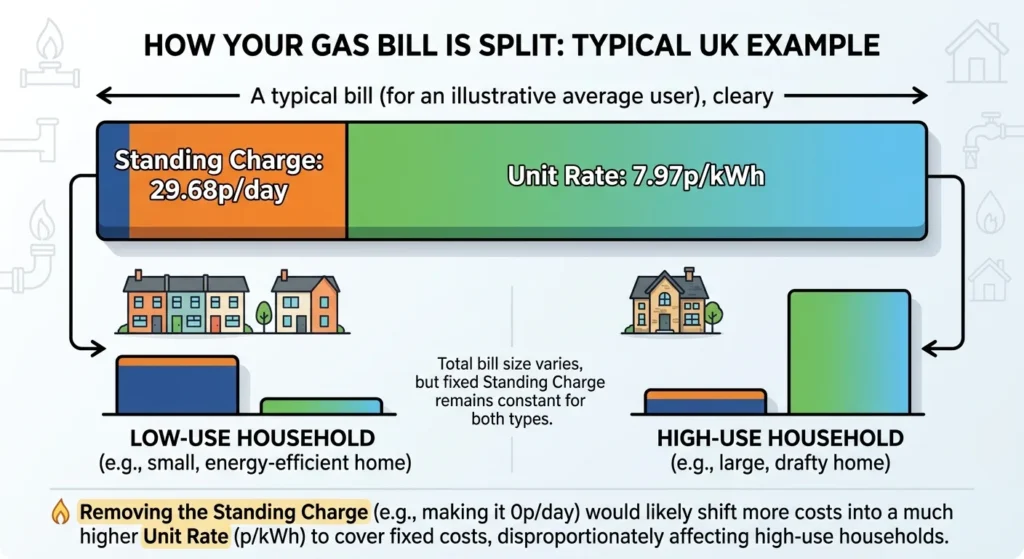
A standing charge is a fixed daily fee that households pay regardless of how much gas they use.
The proposal has attracted attention because the charge can make up a noticeable part of the bill for households with low gas consumption.
However, ministers have been asked to examine the change. That does not mean standing charges have already been abolished or that households have been promised a specific saving.
A new energy wealth fund
The Government announced plans for an Energy Wealth Fund with an initial £2 billion injection.
The fund is intended to use future tax revenues from North Sea oil and gas to support investment in renewable and low-carbon energy projects.
The Government says that expanding cleaner energy production could help reduce the UK’s exposure to volatile international gas markets over time.
That is a longer-term objective. The fund is not a direct payment to households, and its announcement does not mean energy bills will immediately fall.
What Is the Jackdaw Gas Field?
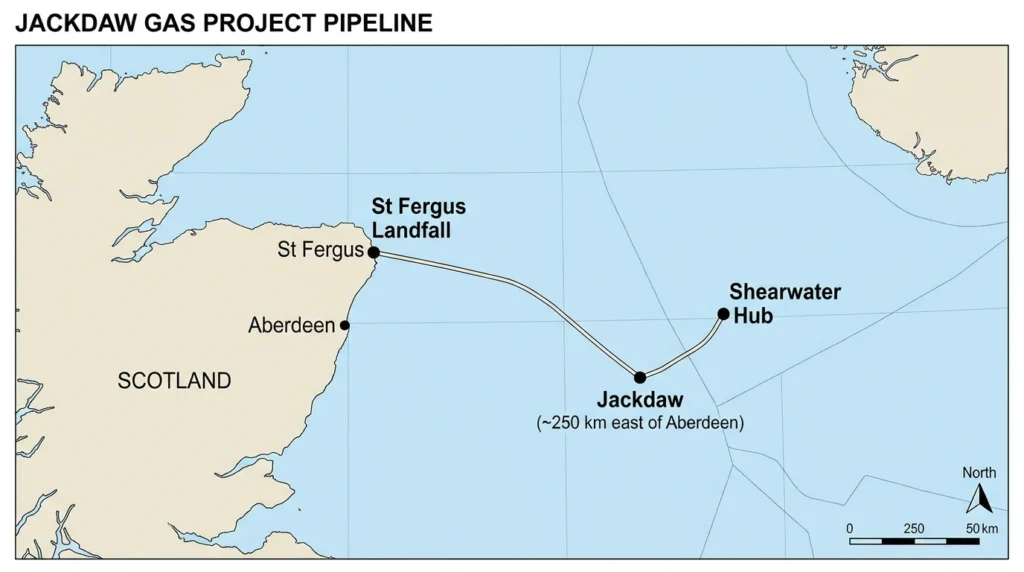
The Jackdaw gas field is an offshore natural gas development in the Central North Sea, approximately 250 kilometres east of Aberdeen.
It is operated by Adura, a joint venture between Shell and Equinor. The project is designed to connect to the existing Shearwater Hub, with gas transported ashore at St Fergus in Aberdeenshire.
Using existing infrastructure is important because it allows the project to connect with the wider gas supply system without requiring an entirely separate network.
How much gas could Jackdaw produce?
The Government estimates that Jackdaw could increase UK domestic gas production by around 6% at peak and support gas supply over a lifespan of up to 11 years.
Its lifetime output is also estimated to have an energy equivalent of around 40 million barrels of oil.
The Government has described the field as a way to support domestic supply, protect jobs and improve energy security.
There is an important distinction between these figures and the effect on consumers. A 6% increase in domestic gas production does not mean a 6% reduction in the gas price, and it does not mean household bills will fall by the same percentage.
Production estimates tell us how much gas a project may provide. They do not tell us what a supplier will charge a household.
Will the Jackdaw Gas Field Lower UK Energy Prices?
The honest answer is that Jackdaw could support domestic gas supply, but lower household energy prices are not guaranteed.
To understand why, it helps to look at how the UK gas market works.
How more domestic gas could help
Producing more gas in the UK gives the country another source of supply.
This can support energy security, reduce reliance on some imported supplies and help maintain production through existing North Sea infrastructure.
The Government has pointed to recent instability in international energy markets as one reason for approving the field.
Domestic production can be useful when global supply routes face disruption. It gives the UK another source to draw on rather than relying entirely on imports.
However, producing gas at home does not automatically mean British households receive it at a lower price.
Why more gas does not automatically mean cheaper bills
Natural gas is traded in interconnected markets. Wholesale prices respond to supply and demand, storage levels, imports and events affecting production in other countries.
Gas produced in the UK is part of this wider market. Its domestic origin does not automatically create a special lower price for households.
The Jackdaw approval could help support supply, but the effect on wholesale prices depends on wider market conditions. The effect on household bills also depends on supplier costs, network charges and other parts of the tariff.
That is why the Government’s estimate of a 6% increase in domestic production at peak should not be presented as a forecast of lower household prices.
For consumers, the practical point is straightforward. Jackdaw may contribute to energy security, but it should not be treated as a promise that gas or electricity bills will fall.
Where Does the UK’s Gas Supply Come From?
The UK relies on a mix of domestic production and imports. Jackdaw will become one part of this wider supply system, rather than a replacement for all other sources.
The Government’s five-year average for 2021 to 2025 gives the following breakdown.
| Source | Share of UK gas supply |
| UK Continental Shelf | 42% |
| Norway | 37% |
| Liquefied natural gas, or LNG | 20% |
| Interconnectors | 1% |
Source: UK Government’s Jackdaw announcement.
The UK Continental Shelf includes many producing fields, not just Jackdaw. These figures describe the historical supply mix during that five-year period. They are not a forecast of future supply.
Norwegian pipeline gas and LNG imports also remain important to the UK’s gas supply. Changes in their availability or price can influence the wider market even when domestic production continues.
This helps explain why approving a single gas field cannot guarantee cheaper energy. Its contribution has to be considered alongside the rest of the UK’s supply and changing market conditions.
What Are Gas Standing Charges, and How Much Do Households Pay?
A gas standing charge is a fixed daily fee that households pay for their gas connection. It applies even when they use no gas on a particular day.
The gas unit rate is different. It is the price paid for each kilowatt-hour, or kWh, of gas consumed.
Both affect a household’s bill, so comparing only one of them can give a misleading picture of the total cost.
What is the current average gas standing charge?
For 1 October to 31 December 2026, Ofgem’s average Direct Debit rates for domestic customers in Great Britain are:
| Gas price component | Average rate |
| Unit rate | 7.97p per kWh |
| Daily standing charge | 29.68p per day |
| Standing charge over 365 days | Approximately £108.33 |
Source: Ofgem’s current unit rates and standing charges.
These are average figures for customers on default tariffs who pay by Direct Debit. Actual rates vary by region, payment method and meter type.
The annual standing charge is calculated by multiplying 29.68p by 365 days. It is not the total cost of gas for the year.
Why standing charges matter to low-use households
A household that uses very little gas can still pay a fixed charge throughout the year.
For example, someone might use gas mainly for heating during the colder months while relying on electricity for cooking or hot water. Their gas consumption may be low for much of the year, but the standing charge continues while the connection remains active.
This is one reason the proposed change has attracted attention. Some households feel that a fixed daily fee places a greater burden on people who use less gas.
The question is whether the costs currently recovered through standing charges should instead be linked more closely to consumption.
Will the Government Remove Gas Standing Charges?
The Prime Minister has asked ministers to examine removing gas standing charges, but a final policy and implementation date have not been confirmed in the announcement.
The details matter because removing a charge from a bill is not the same as removing the costs that it helps cover.
What happens to the costs currently covered by standing charges?
Standing charges help recover fixed costs associated with supplying energy. These include network costs and other parts of the system needed to deliver gas to homes.
Ofgem’s explanation of household energy prices shows that bills include wholesale energy, network costs, policy costs, supplier operating costs and other allowances.
If the gas standing charge were removed, those costs would still need to be covered. One possible approach would be to recover more of them through the unit rate.
That would change how households pay for the costs, rather than make the costs disappear.
Would removing standing charges make every household better off?
Not necessarily. The result would depend on the final policy and how much gas each household uses.
A household with low gas consumption could benefit if it no longer paid a fixed daily fee and the increase in its unit rate was relatively small.
A household that uses a large amount of gas could pay more if the costs were transferred into a higher unit rate.
The impact should be judged by looking at the total bill, not simply by checking whether the daily charge has disappeared.
Until the policy details are confirmed, it would be premature to promise households a specific level of savings.
Who Could Benefit Most From Removing Gas Standing Charges?
Independent research from Nesta helps explain why the proposal could affect households differently.
In its October 2026 analysis of removing the gas standing charge, Nesta modelled a system in which the standing charge is removed and the costs are recovered through unit rates.
Under that model, Nesta estimates that a typical dual-fuel household could save around £27 a year. It estimates that 64% of dual-fuel households would be better off.
The analysis also estimates that households using more than approximately 12,400 kWh of gas a year could begin paying more under the proposed arrangement.
These are Nesta’s estimates, not guaranteed savings or confirmed Government policy.
Why low-use households could benefit
A fixed daily charge makes up a larger share of the bill when gas consumption is low.
If a household uses relatively little gas, removing the charge could save more than it loses through a higher unit rate.
Nesta estimates that 86% of the poorest households could be better off under its model, compared with 24% of the wealthiest households.
Its analysis suggests that this difference is linked to household gas consumption. A fixed charge can represent a larger proportion of the total bill for households that use less gas.
Why higher gas use changes the calculation
Consider two households.
Household A uses relatively little gas. If the standing charge is removed, the saving from no longer paying the daily fee may outweigh the extra cost of a higher unit rate.
Household B uses much more gas. A higher unit rate applies to every kWh consumed, so the extra cost could outweigh the saving from removing the fixed charge.
This is an illustrative comparison, not a prediction of what any household will pay under the Government’s proposal. The actual result would depend on the policy that is eventually introduced.
The lesson is to compare the full annual cost at your own level of consumption. A tariff with no standing charge is not automatically the cheapest option.
Why Is the Jackdaw Gas Field Controversial?
The approval has become a major political issue because it raises questions about energy security, jobs, household bills and the UK’s climate commitments.
It is not just a decision about one gas field. It also tests how the Government intends to balance its promises on climate policy with its position that the UK will continue to need some oil and gas.
What did Labour’s 2024 manifesto promise?
Labour’s 2024 manifesto stated that the party would not issue new licences to explore new oil and gas fields. It also said the party would not revoke existing licences and would work with businesses and workers to manage existing fields over their lifespans.
The Jackdaw field was originally licensed in 1970 and received development consent in 2022 under the previous Government.
That earlier consent was later quashed after legal proceedings over the project’s environmental assessment. The assessment had not accounted for the emissions that would result from burning the extracted gas.
Following the 2024 Supreme Court ruling in the Finch case, the Government had to consider the downstream emissions from the fuel as part of the updated assessment.
The latest approval allows production to proceed following that new consenting process.
The Government’s position is that Jackdaw was already licensed, so approving production at the field does not amount to issuing a new exploration licence.
Critics argue that opening a previously undeveloped field still conflicts with the spirit of the manifesto commitment, even if the legal distinction is between a new exploration licence and production consent for an existing licensed field.
This is an important distinction for readers. The disagreement concerns both the legal interpretation of the pledge and the wider policy direction it was intended to represent.
Why has the decision created political tension?
Sky News political correspondents Sam Coates and Anne McElvoy examined the approval in their 21 October analysis, Burnham’s gas gamble: Why he’s approved Jackdaw.
They framed the decision as a political gamble for Prime Minister Andy Burnham, who has to explain how approving new production at a previously undeveloped field fits with the Government’s climate commitments and energy strategy.
Their analysis also explored reported tensions within Labour over energy policy, including differences between the approach of senior government figures. Such reporting provides context for the political debate, but it should not be treated as proof that internal disagreements determined the formal decision.
The Government’s published rationale focused on the project’s contribution to energy security, jobs and the economy, alongside its assessment of the environmental impact.
The political risk is clear. If households continue to face high energy costs, ministers will need to explain what the Jackdaw approval is expected to deliver and why it should matter to consumers.
That is a fair test of any energy policy. Approval of a project is a decision about supply. It is not evidence, on its own, that household bills will fall.
Can the Energy Wealth Fund follow Norway’s model?
The Government says future tax revenues from North Sea oil and gas will help fund renewable and low-carbon energy investment through the new Energy Wealth Fund.
The idea is to use some of the proceeds from fossil fuel production to help finance the transition towards cleaner energy.
However, it is too early to judge what the fund will achieve. Its impact will depend on how much revenue it receives, how that money is invested and whether the projects it supports deliver lasting value.
Norway is often used as a comparison because its Government Pension Fund Global was established in law in 1990 and received its first capital transfer in 1996. It was designed to manage petroleum revenue over the long term and help future generations benefit from the country’s oil and gas wealth. See the Norwegian fund’s official history.
The UK’s announced £2 billion initial injection is not directly comparable with Norway’s fund, which has accumulated assets and investment returns over several decades.
The more useful question is how the UK fund will be managed, which projects it supports, how future tax revenues will flow into it and how the Government will report on the results.
For households, there is another distinction. Investment in renewable energy may help reduce exposure to volatile gas prices over time, but it is not the same as an immediate reduction in a household’s energy bill.
What Happens Next for the Rosebank Oil Field?
Rosebank is another major North Sea project facing environmental and political scrutiny, but it should not be treated as the same decision as Jackdaw.
Following the Jackdaw approval, Energy Secretary Miatta Fahnbulleh said Rosebank would be considered on its own merits. She described Jackdaw as a gas field that supplies the UK market, while Rosebank is an oil field whose output is predominantly intended for export.
As of 22 October 2026, the Government had not announced a final decision on Rosebank. The Energy Secretary said the process would take longer.
The distinction matters because the projects have different products, markets and assessments. Jackdaw’s approval does not automatically determine Rosebank’s future.
The Rosebank decision will be another test of how the Government weighs domestic energy policy, economic interests and climate commitments.
What Should Households Do While Waiting for More Details?
The Jackdaw approval and standing charge proposal are worth following, but neither should be treated as a reason to make a tariff decision based on savings that have not been confirmed.
There are three practical steps worth taking now.
Check your current gas tariff. Look at the unit rate and daily standing charge on your bill. Both affect the total amount you pay.
Compare the full annual cost. A lower standing charge may come with a higher unit rate. Use your actual gas consumption when comparing tariffs, rather than judging a deal by one headline price.
Follow official updates. The Government has not confirmed the final design or start date for removing gas standing charges. Check official announcements and Ofgem guidance before assuming that the change has taken effect.
The domestic energy price cap also needs to be understood correctly. It limits certain rates for eligible default-tariff customers, but it does not cap the total amount a household can pay. The final bill still depends on energy use.
In energy procurement, looking at one price in isolation can give a misleading picture of the total cost. The same applies to household energy bills. The unit rate, standing charge and actual consumption all need to be considered together.
Frequently Asked Questions About the Jackdaw Gas Field
Who owns the Jackdaw gas field?
The Jackdaw project is operated by Adura, a joint venture between Shell and Equinor. It connects to the existing Shearwater Hub and is designed to bring gas ashore at St Fergus in Aberdeenshire.
How much gas is in the Jackdaw gas field?
The Government estimates that the field’s lifetime output will have an energy equivalent of around 40 million barrels of oil. It also expects the project to increase UK domestic gas production by around 6% at peak. The 40 million figure is an energy-equivalent measure, not a stated physical volume of recoverable gas.
Why is the Jackdaw gas field controversial?
The project has faced legal challenges over its environmental assessment, especially the need to consider emissions caused by burning the gas produced. Supporters point to domestic supply, energy security and jobs, while critics question the climate impact and whether the project will make a meaningful difference to consumer prices.
Does approving Jackdaw break Labour’s 2024 manifesto promise?
The manifesto promised not to issue new licences to explore new fields, while also promising not to revoke existing licences. Jackdaw was already licensed, and the latest decision grants production consent following a revised environmental assessment. The Government says this is consistent with its pledge. Critics argue that opening a previously undeveloped field conflicts with the pledge’s wider purpose.
Will the Jackdaw gas field lower household energy bills?
It could contribute to domestic gas supply, but lower bills are not guaranteed. Prices also depend on international wholesale markets, supplier costs, network charges and other factors. The estimated 6% increase in domestic production at peak does not mean a 6% reduction in gas prices.
Will gas standing charges be removed in the UK?
The Prime Minister has asked ministers to examine removing gas standing charges. As of 22 October 2026, this is a proposal for consideration, not confirmation that standing charges have been abolished. A final policy and implementation date remain to be confirmed.
What is the average gas standing charge in the UK?
For 1 October to 31 December 2026, Ofgem’s average Direct Debit rate for domestic customers in Great Britain is 29.68p per day, equivalent to approximately £108.33 over 365 days. Actual rates vary by region, payment method and meter type.
Are wholesale gas prices falling?
Wholesale gas prices move in response to supply, demand and market expectations. A fall in a single day’s price does not necessarily mean prices are falling over the longer term or that household bills will decrease immediately. Ofgem publishes wholesale-market indicators that can help consumers follow these movements.
What the Jackdaw Gas Field Approval Really Means for Households
The Jackdaw gas field approval is an important development for the UK’s energy supply, but it should not be confused with a promise of cheaper bills.
The project could add domestic gas production, support jobs and contribute to energy security. The proposed removal of gas standing charges could change how fixed energy costs are shared between households. The Energy Wealth Fund could support renewable energy investment over time.
Each measure has a different purpose, and none guarantees an immediate reduction in household energy costs.
The political debate will continue, particularly over whether the approval fits Labour’s climate commitments and whether the Energy Wealth Fund can deliver the longer-term benefits the Government expects.
For households, the immediate priority remains understanding the full cost of the tariff they pay today. Following official updates will help consumers separate confirmed changes from proposals and estimates.
At Energy Solutions, we believe good energy decisions start with understanding the full cost, not just the headline. The same principle applies to national energy policy. What matters in the end is not only how much gas Britain produces, but what these decisions deliver for households and the country over time.