Author: Abdullah Shoaib | Energy Markets Analyst, 8+ years in the energy industry
A business energy audit identifies where a company wastes electricity and gas, prioritises improvements by ROI, and helps reduce energy bills by 10–25%. SMEs can complete a basic audit themselves, while larger businesses may require an ESOS-compliant assessment.
If your business is paying anywhere between 22p and 27p per kWh for electricity right now (that’s where Q4 2025 gov.uk figures put most UK businesses), then finding and cutting out waste is one of the quickest ways to claw some of that cost back. A business energy audit is how you do that properly: a structured look at where and how your company actually uses energy, across the building, the equipment, and the people in it, so you can see exactly where the waste is and what fixing it is worth.
This guide takes you through the full process: what to check, where different sectors should focus, when to DIY versus bring in a professional, your UK compliance obligations, and the part most guides leave out entirely, how your findings should shape your next energy contract.
Key Takeaways
- Most SMEs can save 10–25%
- Annual audits are recommended
- ESOS applies to larger organisations
- Lighting and HVAC offer the fastest ROI
- Procurement should follow the audit
What Is a Business Energy Audit?
A business energy audit looks at your company’s energy use across buildings, lighting, heating and cooling, equipment, and staff habits, with one goal: finding where energy is wasted and which fixes pay off best. What you end up with is a ranked list of actions, each with a cost, an estimated saving, and a payback period attached.
It’s not the same thing as reading your utility bill. A bill tells you what you spent. An audit tells you why, and what to actually do about it.
What a Commercial Energy Audit Covers
A thorough audit looks at building fabric (insulation, glazing, air leakage), lighting, HVAC, energy-consuming equipment, water heating, compressed air where relevant, smart controls, and how staff actually behave day to day.
Who Needs One
Every UK business can benefit from running one regularly. But for large organisations, those with 250 or more employees, or turnover above £44 million and a balance sheet above £38 million, it’s not optional. These businesses fall under the Energy Savings Opportunity Scheme (ESOS), which requires a formal energy audit every four years. We’re currently in ESOS Phase 4, with a compliance deadline of 5 December 2027.
Below that threshold, audits are voluntary, but the numbers still make a strong case regardless of size.
Why Business Energy Audits Matter
UK electricity rates averaged 25.8p/kWh for micro businesses and 26.3p/kWh for medium businesses in Q4 2025, according to gov.uk. There’s no price cap on commercial customers, so every unit you don’t waste goes straight back into the business.
The maths is simple enough. A small business using 20,000 kWh a year that cuts consumption by 15% saves around £780 annually, from an audit that costs nothing if you do it yourself.
Beyond the bill, regular audits also support carbon reporting under the UK’s Streamlined Energy and Carbon Reporting (SECR) framework, help with the sustainability credentials clients and procurement teams increasingly ask about, and catch maintenance issues early, before they shorten the life of expensive equipment.
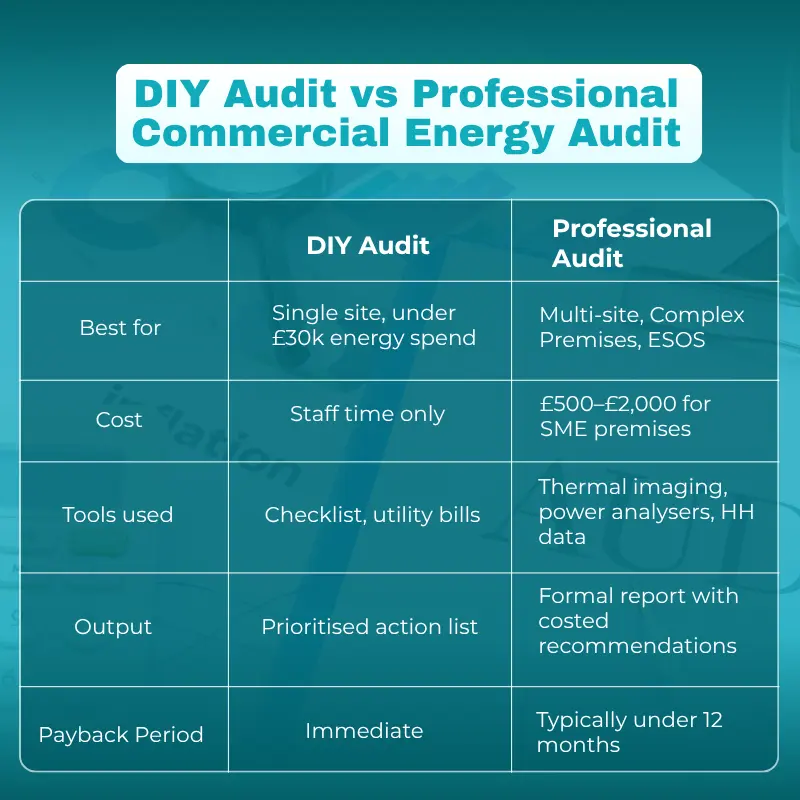
DIY Audit vs Professional Commercial Energy Audit
Before getting into the process itself, it’s worth knowing which route fits your business.
| DIY Audit | Professional Audit | |
| Best for | Single site, under £30k energy spend | Multi-site, complex premises, ESOS |
| Cost | Staff time only | £500–£2,000 for SME premises |
| Tools used | Checklist, utility bills | Thermal imaging, power analysers, HH data |
| Output | Prioritised action list | Formal report with costed recommendations |
| Payback period | Immediate | Typically under 12 months |
A professional auditor brings thermal imaging cameras to spot heat loss you’d never see with the naked eye, power analysers to measure what equipment is genuinely drawing, and half-hourly meter data to catch peak demand charges. For a business spending £80,000 a year on energy, a £1,500 professional audit that finds 15% in savings pays for itself in around six weeks.
If your business qualifies for ESOS, a professional audit signed off by a registered ESOS Lead Assessor isn’t a nice-to-have, it’s the requirement.
Step-by-Step: How to Conduct a Business Energy Audit
Step 1: Define Your Goals
Before you do anything else, decide why you’re auditing. Cost reduction, carbon reporting, ESOS compliance, and pre-renewal benchmarking all pull your focus in slightly different directions, and that shapes both what you scrutinise and how you write up the findings.
Step 2: Gather 12 Months of Energy Data
Pull electricity and gas bills covering the last full year. If you’ve got a smart meter or half-hourly meter, download the interval data too, it shows usage by time of day and makes overnight baseload waste and demand peaks obvious almost immediately.
Watch for anomalies. Unexplained spikes during quiet periods usually mean equipment left running, a heating fault, or occasionally a billing error worth pushing back on.
Step 3: Analyse Consumption Patterns
Work out monthly kWh totals for electricity and gas separately. Find your highest-consumption months and figure out why. Pay attention to your overnight baseload too, the lowest recorded usage during unoccupied hours. Anything above what your essential equipment actually needs is waste.
Step 4: Inspect Your Building Systematically
Walk every part of the premises, inside and out:
- Lighting – all LED? Occupancy sensors in toilets, storerooms, corridors? LED upgrades typically cut lighting energy use by up to 70% versus fluorescent tubes.
- HVAC – what’s the thermostat set to? Running outside occupied hours? The Energy Saving Trust notes each degree you knock off the thermostat saves roughly 8% on heating costs.
- Building fabric – check loft and wall insulation, draught-proofing around doors and windows, roller shutter seals on warehouses, and whether glazing is at least double-paned.
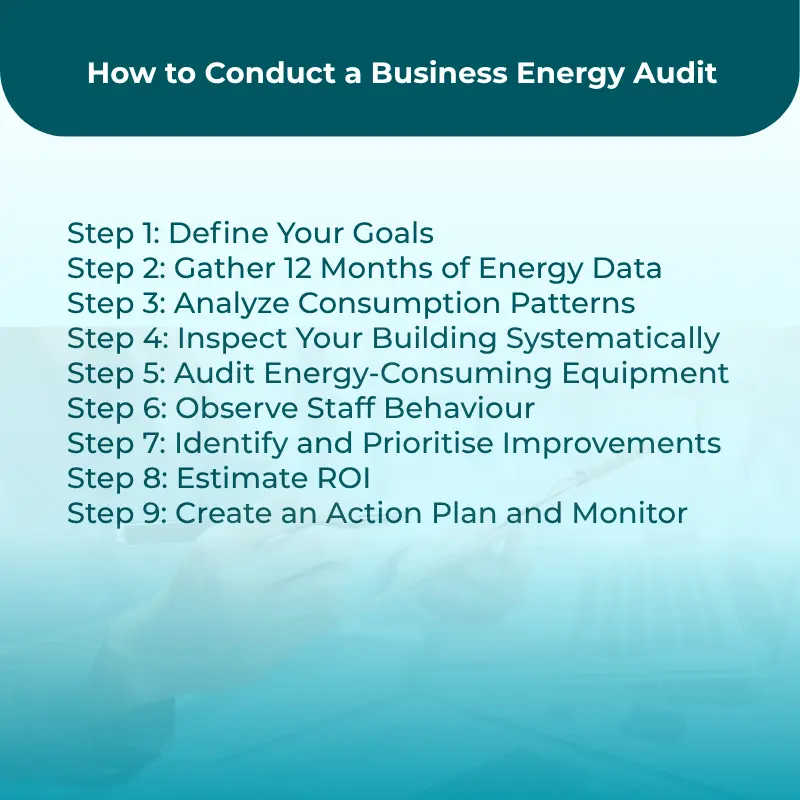
Step 5: Audit Energy-Consuming Equipment
List everything that draws meaningful power: office kit, machinery, refrigeration, kitchen appliances, compressors. Note age, condition, and how each is used. Older equipment is reliably worse, a commercial fridge from 2008 can use two to three times the energy of a current model.
Compressed air deserves close attention in manufacturing and warehouse settings. The Carbon Trust reports that leaks commonly waste 20–30% of the air being produced, making this one of the highest-impact findings you’ll come across in industrial audits.
Step 6: Observe Staff Behaviour
Walk the building at the end of the day. Look for monitors and PCs left on, lights burning in empty rooms, kit sitting on standby instead of off. A single desktop left on overnight costs roughly £35–£50 a year at current rates. An office of 20 with sloppy shutdown habits can easily lose £700–£1,000 a year on this alone.
Step 7: Identify and Prioritise Improvements
Sort what you’ve found into three tiers:
- Quick wins – free or near-free, done this week: thermostat setbacks, shutdown policies, swapping dead LEDs, sealing draughts
- Medium-term – modest spend, 6–24 month payback: occupancy sensors, smart controls, pipe insulation, servicing
- Capital projects – bigger spend, longer payback: boiler replacement, solar PV, HVAC overhaul, BEMS installation
Start with the quick wins. They show results fast, build momentum, and give you a clean baseline to measure everything else against.
Step 8: Estimate ROI
For each improvement: implementation cost ÷ annual saving = simple payback in years. Use current UK rates, roughly 26p/kWh for electricity and 6–7p/kWh for gas across most SMEs.
A £3,000 lighting upgrade that cuts consumption by 15,000 kWh a year saves around £3,900 annually at 26p/kWh, a payback of under 10 months.
Step 9: Create an Action Plan and Monitor
Write up each improvement with an owner, a budget, a target date, and an expected saving. Track monthly consumption against your pre-audit baseline. Check progress quarterly. Run the next full audit in a year.
Sector-Specific Audit Priorities
No two businesses use energy the same way, so here’s where to focus depending on what you run.
Offices: lighting and IT equipment are usually the two biggest draws. Focus on LED upgrades, monitor auto-off policies, HVAC scheduling tied to actual occupancy, and server room cooling.
Hospitality (restaurants, cafés, hotels): refrigeration and catering equipment dominate. A typical independent restaurant uses 25,000–50,000 kWh a year. Check fridge and freezer door seals, dishwasher cycle settings, hot water demand, and whether equipment actually gets switched off overnight.
Retail: refrigeration (in food retail) and display lighting are the main targets. Convenience stores and off-licences typically use 35,000–60,000 kWh a year, much of it from refrigeration running around the clock. Check setpoints, door seal condition, and anti-condensate heater controls.
Warehouses and manufacturing: HVAC, compressed air, and process machinery come first. Check compressor pressure settings (many run 10–20% higher than needed), motor efficiency, and whether heating zones actually match when areas are occupied through the day.
Business Energy Audit Checklist
| Area | What to Check | Typical Saving Potential |
| Lighting | LED throughout, sensors in low-use areas | High |
| HVAC | Boiler age and service record, thermostat setbacks | High |
| Building fabric | Insulation, draught-proofing, glazing standard | High |
| Office equipment | Auto-off settings, standby power, screen policies | Medium |
| Manufacturing/warehouse | Compressor leaks, motor efficiency, process scheduling | High |
| Refrigeration | Door seals, setpoints, overnight anti-condensate heaters | High |
| Water heating | Pipe insulation, thermostat at 60°C, tank sizing | Medium |
| Staff behaviour | Shutdown habits, thermostat discipline, lighting use | Medium |
| Smart controls | Occupancy sensors, timers, BEMS integration | Medium–High |
How an Energy Broker Maximises Audit Savings
Most energy efficiency guides stop the moment you’ve implemented your action plan. An energy broker covers the bit after that, the bit no supplier has any real incentive to bring up.
Your audit changes your energy profile. If consumption’s down, peak demand has shifted, or you’ve spotted an opportunity for on-site generation, the pricing assumptions behind your current contract no longer hold. Letting it auto-renew locks you back into rates set against your old usage.
An independent broker checks the whole market, not just the supplier you happen to be with, and looks for tariff structures that actually fit your post-audit numbers. A business that’s cut its overnight baseload significantly, for example, might do better on a time-of-use tariff with cheaper off-peak rates. A business with lower, more predictable consumption can often secure a better fixed rate just by showing suppliers that improved demand profile.
Brokers also help with timing. If you’re mid-contract and planning a boiler replacement or LED rollout, locking in a new contract now, before that consumption drop takes effect, can mean you benefit from the lower post-improvement bill for the entire contract term, rather than waiting until renewal.
Five Common Business Energy Audit Mistakes
- Only reviewing bills
- Ignoring overnight baseload
- Not checking compressed air
- Skipping staff behaviour
- Renewing contracts before implementing savings
The biggest mistake businesses make isn’t skipping the audit, it’s renewing an energy contract before updating suppliers with their improved consumption profile
Frequently Asked Questions
Is a business energy audit legally required in the UK?
Not for most businesses. But organisations with 250+ employees, or turnover above £44 million and a balance sheet above £38 million, must comply with ESOS, a mandatory scheme requiring a formal audit every four years. ESOS Phase 4’s deadline is 5 December 2027. Full details are on GOV.UK.
How much does a business energy audit cost?
A DIY audit costs nothing beyond your time. A professional audit for a single-site SME usually runs £500–£2,000, rising to £5,000 or more for large or multi-site premises. Some brokers include a basic audit review as part of their procurement service, worth asking about before paying full price.
How much can a business save from an energy audit?
Businesses that act fully on their findings typically cut consumption by 10–25%. At current rates, a business spending £30,000 a year on energy could save £3,000–£7,500 annually from a well-run audit and action plan.
How often should a business perform an energy audit?
Annually, at minimum. Businesses going through major change, new premises, big equipment changes, rapid headcount growth, should do an interim review rather than waiting for the next yearly cycle.
Can small businesses do their own energy audit?
Yes. A DIY audit with a structured checklist is well within reach for any SME owner or office manager, no specialist equipment required. Combine 12 months of bill data with a systematic walk-around and you’ll catch most of the common waste in a single working day.
Conclusion
A business energy audit is the most cost-effective starting point for any UK business looking to cut energy bills, lower emissions, and build a sustainability position that holds up to scrutiny. Even a basic DIY audit, a structured checklist combined with a year of bill data, tends to find savings that far outweigh the time it takes.
What separates businesses that actually benefit from audits and those that don’t usually isn’t the audit itself. It’s what happens next: a prioritized plan, consistent tracking, and a procurement strategy that turns efficiency gains into savings at the contract level.
If you’ve just finished an audit, or you’re planning one, talk to an independent energy broker before your next renewal. Your improved energy profile is leverage; use it.
Sources & further reading: