
Author: Abdullah Shoaib | Energy Markets Analyst, 10+ years in the energy industry
Last updated: September 2026
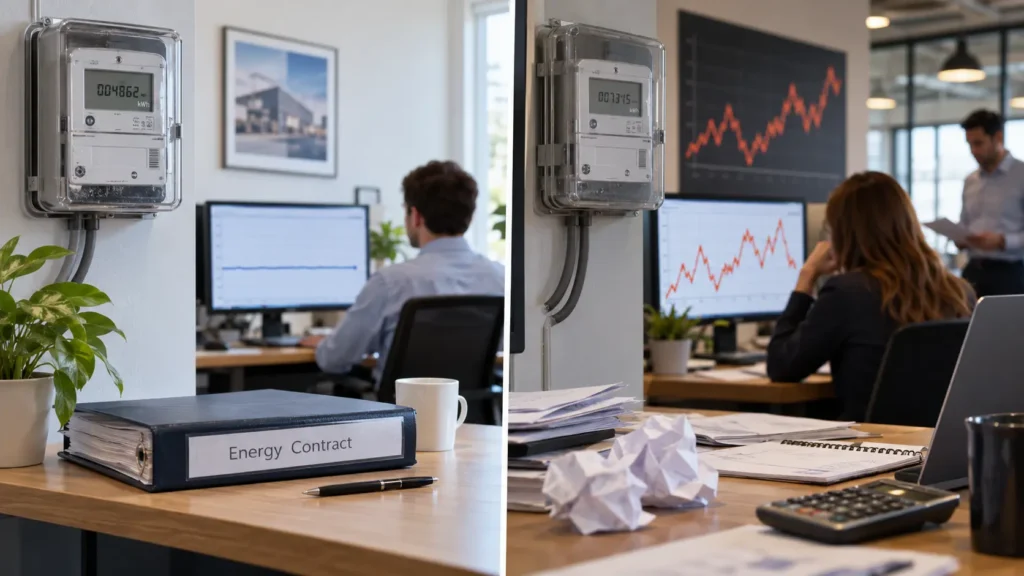
Fixed vs variable business electricity comes down to one main trade-off: price certainty versus exposure to changing energy prices.
A fixed business electricity contract normally fixes the agreed unit rate and standing charge for a defined period. A variable contract allows the price you pay for energy to rise or fall during the agreement.
Neither is automatically cheaper.
The better option depends on how much electricity your business uses, how important predictable costs are, how long you are comfortable committing and what would happen to your margins if electricity prices moved against you.
Quick answer: Fixed business electricity gives you greater certainty over your agreed rates. Variable electricity gives you more flexibility and potential exposure to falling prices, but also leaves you more exposed if rates rise. The right choice depends on your consumption, cash flow, contract terms, future plans and ability to absorb price changes.
Ofgem’s current guidance describes a fixed-rate business contract as one where unit rates and standing charges are fixed for the contract term. Variable-rate contracts allow the price paid for energy to increase or decrease during the agreement. Business energy contracts can run for up to five years.
Fixed vs Variable Business Electricity at a Glance
| Factor | Fixed Business Electricity | Variable Business Electricity |
|---|---|---|
| Unit rate | Agreed for the contract term, subject to contract conditions | Can increase or decrease |
| Standing charge | Normally fixed under a standard fixed-rate contract | May change depending on the contract |
| Total bill | Still changes with consumption | Changes with consumption and rates |
| Price certainty | Higher | Lower |
| Exposure to price rises | Lower for the fixed elements | Higher |
| Benefit if market prices fall | Usually limited until the fixed term ends | Potentially greater |
| Contract commitment | Usually stronger | Generally more flexible |
| Early switching | Usually governed by contract and switching-window rules | Ofgem says variable-rate customers can switch at any time |
| Budget forecasting | Easier | Less predictable |
| Main trade-off | Certainty versus commitment | Flexibility versus price exposure |
That is the basic difference.
The more useful question is what each option means for your business.
What Is a Fixed Business Electricity Contract?
A fixed business electricity contract agrees the rates you will pay for a set period.
If comparable market prices rise after you sign, your contracted unit rate does not normally rise with them.
If prices fall, you do not automatically receive the lower market rate either. You continue paying the rate agreed under your contract unless its terms contain another pricing mechanism.
That is what you are buying with a fixed contract:
certainty, not a guarantee of the cheapest future price.
A fixed rate does not mean a fixed electricity bill
This is one of the most common misunderstandings I see.
Suppose your business agrees an electricity rate of 25p/kWh.
At 40,000 kWh annual consumption:
40,000 × £0.25 = £10,000
At 60,000 kWh:
60,000 × £0.25 = £15,000
The rate did not change.
Your consumption did.
A fixed tariff therefore makes the agreed rate more predictable. It does not make your total electricity bill identical every month.
That matters if your consumption changes because of:
- longer opening hours;
- higher production;
- new machinery;
- additional premises;
- EV charging;
- seasonal demand;
- heating or cooling requirements.

What Does “Fixed” Actually Mean?
Do not judge a business electricity contract from the word fixed alone.
Ofgem’s standard definition is clear: a fixed-rate contract fixes unit rates and standing charges for the contract term. However, Ofgem also warns that some contracts may contain conditions allowing a supplier to change the rate during the agreement.
Commercial products can also be structured differently.
For example, British Gas Business currently advertises a Fixed Wholesale Energy product for commercial landlords where the wholesale energy rate is fixed but regulated non-commodity costs may vary.
That is why I would ask:
- What exactly is fixed?
- Can any regulated or third-party costs change?
- Are network charges included in the fixed price or passed through?
- Can new regulated charges be added under the contract?
- What happens if consumption changes significantly?
Two quotations can both use the word fixed while carrying different levels of cost certainty.
Read what is actually being fixed.

What Are the Advantages of Fixed Business Electricity?
The main advantage is predictability.
If energy represents a meaningful operating cost, knowing your agreed rates makes budgeting easier.
Think about a restaurant, bakery, retailer or manufacturer operating on narrow margins.
The business may already be managing changes in:
- wages;
- rent;
- ingredients or raw materials;
- insurance;
- transport;
- stock.
An unexpected movement in electricity costs is another variable to absorb.
A fixed contract removes some of that uncertainty for an agreed period.
That can make:
- cash-flow forecasting;
- customer pricing;
- annual budgeting;
- margin planning
easier to manage.
You also do not need to react to every short-term movement in wholesale energy markets.
Once you have agreed the contract, you have made the procurement decision for that period.
What Are the Disadvantages of Fixed Business Electricity?
The trade-off is commitment.
If comparable market rates fall after you sign, your existing contract does not normally fall with them.
That does not necessarily mean you made the wrong decision.
You chose certainty when the future price was unknown.
The more important problem is committing for longer than the business itself can justify.
I would examine a long fixed contract carefully if you expect to:
- move premises;
- reach the end of a lease;
- sell the business;
- close a site;
- significantly reduce operations;
- materially change electricity consumption.
Your energy strategy needs to fit the business plan.
Can you leave a fixed business electricity contract early?
Sometimes, but do not assume you can.
Ofgem says most suppliers will not allow a business to switch before a fixed contract ends unless a termination clause has already been agreed or an exit fee is paid.
Fixed contracts also have a switching window before the contract ends. The exact timing and conditions depend on the agreement.
So before signing, do not ask only:
“What rate am I getting?”
Ask:
“What am I committing the business to in return for that rate?”
What Is a Variable Business Electricity Contract?
A variable business electricity contract allows the price you pay for energy to increase or decrease during the agreement.
Ofgem says this may happen because prices change as wholesale market costs change.
But there is an important distinction.
Your electricity rate does not necessarily follow wholesale electricity prices pound-for-pound.
Wholesale energy is only one part of the cost of supplying electricity.
Ofgem said in March 2026 that wholesale costs can typically account for around 40% of a business electricity bill, although the exact proportion varies. Network costs, environmental costs and other charges also contribute.
So if one wholesale market indicator falls by 10%, that does not mean your business electricity rate should automatically fall by 10%.
The tariff structure and supplier pricing still matter.

What Are the Advantages of Variable Business Electricity?
The main advantage is flexibility and potential exposure to falling prices.
If the costs affecting your tariff fall and those reductions feed through to your rate, you may benefit without waiting for a fixed contract to expire.
Variable contracts can also make switching easier.
Ofgem currently says businesses on variable-rate contracts can switch to another supplier at any time.
That can be useful where the business is changing quickly.
For example:
- your lease may end soon;
- you may be relocating;
- a site may be sold;
- consumption may change materially;
- you may not want to commit for several years.
The trade-off is obvious.
The rate can also move against you.
What Are the Disadvantages of Variable Business Electricity?
The biggest disadvantage is cost uncertainty.
If your rate increases, your operating costs increase with it.
How serious that is depends on consumption.
A 1p/kWh difference means:
| Annual Electricity Consumption | Annual Effect of 1p/kWh |
|---|---|
| 10,000 kWh | £100 |
| 25,000 kWh | £250 |
| 50,000 kWh | £500 |
| 100,000 kWh | £1,000 |
| 500,000 kWh | £5,000 |
| 1,000,000 kWh | £10,000 |

That is why I would not describe variable electricity simply as risky and fixed electricity as safe.
Risk depends on the business.
An extra £500 a year may be immaterial to one company.
For another, especially one operating on tight margins, it may matter.
For a high-consumption business, a relatively small movement in pence per kWh can translate into a significant change in annual expenditure.
The useful question is:
How much price movement can your business comfortably absorb?
Fixed vs Variable Business Electricity: Which Is Better?
There is no universal winner.
I would make the decision based on the consequences of each option rather than trying to predict which tariff will look cheapest afterwards.
| Business Situation | What I Would Focus On |
|---|---|
| Tight margins | Financial impact of an unexpected increase |
| Predictable long-term operations | Value of rate certainty |
| Possible premises move | Contract commitment and tenancy terms |
| Lease ending soon | Avoiding unnecessary long-term commitment |
| High electricity consumption | Financial impact of every p/kWh movement |
| Low electricity consumption | Total annual cost, including standing charge |
| Rapidly changing business | Flexibility |
| Stable long-term site | Ability to consider longer contract terms |
| Large sophisticated energy user | Whether flexible procurement should also be considered |
This is more useful than saying:
“Fixed is better when prices are rising.”
or:
“Variable is better when prices are falling.”
Both statements require you to know where prices go next.
You do not.

Is a 1-Year, 2-Year or 3-Year Fixed Contract Better?
Contract length changes two things:
how long you have certainty and how long you remain committed.
A one-year contract gives you a shorter period of certainty and brings you back to the market sooner.
A two- or three-year contract extends the certainty.
Longer contracts can extend it further; Ofgem says business contracts can run for up to five years.
That does not make a shorter contract safer or a longer contract better.
Imagine two businesses receive the same three-year quotation.
Business A owns its premises, has predictable production and expects consumption to remain broadly stable.
Business B has 14 months remaining on its lease and may relocate.
The energy market is identical.
Their commercial circumstances are not.
That is why contract duration should be decided in the context of the business, not simply from a prediction about electricity prices.
Ask:
How long do I need certainty, and how long am I comfortable committing to today’s terms?
Should You Fix Business Electricity in 2026?
There is no responsible answer that says every UK business should fix or remain variable in 2026.
Ofgem said on 31 March 2026 that wholesale energy costs remained volatile and network costs were increasing. It advised businesses approaching renewal to look at both short- and long-term contract options.
Ofgem also made an unusually important point.
It said that in some circumstances it may be worth temporarily remaining on deemed or out-of-contract rates if current longer-term offers are particularly high. At the same time, its wider guidance says deemed and out-of-contract rates are usually more expensive than negotiated contracts.
I would not treat that as a recommendation to stay out of contract.
I would treat it as evidence that there is no automatic answer.
The decision should be based on:
- the live quotes available to your business;
- contract duration;
- exactly what is fixed;
- consumption;
- cash flow;
- premises plans;
- the financial impact if prices move.
Trying to identify the exact top or bottom of the wholesale market is not something I would build a business procurement decision around.
Don’t Compare Business Electricity Quotes on Unit Rate Alone
This is one of the most expensive-looking mistakes because the cheaper p/kWh figure can still produce the more expensive contract.
Take a simplified example for a business consuming 50,000 kWh per year:
| Quote A | Quote B | |
|---|---|---|
| Unit rate | 24.5p/kWh | 25p/kWh |
| Standing charge | £1.50/day | £0.60/day |
| Annual usage cost | £12,250 | £12,500 |
| Annual standing charge | £547.50 | £219 |
| Combined annual amount | £12,797.50 | £12,719 |
Quote A has the cheaper unit rate.
Quote B has the lower combined annual figure.
This example deliberately excludes VAT, Climate Change Levy and any other contract-specific costs. Its purpose is to show why pence per kWh should not be viewed in isolation.
A useful starting calculation is:
Estimated annual electricity cost = annual consumption × unit rate + annual standing charge
Then check everything else the contract includes.
For a high-consumption business, small differences in unit rate matter because they apply to every kWh.
For a very low-use site, the standing charge can form a much larger percentage of total spend.
Compare the total commercial offer.
Not one number.
Variable Tariff, Out-of-Contract and Deemed Rates Are Not the Same Thing
This distinction is frequently blurred online.
Variable contract
Variable describes a pricing arrangement where the amount you pay can rise or fall during the contract.
Out-of-contract rate
Out-of-contract describes your contractual position when a previous agreement ends and its terms specify the rates that will apply afterwards.
Deemed contract
A deemed contract commonly arises when you move into business premises and start using energy before arranging a negotiated contract.
Ofgem also says deemed arrangements can arise in certain other circumstances, including when an existing contract expires without setting out what happens next.
Deemed and out-of-contract rates are usually more expensive than negotiated contract rates.
So do not use variable, deemed and out-of-contract as interchangeable terms.
One describes how pricing behaves.
The others describe contractual status.
What Happens When a Fixed Business Electricity Contract Ends?
Your electricity supply does not simply stop.
What happens financially depends on the agreement.
You may:
- negotiate a new contract with the existing supplier;
- switch supplier;
- move onto out-of-contract rates;
- enter a rollover or evergreen arrangement;
- move onto deemed rates in circumstances where those rules apply.
Ofgem says rollover arrangements can automatically renew a contract, generally for another fixed period, and may be priced higher. Microbusinesses cannot have a rollover contract lasting more than 12 months.
The practical lesson is simple:
Know what your contract says will happen before the end date arrives.
Do not discover it from the first bill afterwards.
Are Business Electricity Prices Protected by the Ofgem Price Cap?
No.
Business energy contracts are not protected by the domestic Ofgem energy price cap.
Ofgem’s price cap applies to qualifying domestic standard variable/default tariffs. Its guidance specifically lists business energy contracts among those not protected by the cap.
This matters because headlines saying:
“The energy price cap is rising”
or:
“The price cap is falling”
can easily be mistaken for business-energy pricing announcements.
They are not.
Domestic cap movements may reflect some wider energy-market pressures, but they do not determine your commercial electricity contract.
Your business rate is priced separately.
What About Flexible Business Electricity Procurement?
For many SMEs, the practical decision will remain fixed versus variable.
For larger energy users, that may be too simple.
Ofgem recognises flexible or structured contracts, where businesses can buy energy in smaller portions rather than locking the entire requirement at one price and one time. These products are generally aimed at larger users.
The benefit is that you do not commit the entire volume at one market point.
The trade-off is that somebody needs to manage the buying strategy.
As a current market example, British Gas Business offers Flex Advantage to businesses consuming more than 1 GWh a year, with energy purchased in tranches rather than all at once.
Flexible procurement is not simply a more sophisticated variable tariff.
It is a different procurement strategy.
For a typical SME, a straightforward fixed or variable contract may be easier to manage.
For a large user, fixed versus variable may not be the whole conversation.
What If Your Business Moves Premises?
Do not assume moving premises automatically means you can leave the existing contract without consequences or that an exit fee must automatically apply.
Check the agreement.
Ofgem advises businesses moving premises to:
- review the existing contract;
- tell the existing supplier;
- check whether the account is in credit or debt;
- arrange supply at the new premises where possible.
If you move into a site and start consuming electricity before arranging a contract, you may initially be supplied under a deemed contract.
If you may relocate during the proposed contract term, deal with that question before signing.
A five-year rate can look attractive today.
It is much less attractive if the agreement does not fit where the business expects to operate in two years.
When Should You Start Comparing Business Electricity Contracts?
Do not leave contract review until the expiry date.
Ofgem says fixed business contracts have a switching window before they end. The exact window and notice requirements depend on the contract.
Starting earlier gives you time to establish:
- current annual consumption;
- existing unit rate;
- standing charge;
- contract end date;
- switching window;
- supplier offers;
- available contract lengths;
- what each quotation actually fixes;
- early-termination provisions;
- broker fees or commission;
- what happens when the new contract ends.
That is the information I would want in front of me before deciding.
What Should You Check Before Signing a Business Electricity Contract?
Before agreeing anything, I would want clear answers to these questions:
- What is the unit rate?
- What is the standing charge?
- What exactly is fixed?
- Which charges, if any, can change?
- What are the start and end dates?
- What is the estimated annual cost using my actual consumption?
- What are the early-termination conditions?
- What happens if consumption changes significantly?
- What happens if I move premises?
- When can I switch supplier?
- What happens at contract expiry?
- Are there security-deposit or payment conditions?
- Is a broker fee or commission included?
- Which suppliers were actually compared?
This is particularly important because business energy contracts do not have the same cooling-off protection many people are familiar with from domestic contracts.
Ofgem’s current business guidance says there is no cooling-off period after you agree to the contract and recommends checking terms carefully before committing. Its March 2026 guidance also advises businesses discussing contracts by phone to ask for the offer in writing before agreeing.
A slightly cheaper rate is not valuable if the contract itself does not fit your business.
If You Use an Energy Broker, Check How They Are Paid
A broker can save time by obtaining and comparing supplier offers.
But you should still understand:
- which suppliers were compared;
- whether the broker searches the whole market;
- what service the broker provides;
- how the broker is paid;
- how much commission or fee is included.
Ofgem says broker fees or commissions included in the energy bill should be disclosed in the contract’s Principal Terms, and businesses can request information about these costs.
Ofgem’s July 2026 good-practice guidance also says intermediaries should clearly explain pricing, contract length, renewal terms, termination conditions, early-exit fees and commission arrangements before the customer agrees.
I would ask those questions before signing.
Not after the first bill.
Three Mistakes I Would Avoid
1. Choosing the lowest unit rate without calculating annual cost
The cheapest-looking p/kWh figure does not necessarily produce the lowest annual bill.
Include the standing charge and other applicable costs.
2. Trying to perfectly time the energy market
“Never fix when prices are high” sounds sensible until you ask how you know, at the time, that today’s price is the peak.
You normally know afterwards.
A stronger decision is to ask whether the available price and contract risk are commercially acceptable.
3. Treating contract length as an energy-market decision only
Your lease, site plans, cash flow, expansion plans and likely consumption can matter just as much as your view of future wholesale prices.
The contract needs to fit the business.
Not only the market.
Fixed vs Variable Business Electricity: A Practical Decision Framework
When I look at this decision, I would ask three questions.
1. What happens if electricity prices rise?
Calculate the impact.
If another 2p/kWh would materially affect margins, certainty may have meaningful commercial value.
At 100,000 kWh a year, 2p/kWh represents £2,000 before considering any other changes.
2. What happens if prices fall after you fix?
Would you be comfortable remaining on the agreed rate because the business had certainty?
Or would losing the ability to benefit from lower market rates create a problem?
That tells you something about your tolerance for commitment.
3. What might change inside the business?
Think beyond electricity.
Could you:
- relocate?
- expand?
- reduce production?
- sell the business?
- close a site?
- install solar?
- electrify heating or vehicles?
- materially change operating hours?
A sensible energy contract needs to fit the business you expect to operate during the term.
So, Is Fixed or Variable Business Electricity Better?
Neither is universally better.
A fixed electricity contract gives your business greater certainty over the agreed rates. In return, you usually accept a stronger contractual commitment and do not automatically benefit if comparable market prices fall.
A variable contract gives you more exposure to changing prices. That may work in your favour when rates fall, but it can increase your costs when rates rise.
For larger electricity users, flexible procurement may add another option.
So I would not begin with:
“Which tariff will be cheapest?”
I would begin with:
“Which type of risk is my business better equipped to manage?”
If unpredictable electricity costs would materially affect margins, cash flow or budgeting, the certainty of a fixed contract may carry real value.
If flexibility matters more and the business can comfortably absorb changing rates, variable pricing may be appropriate.
There is no contract type that guarantees the lowest future price.
A good commercial energy decision is one where you understand the price, commitment and risk before you agree to it.
Frequently Asked Questions
Is fixed or variable business electricity cheaper?
Neither is automatically cheaper.
If comparable market rates rise after you sign a fixed contract, your agreed rate may look more attractive relative to new offers. If market costs fall, a variable tariff may benefit if those reductions are reflected in its pricing.
Because future rates cannot be known with certainty, compare the contracts actually available rather than assuming one tariff type always costs less.
Does a fixed electricity tariff mean my business bill cannot increase?
No.
A fixed tariff normally fixes the agreed unit rate and standing charge, not the amount of electricity your business consumes.
If usage rises, the total bill rises.
You should also check the contract carefully because some commercial products allow particular pricing components to change.
Can variable business electricity rates fall?
Yes.
Variable prices can increase or decrease during the agreement.
However, your tariff should not be assumed to follow wholesale electricity prices exactly. Wholesale energy is only one part of the overall cost of supplying electricity.
Can I leave a fixed business electricity contract early?
It depends on the contract.
Ofgem says most suppliers will not allow a business to switch before the fixed contract ends unless an agreed termination clause applies or an exit fee is paid.
Check the agreement before assuming early termination is available.
Can I switch from a variable business electricity contract?
Ofgem says businesses on variable-rate contracts can switch supplier at any time.
You should still check your account and contractual position before starting the switch.
Is a one-year fixed business electricity contract better than three years?
Not automatically.
One year means a shorter commitment and an earlier return to the market.
Three years provides certainty for longer.
The better term depends on the prices being offered, your business plans and how long you want to commit.
What happens when my fixed business electricity contract ends?
Depending on the agreement, you may negotiate another contract, switch supplier, move onto out-of-contract rates or enter a rollover arrangement.
Deemed rates can apply in certain circumstances where energy is being supplied without a negotiated contract.
Check your contract well before expiry.
Are business electricity prices capped by Ofgem?
No.
The domestic energy price cap does not protect business energy contracts.
Should I wait for electricity prices to fall before fixing?
Only if your business is comfortable carrying the risk that prices could rise instead.
Waiting can work in your favour if rates fall.
It can cost more if they rise before you act.
I would compare the contracts currently available and decide whether their price, term and risk fit the business rather than trying to identify the exact bottom of the market.
Is an out-of-contract rate the same as a variable tariff?
No.
Variable describes how pricing can change.
Out-of-contract describes the contractual position that can apply after a previous agreement ends.
An out-of-contract rate may have variable pricing, but the terms do not mean the same thing.
Compare the Contract, Not Just the Rate
The cheapest-looking electricity rate is not automatically the best business electricity contract.
Before committing, compare:
- unit rate;
- standing charge;
- estimated annual cost;
- contract duration;
- what is genuinely fixed;
- what can change;
- termination conditions;
- switching arrangements;
- broker costs;
- what happens when the agreement ends.
Then consider those terms against your consumption, cash flow and future business plans.
That gives you a much stronger basis for choosing between fixed and variable business electricity than trying to predict exactly where the energy market will move next.
If your existing contract is approaching renewal, Energy Solutions can help you compare available business electricity options, understand the contract terms and assess the commercial differences before you make a decision.