

Most UK businesses are paying higher business gas prices than they actually need to.The frustrating part? Many owners only realise it when the bill lands on their desk and the number makes them pause for a second. Sound familiar?
In most cases, the reason is surprisingly simple. A business gas contract quietly rolls over onto expensive out-of-contract rates, or the business stays with the same supplier for years without ever running a proper comparison. It’s a bit like renewing your car insurance automatically every year without checking the market, convenient, yes, but often far more expensive than it needs to be.
Here’s a quick question worth asking yourself right now: When was the last time you actually checked your business gas rate? Last month… last year… or can’t quite remember? If it’s the last one, you’re definitely not alone.
When contracts roll over unnoticed, the unit rate and standing charges on your bill can creep up well above what suppliers are offering new customers today. That small difference in pence per kWh might look harmless at first glance, but across a full year it can quietly turn into thousands of pounds leaving your business.
Whether you run a small shop, manage a commercial building, or oversee energy costs for a larger organisation, understanding business gas rates is one of the quickest financial wins available. In fact, many businesses reduce their energy costs simply by asking one question: “Am I actually on a competitive rate?”
This guide is designed for businesses at every stage. Maybe you’ve never compared commercial energy before, or maybe you already review tariffs but want to be sure you’re not missing a better deal. Either way, by the end you’ll know:
- What a competitive business gas rate looks like in 2026
- What factors are really driving the price on your bill
- And how to find a better deal without spending half your day on the phone with suppliers
Because let’s be honest, energy shouldn’t be the most complicated part of running your business. But saving money on it definitely should be the easiest.
Are You Paying Too Much for Business Gas? Here’s How to Tell
A lot of UK companies don’t catch the problem until they take a proper look at their bill alongside current market prices. If your energy costs have been creeping up over the past year, the issue may not be how much gas you’re using. It may simply be the tariff you’re on.
Your business gas bill tells you more than most people realise. The two numbers that matter most are the unit rate (what you pay per kWh of gas) and the daily standing charge. Together, those two figures account for the bulk of what you’re paying, whether you run a café, a small office, or a mid-sized manufacturing site.
What “Too Much” Actually Looks Like in 2026
As of March 2026, typical business gas prices on a one-year fixed contract average around 6p per kWh for most UK businesses. That’s a reasonable benchmark to work from, though your actual quote will vary based on your location, meter type, consumption level, and contract length.
Here’s the warning sign worth knowing: if your current unit rate is above 9p or 10p per kWh, there’s a strong chance you’ve slipped onto a deemed or out-of-contract tariff. Those aren’t competitive rates. They’re what suppliers charge when there’s no active agreement in place.
A straightforward way to check your position is:
Annual Usage (kWh) x Your Unit Rate = Annual Gas Spend
If your business uses 50,000 kWh a year and you’re paying 10p per kWh, you’re spending around £5,000 on gas. On a properly negotiated 6p rate, that same usage would cost £3,000. That’s £2,000 a year saved without changing how much gas you use.
The Hidden Trap: Out-of-Contract and Deemed Rates
This is where most businesses quietly lose money. The contract expires, no new deal gets arranged, and the supplier moves the account onto temporary pricing. Nobody sends a warning. It just happens.
Those temporary rates are rarely kind. In many cases, the price per kWh can be two to four times higher than what you’d pay under a negotiated fixed deal. A business that should be paying around 6p per kWh could find itself on 12p or 15p without realising anything has changed.
It’s an easy trap to fall into. When you’re running a business, a contract renewal date isn’t always at the front of your mind. But most suppliers will let you lock in a new tariff six to twelve months before your current contract ends. That window is your best opportunity to compare prices and secure something competitive before the rollover happens.
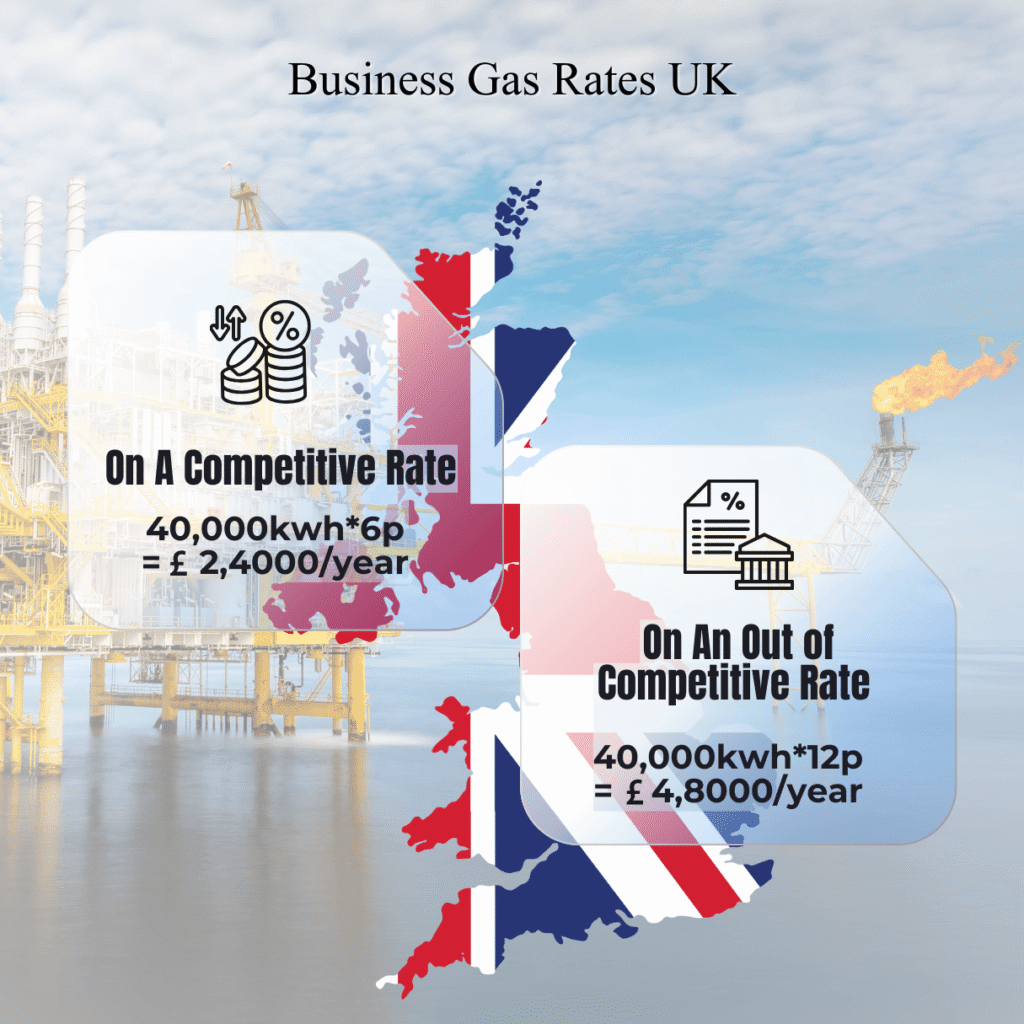
To put it in real terms: a café using 40,000 kWh a year on a competitive 6p rate pays around £2,400 for gas. On an out-of-contract rate of 12p, that same café pays £4,800. The gas usage hasn’t changed. The bill has doubled.
A simple habit prevents this: check your contract end date once a year and get a few fresh quotes before it arrives.
What is a deemed rate for business gas?
A deemed rate is a temporary tariff that a supplier applies automatically when a business moves into new premises or continues using gas without agreeing to a formal contract. Because there’s no negotiated deal in place, the unit price is almost always significantly higher than standard market rates.
Understanding Business Gas Rates: A Plain-English Breakdown
Business energy bills can look confusing at first glance, but they’re built from a small number of components. Once you understand what each charge actually represents, comparing suppliers becomes much more straightforward.
What Is a Unit Rate and Why Does It Matter?
The unit rate is the price you pay for each kWh of gas your business consumes, expressed in pence per kWh.
It’s the single most important number when comparing tariffs. Suppliers will often present attractive annual estimates in their quotes, but those figures are calculated using your specific consumption level. The unit rate is what lets you compare fairly across different suppliers, regardless of how much gas you use.
Think of it like fuel: the price per litre is what tells you whether one petrol station is cheaper than another, not the total cost of a full tank. The same logic applies to your gas bill.
One practical tip worth remembering: when you’re reviewing quotes, always look at both the unit rate and the standing charge together, not just the headline annual estimate.
What Is a Standing Charge on a Business Gas Bill?
The standing charge is a fixed daily fee for maintaining the gas supply to your premises. It covers things like meter maintenance, distribution network costs, and account administration. You pay it whether you use gas that day or not.
There’s a pattern worth knowing here. Larger businesses with higher consumption tend to receive lower unit rates but pay higher standing charges. Smaller businesses often see the reverse: slightly higher unit rates but lower daily charges. Neither structure is inherently better; it depends on your usage profile. The point is that you need to compare the full tariff, not just one part of it.
CCL, VAT, and Other Charges That Quietly Inflate Your Bill
Two additional costs sit on top of the unit rate and standing charge, and they catch a lot of businesses off guard.
The first is the Climate Change Levy, a government tax applied to most commercial energy use. It’s designed to encourage businesses to reduce consumption and improve efficiency. Most businesses pay it automatically unless they’re on certain green tariffs or qualify for an exemption.
The second is VAT. Most UK businesses pay the standard 20% VAT rate on their gas. However, micro businesses and certain eligible organisations pay just 5%. This reduced rate also applies to businesses consuming under approximately 4,397 kWh per month.
If you’re a charity, a not-for-profit, or a smaller business that falls under that consumption threshold, it’s worth asking your supplier for a VAT declaration form. A surprising number of organisations miss this and end up paying the higher rate when they don’t need to.
Average UK Business Gas Rates, March 2026
Last updated: March 2026
| Business Size | Average Unit Rate (p/kWh) | Average Annual Cost |
| Micro Business | ~7.4p | ~£1,800 |
| Small Business | ~7.2p | ~£2,500 |
| Medium Business | ~7.1p | ~£6,000 |
| Large Business | ~7.0p | £10,000+ depending on usage |
These figures reflect typical prices on fixed-rate contracts across the UK market. Your actual quote will vary based on your location, meter type, consumption, and contract terms.
What Affects Your Business Gas Rate?
If you’ve ever requested two quotes and been surprised by how different they are, there are usually clear reasons behind it. Some factors are completely outside your control. Others are decisions you can actively influence.
Factors Outside Your Control
The wholesale gas market sets the floor for every commercial rate in the UK. When wholesale prices rise, supplier tariffs follow. Global events, supply disruptions, seasonal demand, and UK storage levels all play a role. The UK’s reliance on imported liquefied natural gas also makes domestic prices more sensitive to international shifts than many business owners realise.
None of this can be managed directly. But understanding it helps explain why prices change and why locking in a rate at the right time matters.
Factors You Can Control and Optimise
This is where the real opportunity sits.
Contract type is the most fundamental decision. A fixed-rate contract locks your unit price for the duration of the agreement, which is useful for budgeting and protects you if wholesale prices rise. A variable-rate contract moves with the market, which can work in your favour when prices fall but creates uncertainty. Flexible contracts, typically used by larger businesses, allow gas to be purchased in stages, giving more control over timing and cost.
Contract length is also worth considering carefully. Longer deals, often two or three years, can offer lower unit rates. The trade-off is reduced flexibility if market prices drop.
Timing your renewal has more impact than most businesses give it credit for. Starting your comparison six to twelve months before your contract ends puts you in the strongest negotiating position and gives you enough time to avoid the rollover trap.
Consumption accuracy matters too. Providing suppliers with precise usage data rather than estimates typically results in more competitive quotes. If you have a smart meter, use the data it provides.
Business credit rating is something worth being aware of. Some suppliers factor this in when deciding which tariffs they’ll offer. Strong credit can open up better deals.
How to Compare and Switch Business Gas Rates in 5 Steps
Switching suppliers is simpler than most businesses expect. Here’s how to do it without it becoming a project.
Step 1: Gather your current contract details
Pull out your latest gas bill. You’ll need your MPRN (Meter Point Reference Number), your current unit rate, daily standing charge, contract end date, and annual consumption in kWh. If you can’t find your MPRN on the bill, you can request it by calling 0870 608 1524.
Step 2: Know your usage
Suppliers group businesses into consumption bands when calculating quotes. Knowing which band you fall into helps you understand the rates you’re likely to be offered. Check the kWh figures on your bill or pull the data from your smart meter if you have one.
Step 3: Decide what matters beyond price
The cheapest unit rate isn’t always the right choice. Think about contract length, billing preferences, customer service reputation, and whether a green gas tariff fits your sustainability goals. Getting clear on your priorities before you compare makes the decision much easier.
Step 4: Compare live quotes
Use a trusted comparison service to see current offers from multiple suppliers. When reviewing quotes, compare the total annual cost rather than just the unit rate. Standing charges and CCL can make a significant difference to the final figure, and a low headline rate can sometimes mask a higher overall cost.
Step 5: Switch without disrupting your supply
Switching supplier does not affect your gas supply. The physical network stays the same. Only the account management changes.
If you’re not sure who currently supplies your gas, the Meter Point Administration Service can help. You’ll need your MPRN or your postcode and the first line of your address. Most switches complete within two to six weeks.
Fixed vs. Variable Business Gas Contracts: Which Is Right for You?
The contract type you choose has a bigger impact on your costs than many businesses realise, and the right answer depends on your circumstances.
Fixed-Rate Contracts: Predictability and Protection
A fixed-rate contract locks your unit price for the length of the agreement, typically one to three years. Your rate doesn’t change when wholesale prices move, which makes budgeting straightforward and protects you if the market rises during your contract term.
This works well for businesses that value cost certainty, particularly those managing tight margins or operating in sectors where overheads need to be predictable.
Variable Rate Contracts: Flexibility at a Price
A variable-rate contract tracks the wholesale market, so your unit price can go up or down. When prices fall, you benefit. When they rise, your bill follows.
This can suit businesses on short-term leases, those expecting to change their premises soon, or those comfortable managing some price uncertainty in exchange for flexibility.
The honest verdict: for most UK SMEs in 2026, a fixed-rate contract is the lower-risk option. Wholesale markets remain uncertain, and the predictability of a fixed deal is worth more to most businesses than the potential upside of a variable rate. That said, if your situation involves genuine short-term uncertainty about your premises or usage, a variable contract may make more sense for now.
Business Gas Rates: Frequently Asked Questions
What is a good business gas rate per kWh in the UK right now?
A competitive business gas rate in the UK in 2026 is around 6p to 7.5p per kWh on a fixed one-year contract. The exact figure depends on your business size, location, and consumption level. If your current rate is above 9p to 10p, it’s worth comparing quotes.
How do I find out my current business gas supplier?
Check your most recent gas bill, which should show your supplier’s name and contact details. If you don’t have a recent bill, you can use the Meter Point Administration Service online tool or call 0870 608 1524 with your MPRN or address details.
Is business gas cheaper than domestic gas?
Not always. Domestic gas benefits from the energy price cap, which offers a degree of price protection that doesn’t apply to most businesses. However, larger businesses with higher consumption can negotiate competitive commercial rates that rival domestic pricing.
What is a deemed rate and how do I know if I’m on one?
A deemed rate is a temporary tariff applied when there’s no active gas contract in place. If your unit rate is noticeably higher than the market average, or if you’ve recently moved into new premises without arranging a contract, there’s a reasonable chance you’re on a deemed rate.
Can I switch business gas supplier before my contract ends?
Yes, but exit fees may apply depending on your contract terms. It’s worth checking the terms before initiating a switch mid-contract. In some cases, the savings from switching still outweigh the exit cost.
How much VAT do businesses pay on gas in the UK?
Most UK businesses pay 20% VAT on their gas. Businesses consuming under approximately 4,397 kWh per month, along with charities and certain not-for-profit organisations, may qualify for the reduced 5% rate.
What is the Climate Change Levy and do I have to pay it?
The Climate Change Levy is a government tax applied to most commercial energy use in the UK. It’s designed to encourage energy efficiency and reduce emissions. Most businesses pay it automatically unless they hold a qualifying exemption or are on certain green tariffs.
How long does switching business gas supplier take?
Most switches complete within two to six weeks, depending on the suppliers involved and the contract terms. Your gas supply continues uninterrupted throughout the process.
Ready to Find Out What You Should Really Be Paying?
Most businesses overpay for gas not because of anything complicated, but simply because the contract renewed without anyone noticing. Understanding your unit rate, standing charge, and the additional costs sitting on top of them gives you the clarity to see where the money is going.
The longer a business stays on a rolled-over contract, the more it overpays. And switching, for most businesses, takes less time than they expect.
Compare business gas rates with Energy Solutions today and see live quotes tailored to your usage and location, with no obligation to switch. If you’d prefer to talk it through first, our energy experts are available to help you find the right deal for your business.