Guess what? Octopus Energy just made history by becoming the UK’s largest energy supplier, officially nudging British Gas off the top spot for the very first time! That little headline says a lot about just how much the UK energy scene has shaken up.
For over 20 years, we’ve talked about the so-called “Big Six” energy suppliers, the giants keeping our lights on and boilers running. But the group that dominates today? It looks nothing like the original six that once ruled the UK energy market.
In this guide, we’ll break it all down for you: who the Big Six are in 2026, how they came to hold power, how the energy crisis reshuffled the cards, and most importantly, what it all means for your gas and electricity bills. Spoiler: there’s plenty of drama behind those numbers!
What Is the ‘Big Six’ Nickname?
The “big six” is the nickname given to the six largest energy suppliers operating in the UK at any given time. These are the energy companies that supply gas and electricity to the majority of UK households, collectively accounting for the lion’s share of the domestic energy supply market.
The term emerged in the early 2000s after the UK energy market was fully deregulated, allowing consumers to choose their energy provider for the first time. As competition developed across the electricity supply market, six firms rose above the rest, not necessarily because they were better, but because they had the scale, infrastructure, and legacy customer bases to dominate the market.
It is worth noting that the big six energy suppliers do not have to be British-owned to qualify. EDF Energy is French state-owned, ScottishPower is owned by Spanish company Iberdrola, and E.ON is German. What defines membership of the big six is the size of a supplier’s customer base in the UK, not its country of origin.
Who Are the Big Six Energy Suppliers in 2026?
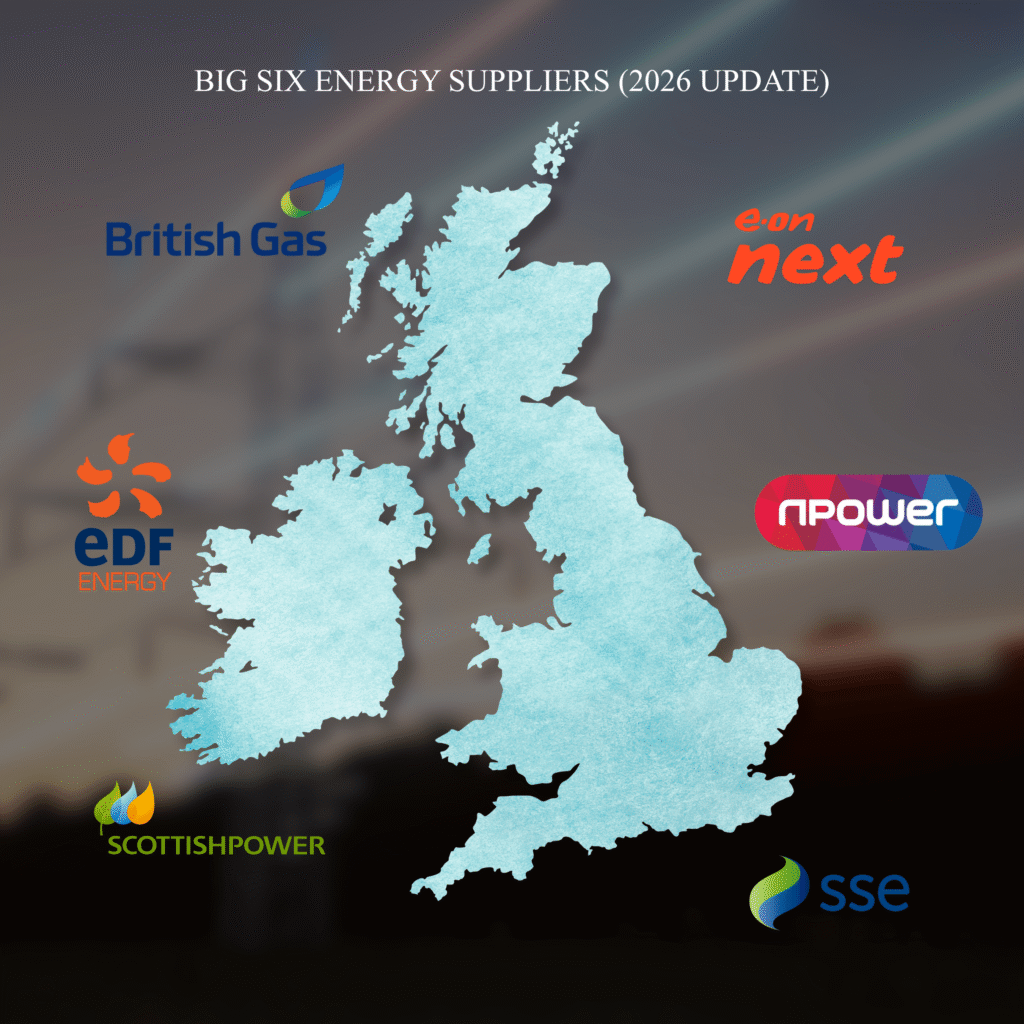
As of 2026, the six largest energy suppliers in the UK, ranked by overall market share, are Octopus Energy, British Gas, E.ON Next, OVO Energy, EDF Energy and ScottishPower. Here is what you need to know about each one.
Octopus Energy: The UK’s Largest Energy Supplier
Few rises in the UK energy industry have been as dramatic as Octopus Energy’s. Founded in 2016 as a small challenger brand, Octopus leveraged technology and a customer-first model to grow at a remarkable pace. Its acquisition of Shell Energy’s domestic energy supply business, completed in December 2023, catapulted it past British Gas to become the UK’s largest energy supplier for the first time.
By mid-2025, Octopus holds approximately 24% of electricity customers and 24.1% of gas customers across the UK. The company now serves well over seven million customers and continues to grow through a combination of organic switching and strategic acquisitions. It is widely regarded as setting the benchmark for customer service among major UK energy companies and has invested heavily in smart technology, time-of-use tariffs, and renewable energy products.
British Gas: Britain’s Oldest Energy Supplier
British Gas remains the UK’s largest gas supplier and its second-largest electricity supplier as of 2025. With roots going back to 1812, it is Britain’s oldest energy supplier and carries enormous brand recognition among UK households. It is owned by Centrica plc and operates across both residential and business energy markets.
Despite losing its long-held position as the UK’s top overall supplier to Octopus, British Gas retains tens of millions of customers and remains one of the most dominant forces in energy supply across Great Britain. It is also well known for its boiler cover and home services division, which sets it apart from many other large energy providers.
E.ON Next: The UK’s Third Largest Energy Supplier
E.ON Next is the UK-facing brand of German energy giant E.ON, and currently the UK’s third-largest energy supplier. Its position in the current big six was cemented largely through the acquisition of npower’s customer base in 2021, which brought millions of additional energy customers under the E.ON umbrella through the new sub-brand E.ON Next.
The company has placed a strong emphasis on renewable energy and green energy tariffs, positioning itself as a forward-thinking supplier for environmentally conscious households. It also offers a growing range of electric vehicle tariffs, smart home energy solutions, and heat pump energy plans, making it one of the more innovative energy providers in the UK today.
OVO Energy: UK’s Fourth-Largest Energy Supplier
OVO Energy is a British company, founded in 2009, that transformed from a small challenger brand into one of the big six energy companies through strategic acquisition. Its most significant move was purchasing SSE Energy’s domestic customer portfolio of approximately 1.5 million customers in December 2019, a deal that made OVO the UK’s fourth-largest energy supplier almost overnight.
OVO has made sustainability a central part of its brand identity and offers customers the option to purchase carbon-neutral energy plans. The company operates its own technology platform and is known for competitive energy tariffs and a transparent approach to billing. It remains one of the few big six suppliers to be British-founded and British-headquartered.
EDF Energy: Nuclear-Backed UK Energy Provider
EDF Energy is a subsidiary of the French state-owned EDF group, has been one of the six largest energy suppliers in the UK since 2002. The company is perhaps best known for its nuclear power generation, operating several of the UK’s nuclear plants, making it a significant contributor to low-carbon electricity supply in Britain.
EDF has consistently ranked as one of the more highly rated large suppliers for customer service among the major energy companies and offers a range of competitive energy tariffs for households. As the UK’s fifth-largest energy supplier in 2026, it holds approximately 10% of the domestic energy supply market.
ScottishPower: The UK’s Sixth Largest Energy Supplier
Despite its name, ScottishPower is owned by Spanish multinational Iberdrola and serves customers across Great Britain, not just Scotland. As of 2026, it remains the UK’s sixth-largest energy supplier by market share, supplying gas and electricity to millions of households.
ScottishPower was one of the first major UK energy companies to transition to selling 100% renewable electricity, cementing its reputation in the green energy space. It also has significant wind farm investments and plays an active role in the UK’s long-term energy transition. ScottishPower offers a range of energy tariffs including smart and EV-friendly plans.
The Original Big Six: A Brief History of UK Energy Suppliers
The original big six energy suppliers, the companies that dominated the UK energy market from the early 2000s, were British Gas, EDF Energy, E.ON, npower, ScottishPower, and SSE. At the height of their influence, these six firms supplied around seven in every ten UK households with gas and electricity. They were the defining companies of the domestic energy supply market for nearly two decades.
These large energy suppliers benefited from established infrastructure, enormous brand recognition and a degree of consumer inertia. Many UK households simply stayed with the same supplier year after year, even when cheaper energy deals were available elsewhere. At their peak, the original Big Six collectively held a market share that made meaningful competition from smaller suppliers extremely difficult.
The electricity supply market shares of the 2000s and early 2010s were dominated almost entirely by these six firms. It was only with the rise of digital challenger brands, most notably Octopus Energy, that the grip of the original big six began to loosen.
How the UK Energy Market Changed: From the Original Big Six to the New Big Six
The UK energy market has undergone seismic change over the past decade. The market that exists in 2026 is significantly different from the one that gave birth to the original “big six” nickname, and the question of whether the big six still deserve that label, given how much the roster has shifted, is a fair one. Here is how the energy market in the UK transformed.
SSE’s Exit from the Big Six
In December 2019, SSE announced it had reached an agreement to sell its residential energy customer base to OVO Energy. The deal transferred approximately 1.5 million customers and effectively ended SSE Energy’s presence as a domestic energy supplier in the UK. SSE has since focused on its energy generation and networks business, withdrawing entirely from the domestic energy supply market. With SSE gone, OVO Energy stepped into its place as one of the largest energy suppliers in the country.
npower’s Exit: E.ON Next Is Born
German-owned npower, once a major player in the UK energy market. Agreed a deal in 2021 to transfer its customer base to E.ON. Those customers were migrated to a newly created sub-brand called E.ON Next, which replaced npower’s presence in the market entirely. This left British Gas, EDF Energy, E.ON Next, OVO, and ScottishPower as five of the biggest energy companies in the country, with the sixth spot increasingly being contested by fast-growing challenger brands.
Shell Energy Emerged: Then Exited
Meanwhile, First Utility, one of the more prominent challenger energy brands in the UK, was acquired by Shell and rebranded as Shell Energy. With the weight of one of the world’s most recognisable and powerful companies behind it, Shell Energy emerged as a legitimate competitor to the established major energy suppliers in the UK. For a period, Shell energy emerged as a genuine contender for a place in the new big six, and many industry observers treated it as such.
However, in the summer of 2023, Shell announced it would be selling its domestic energy business in the UK to Octopus Energy and exiting the residential market. That transaction completed on 1 December 2023, handing Octopus millions of additional customers and cementing its position as the UK’s largest energy supplier by overall market share.
Octopus continued to grow throughout 2024, claiming that nearly one million people switched to Octopus during that year alone. By mid-2025, the company supplies approximately 24% of electricity customers and 24.1% of gas customers across the UK, figures that make it comfortably the UK’s largest energy supplier.
The Energy Crisis and Its Impact on UK Energy Firms
The energy crisis that gripped the UK from late 2021 had a profound and lasting impact on the energy industry. Wholesale gas and electricity prices surged to record levels following a combination of post-pandemic demand recovery and the disruption of gas supply across Europe. Dozens of smaller energy suppliers collapsed under the pressure of having sold fixed-rate tariffs they could no longer afford to honour at market prices.
The energy regulator Ofgem was forced to intervene repeatedly, using its Supplier of Last Resort process to redirect millions of customers from failed small energy suppliers to larger, more financially stable companies. This process reinforced the dominance of the major energy firms, including the Big Six, as consumers were transferred away from smaller energy companies that had gone out of business.
The energy crisis also led to the introduction of the energy price cap as a formal consumer protection mechanism, alongside the temporary government Energy Price Guarantee. Both measures fundamentally changed how energy prices are set for UK households. As of 2026, the energy price cap remains in place, reviewed quarterly by Ofgem, and applies to all energy suppliers in the UK operating in the domestic energy supply market.
The energy crisis was also a defining moment for the concept of the Big Six. It demonstrated that scale and financial stability matter and that the energy market, dominated by six large firms, while imperfect, provides a degree of resilience that smaller energy companies cannot always match.
What Are the Dangers of an Energy Market Dominated by Six UK Energy Companies?
The question of what risks arise when the UK energy market is dominated by six large companies is a legitimate consumer concern. The UK economy runs on competitive markets, and an energy market dominated by six UK energy firms raises valid questions about whether consumers are truly getting the best available deals on their energy bills.
When large energy suppliers hold the majority of market share, several concerns emerge. First, reduced competitive pricing: fewer companies competing for your custom means less pressure to offer the most attractive energy tariffs. Second, slower innovation: dominant players can afford to move cautiously. It arguably took challenger brands like Octopus Energy to drive genuine innovation in the UK energy sector, from smart time-of-use tariffs to app-based account management.
Third, consumer inertia is a major issue. People staying with the same big six supplier for years, even when cheaper energy deals are available, allows companies to generate significant margin from loyal but unengaged customers. Energy regulator Ofgem has consistently flagged this issue in its retail market reviews.
That said, Ofgem actively monitors the supply market to ensure fair competition. The energy price cap exists specifically to prevent the largest suppliers from exploiting their dominant market position to inflate energy bills for customers on default tariffs. As of March 2025, there were 21 active licensed energy suppliers operating in the UK according to Ofgem data — meaning that while the big six dominate market share, competition does exist across the wider energy market.
UK Energy Market Share in 2025
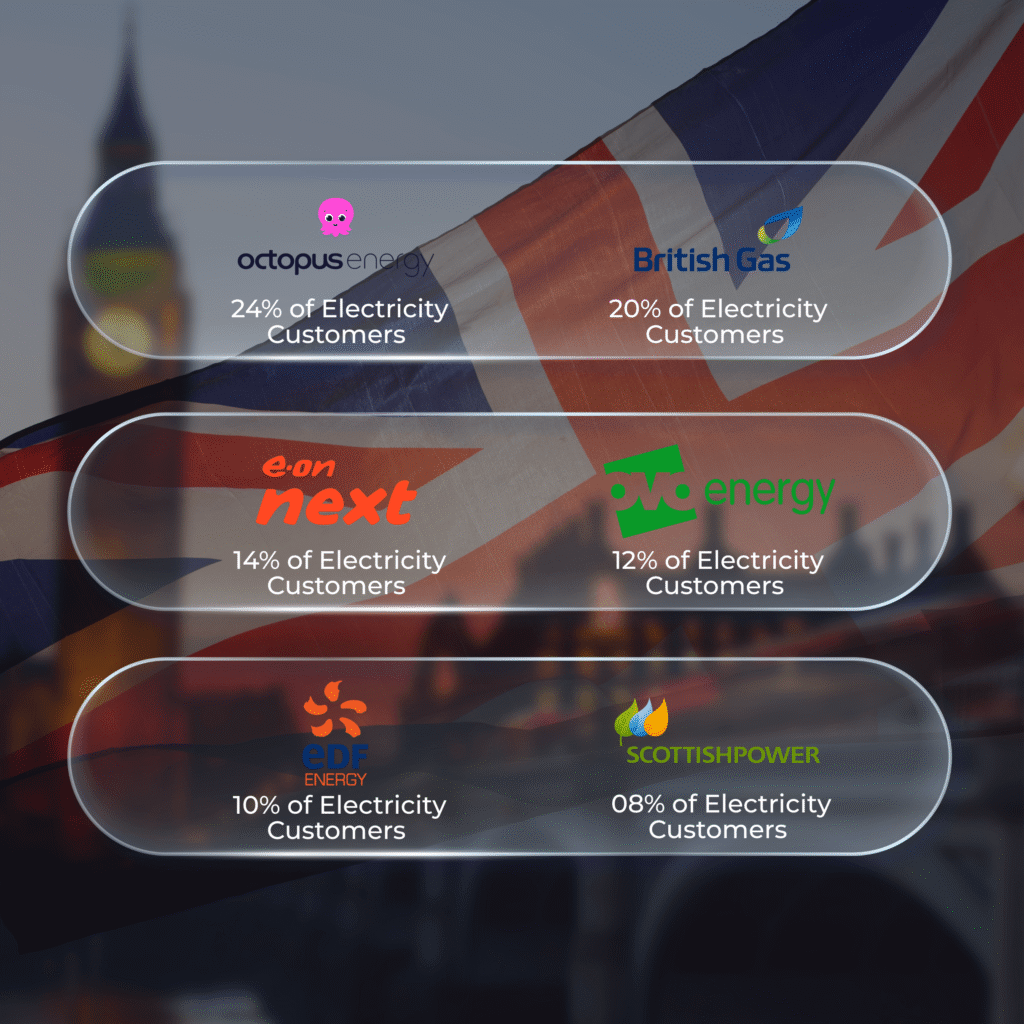
The electricity supply market shares in the UK have shifted markedly over the past five years. Here is how the energy market currently breaks down among the six largest suppliers:
Octopus Energy holds approximately 24% of electricity customers and 24.1% of gas customers, making it the UK’s overall largest energy supplier. British Gas holds approximately 20% of electricity customers and is the largest gas supplier. E.ON Next accounts for approximately 14% of the market as the third-largest overall supplier. OVO Energy holds approximately 12% as the fourth-largest, while EDF Energy accounts for approximately 10% and ScottishPower approximately 8%.
Together, these six suppliers account for the vast majority of domestic energy supply across the UK. The remaining licensed energy companies collectively supply the remaining share of the market, with no single smaller supplier coming close to the scale of the current big six.
Alternatives to the Big Six: Smaller Energy Suppliers in the UK
The big six energy providers are not the only option available to UK households. Smaller energy suppliers and independent energy companies represent a growing and genuinely competitive alternative, and in many cases offer lower prices or more personalised customer service than the large energy providers.
Utilita Energy
Utilita Energy is a specialist energy provider focused on prepayment meter customers. It serves a significant number of energy customers across the UK who prefer pay-as-you-go energy usage over direct debit billing. While not one of the six largest energy suppliers, Utilita has built a substantial customer base and is a well-established name in the small energy suppliers landscape.
Co-op Energy
Co-op Energy is part of the wider Co-operative Group and offers ethically positioned energy plans to UK households. It provides an alternative for consumers who prioritise brand values alongside competitive energy deals. Despite not being one of the six UK energy companies by market share, Co-op Energy has grown steadily as consumer interest in ethical and values-led energy providers has increased.
Rebel Energy
Rebel Energy is a newer entrant to the UK energy market with a strong focus on serving lower-income households and those on social tariffs. It positions itself as a challenger to the established order, offering transparent pricing and a mission-driven approach to energy in the UK. While a smaller energy company in terms of customer numbers, Rebel Energy represents the kind of specialist alternative that the Big Six do not provide.
Other notable smaller energy suppliers include So Energy and various regional providers, all of which represent genuine alternatives to the big six for UK consumers who want to explore beyond the largest energy companies.
Big Six Energy Suppliers vs. Smaller Energy Companies: What’s the Difference?
Choosing between one of the big six and a smaller energy supplier involves trade-offs that are worth understanding before you switch energy.
In terms of brand recognition, the big six are household names every UK consumer has heard of British Gas, EDF and the others. Smaller energy companies are often unknown to new customers, which creates a trust barrier even when their tariffs are competitive.
On pricing, the big six are competitive but rarely the cheapest option across all regions and usage levels. Smaller energy suppliers frequently undercut the major energy firms on unit rates and standing charges, and running an energy comparison is the only reliable way to identify the best deal for your specific circumstances.
Customer service is more variable. Some big six suppliers have historically ranked poorly for customer satisfaction, while others, notably Octopus Energy, are consistently rated among the best energy providers in the UK. Smaller energy companies often provide more personalised service, though this too can vary considerably.
Financial stability is perhaps the most significant factor. The energy crisis demonstrated that small energy suppliers can and do go out of business, sometimes suddenly. If your energy supplier fails, Ofgem will assign you to a new supplier, but the tariff you are placed on may not be the cheapest. Crucially, you will not be cut off or lose your gas and electricity supply.
It is also worth noting that Ofgem regulation applies equally to all licensed energy suppliers in the UK, whether they are one of the big six or a small energy company with a fraction of the market share. All suppliers must adhere to the same consumer protection standards.
Should I Switch to a Smaller Energy Supplier?
Switching to a smaller energy supplier is a perfectly reasonable decision and can result in meaningful savings on your energy bills. However, there are a few important things to consider.
Before switching, check independent customer reviews for the supplier you are considering. Look at Citizens Advice energy supplier ratings, Trustpilot scores, and Which? assessments to get a sense of real-world customer experience. Cheaper tariffs are only genuinely beneficial if the supplier also delivers reliable billing and accessible customer service.
Consider also the tariff type. Fixed-rate tariffs offer price certainty but may include exit fees if you want to switch again during the term. Variable tariffs, including the Ofgem price-capped standard variable rate, offer flexibility but no protection against price rises.
If you are concerned about a smaller energy company going out of business, remember that Ofgem’s Supplier of Last Resort process means you will never be left without energy supply. Your energy credit balance will also be protected. The risk is not losing your supply, it is being moved onto a potentially uncompetitive tariff with your new supplier, which is why running a fresh energy comparison after any SoLR transfer is always advisable.
Is the ‘Big Six’ Still Relevant in 2026?
The honest answer is: the big six still exist as a meaningful concept, but the specific companies have changed significantly. Of the original big six British Gas, EDF, E.ON, npower, ScottishPower, and SSE, only four remain in the current lineup. npower and SSE have both exited domestic energy supply, replaced by OVO Energy and, most dramatically, Octopus Energy.
Some commentators briefly used the term “big five” following npower’s exit, before Octopus’s rise made six the correct number again. Others prefer “major energy suppliers” or “largest energy suppliers” as more neutral terminology. But “big six energy companies” and “big six energy suppliers” remain the most widely recognised terms among UK consumers and in media coverage of the energy industry.
What matters for consumers is less the label and more the reality: six large energy firms currently account for the majority of domestic energy supply in the UK, and understanding who they are, how they compare, and how to use competition between them is the most effective way to manage your energy costs.
How to Switch Energy Supplier
Switching your energy supplier is one of the simplest and most effective ways to reduce your energy bills, and it takes as little as five minutes to get started. You do not need to contact your old supplier directly, you will not experience any interruption to your electricity supply or gas supply, and the same pipes and cables deliver your energy regardless of which company bills you for it.
To switch, you will need your current energy supplier’s name, your existing tariff name, your postcode, and a recent energy bill or meter reading to ensure the comparison is accurate. Once you have used an energy comparison tool to identify the right deal for your usage and location, confirm the switch and your new supplier handles everything from there.
Under Ofgem’s switching guarantee, the process completes within five working days. A 14-day cooling-off period also applies, meaning you can cancel the switch without penalty if you change your mind. There are no charges for switching energy supplier, and your supply is never interrupted during the process.
Whether you are looking to switch energy supplier from one of the big six to a challenger brand, or from a smaller energy company to one of the major suppliers, the process is exactly the same. The key is to compare energy regularly, tariffs change, the price cap moves quarterly, and the deal that was best value six months ago may no longer be the most competitive option available to you today.
Frequently Asked Questions About the Big Six Energy Suppliers
Which is the UK’s largest energy supplier in 2026?
Octopus Energy is the UK’s largest energy supplier as of 2026, holding approximately 24% of both the electricity and gas markets. It overtook British Gas in late 2023 following the completion of its acquisition of Shell Energy’s domestic customer base, ending decades of British Gas dominance at the top of the UK energy market.
Is the ‘big six’ term still used today?
Yes, the term remains widely used even though the composition of the group has changed significantly. Of the original big six, four companies British Gas, EDF, E.ON, and Scottish Power, remain in the current lineup. SSE and npower have exited domestic supply, replaced in the new big six by OVO Energy and Octopus Energy. Some prefer terms like “big five” or “major energy suppliers”, but “big six” remains the most commonly understood label in the UK energy industry.
What happens if my energy supplier goes out of business?
If your energy supplier goes out of business, Ofgem. The energy regulator will appoint a Supplier of Last Resort to take over your energy supply. You will not be cut off, your gas and electricity will continue uninterrupted, and any credit balance you hold with your old supplier will be protected. Once transferred to a new supplier, you are free to run an energy comparison and switch to a different deal if the one you have been placed on is not competitive.
Are the big six energy suppliers cheaper than smaller energy companies?
Not necessarily. Smaller energy suppliers frequently offer competitive or cheaper tariffs than the Big Six. No single supplier is consistently the cheapest across all regions and tariff types. The only reliable way to find the best energy deal is to run a current energy comparison using your postcode and actual energy usage figures.
Which Big Six supplier is best for green or renewable energy?
ScottishPower was the first major UK energy company to transition to selling 100% renewable electricity. Octopus Energy, E.ON Next, and OVO Energy also offer strong green energy credentials, with carbon-neutral plans and renewable tariff options. For households prioritising sustainability alongside competitive pricing, running a dedicated green energy comparison is the best approach.
What is Co-op Energy and is it part of the Big Six?
Co-op Energy is an independent energy supplier associated with the Co-operative Group. It is not one of the big six energy suppliers by market share, but it offers an ethically positioned alternative to the major providers for UK households that prioritise values alongside value. It focuses on transparent pricing and operates as a smaller energy company in the context of the broader UK energy market.
What is the difference between an electricity supplier and a gas supplier?
In the UK, most households use a dual fuel energy deal, a single tariff that covers both gas and electricity supply from the same provider. However, it is also possible to have separate electricity and gas suppliers. Dual fuel deals are often (though not always) the most convenient and cost-effective option, and all of the big six energy suppliers offer dual fuel tariffs alongside separate gas and electricity options.