
Infrared Radiators for UK Homes & Businesses
Heating accounts for the largest share of energy use in UK homes, yet most conventional radiators work by warming the air, which rises to the ceiling and drifts away through gaps and ventilation before you feel it. Infrared radiators work on an entirely different principle. They heat you, your walls, your furniture, and your floors directly, the same gentle, radiant warmth you feel stepping into winter sunlight. The result is a room that feels warmer at a lower thermostat setting, stays comfortable longer after the panel switches off, and costs less to heat.
At Energy Solutions, we supply and install premium infrared radiator systems from Redwell, Europe’s leading infrared heating brand, through our MCS-certified installation partner Northern Renewable Centre. Whether you want a single panel for a home office, a complete whole-home infrared heating solution, or a commercial fit-out, we handle design, supply, and installation with the same straightforward, no-pressure approach we bring to every service we offer.
Stylish enough to double as artwork. Silent enough for a bedroom. Clean enough for allergy sufferers. Efficient enough to run directly from your solar panels. Infrared heating is one of the most versatile and genuinely useful technologies in modern domestic energy.
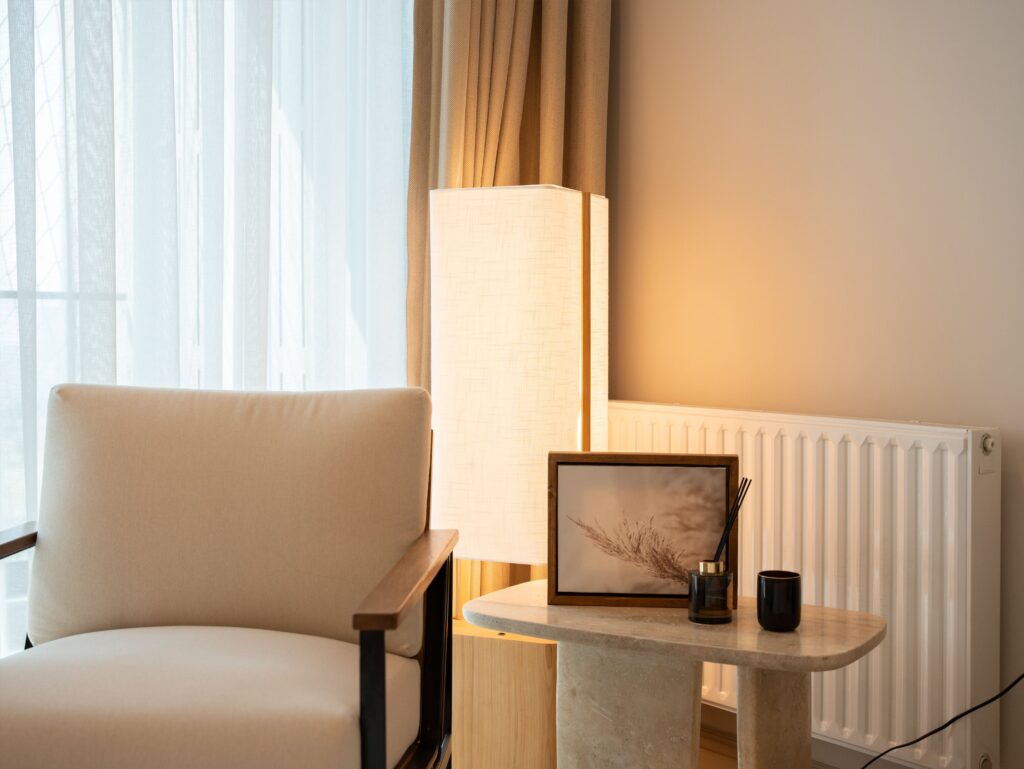
How Infrared Heating Works: The Science Made Simple
Conventional central heating and electric convection radiators work by warming the air in a room. Warm air rises, cold air falls, and the boiler or heater must run continuously to maintain temperature as warm air escapes through draughts, ventilation, and gaps in the building fabric. The result is a constantly cycling process that consumes significant energy while still leaving cold spots near floors and windows. Infrared radiators operate on a completely different physical principle. They emit far-infrared electromagnetic waves, part of the natural electromagnetic spectrum, entirely invisible, and completely safe, that travel through the air without heating it.
These waves are absorbed by solid objects: your walls, ceiling, floor, furniture, and your body. As these surfaces absorb infrared energy, they warm up and begin to re-radiate gentle, even heat back into the room. Because walls, floors, and thermal mass retain heat far more effectively than air, the room continues to feel warm even after the panel switches off — and without the temperature stratification (hot ceiling, cold floor) that plagues convection-based systems. The thermostat reaches its set point faster, the panel switches off sooner, and less energy is wasted overall.
THE KEY PRINCIPLE: Infrared heats surfaces and people, not air
A room heated by infrared at 18°C feels as comfortable as a conventionally heated room at 21°C because the radiant warmth acts directly on your skin and body, just as stepping into winter sunlight feels warm even when the air temperature is cold. This lower thermostat requirement translates directly into lower energy consumption and lower running costs.
Benefits of Infrared Radiators for UK Homes & Businesses
Lower Energy Consumption and Reduced Heating Bills
Infrared panels convert 100% of their electrical input into radiant heat, there are no flue losses, no standby losses, and no heat dissipated through pipework. Because they heat surfaces rather than air, rooms reach a comfortable temperature faster and retain warmth longer after the panel switches off. Studies and independent testing have shown infrared heating can reduce energy consumption by up to 30% compared to electric storage heaters or convection radiators operating in the same space. The savings are even more compelling for homes with solar PV. Because infrared panels run on standard 230V electricity and respond instantly, unlike underfloor heating or a wet central heating system that needs to heat a large volume of water, they can be timed to run precisely during solar generation hours, using electricity that would otherwise be exported to the grid at a fraction of the import price. Want to maximise your infrared heating savings with solar? Explore our Solar PV Systems page to see how the two technologies work together.
Elimination of Dust Circulation: The Allergy and Asthma Advantage
Conventional convection heating works by creating air currents, warm air rises, cool air falls, that continuously circulate throughout the room. This constant air movement disturbs and redistributes dust, pollen, pet dander, mould spores, and other airborne particles, keeping them suspended and breathable. For the estimated 12 million UK adults with asthma, and the many millions more with dust, pollen, or mould allergies, this is a significant quality-of-life issue. Infrared radiators produce no air movement whatsoever. The room air remains still. Airborne particles settle and stay settled. The result is measurably cleaner, stiller air that respiratory sufferers consistently find more comfortable than conventionally heated environments. For family homes, nurseries, care environments, and healthcare settings where air quality matters, this is not a minor benefit, it is transformative.
Dry Walls, No Damp, No Mould
One of the most practically significant advantages of infrared heating in the UK context , where dampness and mould are persistent problems in millions of properties, is its effect on wall surface temperatures. Because infrared heat is absorbed directly by walls, it raises their surface temperature above the dew point, preventing moisture from condensing on them. Cold walls are the primary cause of condensation, damp patches, and the black mould growth that affects so many UK homes, particularly in older properties, basement flats, and north-facing rooms. Infrared heating attacks the root cause of this problem rather than simply masking it. Properties that have struggled with persistent damp and mould often see a marked improvement after infrared panels are installed in affected rooms.
Completely Silent, Ideal for Bedrooms, Studies, and Quiet Spaces
Infrared panels have no moving parts, no fans, no pump, no heat exchanger. They operate in total silence. For bedrooms, nurseries, meditation rooms, home offices, libraries, and healthcare settings where background noise is disruptive, this is a significant practical advantage over fan heaters, heat pumps with audible outdoor units, or boiler-fed central heating systems with their accompanying clicks, gurgles, and pump noise.
Designed to Complement Your Interior, Not Intrude on It
Traditional radiators are functional but rarely beautiful. Infrared heating panels from Redwell are engineered to be both. The product range includes slim frameless wall panels in matte white or custom finishes, decorative picture panels printed with any image of your choice, mirror panels that function as full-length or bathroom mirrors when not heating, and ceiling panels that disappear into the room above you. This design flexibility means infrared heating can be integrated into any room in your home, from a contemporary open-plan kitchen to a period bedroom, without compromising the aesthetic. In some cases, a custom picture panel actually improves the room's appearance compared to a standard radiator.
Zero Maintenance, Fit It and Forget It
Infrared panels contain no moving parts, no water, no refrigerant, and no combustion components. There is nothing to service, bleed, descale, or replace. Unlike a gas boiler that requires an annual service certificate, an air source heat pump that needs refrigerant pressure checks, or a wet central heating system with its pump, valves, and expansion vessel, an infrared panel is installed once and left to operate indefinitely. The only operational consideration is keeping the panel surface free of dust, which in most cases means an occasional wipe with a dry cloth. Typical panel lifespans exceed 20 years under normal operating conditions.
Instant Heat, Responsive, Zoned, and Smart-Controllable
Infrared panels reach full operating temperature within approximately five minutes of being switched on, significantly faster than underfloor heating (which can take hours) or a cold wet radiator system. This responsiveness makes zoned heating practical and efficient: heat only the rooms you are actually using, exactly when you need warmth, without the lead time of a whole-house heating system. All panels can be controlled via individual thermostats, smart thermostats (compatible with most major systems including Google Home, Amazon Alexa, and dedicated apps), or building management systems for commercial installations. Schedule heating around your solar generation windows, your occupancy patterns, or your off-peak electricity tariff, with precise, room-by-room control.
Perfect Integration With Solar PV and Battery Storage
Infrared radiators are one of the most natural complements to a solar PV installation. Unlike underfloor heating or a heat pump that needs to heat a large volume of water, an infrared panel responds instantly and draws exactly its rated wattage, making it trivially easy to match panel output to available solar generation. During daylight hours, your solar panels can power your infrared heating at zero marginal cost. With battery storage added to the system, surplus solar energy charged during the day can power evening and overnight infrared heating — extending the period of zero-cost warmth well beyond sunset. This combination of solar, battery, and infrared heating represents one of the most cost-effective whole-home energy strategies available to UK homeowners today. Explore how solar and battery storage complement infrared heating on our Battery Storage page.
Our Infrared Radiator Product Range: Redwell by Northern Renewable Centre
We supply the Redwell infrared radiator range, European market leaders in far-infrared heating technology, through our installation partner Northern Renewable Centre. Every product in the range is engineered to the highest standards of build quality, efficiency, and design. Here is an overview of the main product lines available:
WE-Line Wall Panels
The core Redwell product line, slim, frameless infrared wall panels designed to integrate seamlessly into any room. Available in matte white and a range of finishes.
- Portrait or landscape orientation
- Suitable for all main living spaces
- Hardwired or plug-in options
- Smart thermostat compatible
- IP20 rating (indoor use)
Picture Heating Panels
Infrared panels with a high-resolution photograph or custom artwork printed on the surface. A fully functional radiator that doubles as wall art, completely undetectable as a heater.
- Custom image printing available
- Any room, any aesthetic
- Same infrared performance as WE-Line
- Ideal for living rooms and bedrooms
- Gallery-style hanging brackets included
Mirror Infrared Panels
Full-length or portrait mirrors with an integrated infrared heating element. Bathroom-safe IP44 rated versions available, a space-saving, stylish solution for bathrooms, en-suites, and hallways.
- IP44 rated bathroom versions
- Full-length and portrait sizes
- Demisting function on heated surface
- Wall-mounted — no floor space needed
- Doubles as a functional mirror
Ceiling Heating Panels
Ceiling-mounted infrared panels that disappear into your room above you. Completely unobtrusive, ideal for rooms where wall space is limited or for high-traffic commercial spaces.
- Flush-fit ceiling installation
- Ideal for kitchens, bathrooms, conservatories
- Excellent for commercial offices
- No wall space consumed
- Even heat distribution across the floor area
Infrared Radiators vs Conventional Radiators: Full Comparison
How does infrared heating stack up against the UK’s most common heating methods? This 12-point comparison covers the key differences across efficiency, health impact, design, maintenance, and compatibility with renewable energy:
Conventional Radiators
Infrared Radiators
Note: The right heating choice depends on your property, your existing heating setup, your health needs, and whether you have or plan to install solar PV. Infrared works best as a whole-home solution in well-insulated modern properties, and as a highly effective supplementary or zone heating solution in older properties. Our advisers will give you an honest assessment of which approach makes most sense for your specific situation.
Which Infrared Panel for Which Room?: Room-by-Room Guide
Choosing the right infrared panel type and wattage for each room is the most important step in getting your system right. Too low a wattage and the panel runs constantly without achieving comfort; too high and you overpay for equipment and electricity. Here is our room-by-room guide for typical UK properties:
| Room / Space | Recommended Product | Typical Wattage |
|---|---|---|
| Living room / lounge | WE-Line panel or picture panel | 600-1,000W depending on room size |
| Bedroom | WE-Line panel or picture panel | 400-700W - silent = undisturbed sleep |
| Bathroom / en-suite | IP44-rated mirror or panel | 250–450W - bathroom-safe rating essential |
| Kitchen / dining | Ceiling panel or WE-Line | 400–800W - unobtrusive ceiling fit |
| Hallway / landing | Ceiling panel or slim wall panel | 250–400W — efficient spot heating |
| Home office | Desk-area wall panel | 300–500W - targeted personal warmth |
| Conservatory / garden room | Ceiling or wall panel | 600-1,200W - ideal for hard-to-heat spaces |
| Commercial office | Ceiling panels (zoned) | Based on m² heat loss calculation |
| Warehouse / workshop | High-intensity ceiling panels | 1,000W+ per zone - spot heating |
Note: Wattage recommendations are based on typical UK room sizes with reasonable insulation. Poorly insulated rooms or properties in colder regions of the UK may require higher wattages. Your free survey includes a room-by-room heat demand assessment so every panel is correctly specified from the outset.
Is Infrared Heating Right for Your Property?
Infrared radiators are versatile and effective across a wide range of UK properties and use cases. Here is a straightforward guide to where infrared heating works best, and where other technologies might be a better fit:
Infrared Heating Works Exceptionally Well For:
- Modern, well-insulated homes, where lower heat demand means lower wattage panels and minimal running costs
- Properties with solar PV, where infrared panels consume self-generated electricity at zero or near-zero marginal cost
- Individual rooms and zones, heating only where and when needed, without running a whole-house system
- Allergy, asthma, and respiratory sufferers, the still-air environment is measurably beneficial
- Damp-prone or mould-affected rooms, raising wall surface temperature tackles the root cause
- Bedrooms and quiet spaces, completely silent operation, no disturbance during sleep
- Home offices and studies, instant, zoned warmth exactly when you need it
- Conservatories and garden rooms, ideal for spaces that conventional central heating struggles to reach effectively
- Holiday lets and rental properties, zero maintenance, no boiler, no engineer call-outs
- Listed buildings and heritage properties, no pipework, no boiler flue, minimal structural intervention required
- Commercial offices, retail, and hospitality, zoned, smart-controlled, stylish
Where to Seek Additional Advice First:
- Poorly insulated older properties with high heat loss, infrared works but heat demand assessment is essential
- Properties without solar PV on a high electricity tariff, running costs should be compared carefully against a heat pump or gas option
- Properties requiring domestic hot water from the heating system, infrared provides space heating only; a separate hot water solution is needed
Infrared Radiator Costs: Supply, Installation & Running Costs
Infrared radiators are one of the most cost-accessible heating technologies available in the UK. Individual panels start from well under £300 fully installed, and a whole-home system typically costs a fraction of a new gas boiler or air source heat pump installation. Here are indicative costs for common scenarios:
| Product / System | Indicative Cost | Installation Time |
|---|---|---|
| Single panel - small room (250–400W) | £150 – £350 | 1 hour (DIY-friendly plug-in) |
| Single panel - medium room (400–700W) | £250 – £550 | 1–2 hours (hardwired) |
| Decorative / picture panel (400–800W) | £300 – £700 | 1–2 hours (hardwired) |
| Mirror panel (200-600W) | £200 – £500 | 1–2 hours (hardwired) |
| Ceiling panel (250-1,000W) | £250 – £600 | 22–3 hours (professional install) |
| Whole-home system (multi-room) | £1,500 – £5,000+ | 1–2 days (full installation) |
| Commercial / office fit-out | POA | Site-specific |
Note: Costs are indicative as of 2025. Your free quote will be fully itemised with no hidden costs. Installation by our qualified electricians includes all wiring, fixings, smart thermostat setup, and system commissioning.
Running Cost Comparison
Running costs for infrared heating depend primarily on your electricity tariff rate and how efficiently the panels are used. As a guide for a single 600W panel:
- At the UK average electricity rate of approximately 24p/kWh: running at full power costs around 14p per hour
- On a solar-powered system during daylight hours: effectively free, using electricity you have generated yourself
- On an overnight off-peak tariff (e.g. Octopus Go at ~7p/kWh): approximately 4p per hour
- With smart thermostat control, panels typically run at 40–60% duty cycle, significantly lower than full-power figures suggest
Our energy consultants can review your current electricity tariff and recommend whether a time-of-use tariff would reduce your infrared heating running costs, particularly valuable if you are considering infrared as your primary heating source.
Compare electricity tariffs to find the best rate for infrared heating on our Business Electricity page, or explore the combination with solar on our Solar PV Systems page.
The Ideal Clean Energy Trio: Solar PV + Battery Storage + Infrared Heating
Of all the home heating technologies available in the UK today, infrared radiators are uniquely well-suited to integration with a solar PV and battery storage system, and this combination is one of the most compelling clean energy propositions for UK homeowners.
Why Infrared Works So Well With Solar
Instant response: infrared panels switch on at full output immediately, they can be powered by solar at the exact moment generation peaks, with no lag or warm-up period
Precise wattage: a 600W panel draws exactly 600W, simple to match against your inverter's output and surplus calculation
No thermal mass to heat: unlike underfloor heating or a heat pump's water circuit, infrared panels can be switched on for 30 minutes during a solar peak and still deliver meaningful warmth
Zone control: run infrared in occupied rooms only during solar generation hours, zero wasted energy
Smart integration: most smart thermostats can be configured to trigger infrared panels based on solar output signals from your inverter monitoring system
Commercial Infrared Heating for UK Businesses
Infrared heating is increasingly popular in commercial settings across the UK, from professional offices and retail environments to warehouses, workshops, healthcare facilities, and hospitality venues. The combination of low installation cost, zero maintenance, silent operation, and smart zone control makes infrared an outstanding commercial heating solution.
Commercial Applications
Open-plan offices, ceiling panels provide even, unobtrusive warmth without occupying wall space or creating draughts
Retail premises, discreet, stylish heating that does not intrude on the customer environment
Warehouses and workshops, high-intensity infrared provides targeted spot heating for workers without trying to heat an entire industrial volume
Healthcare and care homes, the clean, still air environment is particularly beneficial; no dust circulation around vulnerable patients
Hospitality, pubs, restaurants, and hotels benefit from the instant, zoned warmth and the ability to mount picture panels as design features
Education, classrooms and common areas can be heated zone-by-zone with smart control and no maintenance requirement
Listed and heritage buildings, infrared can be installed with minimal structural intervention in buildings where conventional heating systems are impractical
Commercial Benefits
No boiler, no annual service cost, no engineer call-outs, no gas contract required
Zone control, heat only occupied areas, reducing wasted energy across large floor plates
Smart BMS integration, compatible with most building management systems
Low capital cost vs boiler or ASHP installation, favourable payback for commercial landlords and tenants
Supports sustainability reporting, low-carbon when paired with renewable electricity or solar PV
For businesses with significant electricity consumption, combining infrared heating with a strategic energy procurement approach can reduce overall costs further. Explore our Energy Procurement service for details.
How Infrared Radiator Installation Works: Our Simple 4-Step Process
Infrared installation is far simpler and less disruptive than a gas boiler or heat pump installation, no pipework, no boiler flue, no major structural works. Here is what to expect:
Free Consultation & Room Assessment
Our adviser discusses your property, your heating needs, and any specific requirements, health considerations, aesthetic preferences, solar integration, or commercial specifications. For whole-home or commercial projects, we carry out a room-by-room assessment covering dimensions, insulation level, and usage pattern. For single-room enquiries, we can often provide a specification and quote from room measurements alone. You receive a fully itemised product and installation quote with no hidden costs.
System Design & Product Specification
We design your infrared heating system room by room, selecting the correct product type (WE-Line, picture, mirror, or ceiling panel), wattage, and quantity for each space. For homes with solar PV, we design the system to maximise the proportion of heating powered by self-generated electricity. For commercial projects, we produce a full layout plan showing panel positions, zones, and smart thermostat locations.
Professional Installation by Qualified Electricians
All hardwired installations are carried out by our qualified electrician partners, fully compliant with Part P of the Building Regulations. Panels are fixed, wired, and connected to smart thermostats or a central control system as specified. Plug-in panels can be self-installed from a standard 13A socket, our team will advise on positioning and thermostat setup. Installation of a whole-home system typically takes one to two days with minimal disruption.
Commissioning, Smart Control Setup & Handover
Each panel and thermostat is commissioned and tested. Smart controls are configured to your schedule, including solar generation windows if applicable. You receive a full system handover: how to adjust temperatures, set schedules, integrate with your solar monitoring app, and contact us if you need support. For commercial installations, building management system integration is completed and tested before handover.
Why Choose Energy Solutions for Infrared Heating?
Energy Solutions brings the same values to infrared radiators that have made us a trusted energy broker since 2016: honest advice, quality products, transparent pricing, and your long-term interests first. Here is what sets us apart:
We combine direct access to high-yield, premium-grade tier-1 solar system component stock with fully certified local engineer deployment teams.
Premium Redwell Products
We supply the Redwell range, European leaders in far-infrared heating, through our certified partner. Market-leading performance, build quality, and longevity.
Qualified Electrical Installation
All hardwired installations comply with Part P of the Building Regulations, carried out by qualified electricians. You receive full compliance certification.
Honest, Impartial Advice
If infrared is not the best solution for your property, we will say so, and recommend the right alternative, whether that is a heat pump, battery storage, or a different approach.
Solar & Battery Integration
Unlike a standalone infrared supplier, we can design and install your solar PV and battery storage alongside your infrared system, one partner, one integrated solution.
Finance Options Available
Spread the cost of a whole-home infrared installation with flexible monthly finance through our installation partner.
Tariff Optimisation Included
Our energy consultants review your electricity import tariff to ensure you are on the best rate for infrared heating, including time-of-use tariffs that work with your solar schedule.
Infrared Radiators FAQs
Are infrared radiators cheaper to run than conventional radiators?
Infrared radiators are typically more efficient than electric storage heaters and convection radiators because they heat objects, walls, and people directly rather than heating air, which escapes through ventilation and draughts. When powered by solar PV electricity, infrared panels can run at near-zero marginal cost during daylight hours, making them a highly cost-effective heating option for solar-equipped homes.
Do infrared radiators cause any health risks?
No. Infrared heating panels emit far-infrared radiation, the same gentle warmth produced by the sun — which is entirely safe for humans and animals. Unlike ultraviolet radiation, far-infrared does not damage skin or eyes. In fact, far-infrared heat is widely used in therapeutic and wellness settings because it gently warms body tissue, supports circulation, and improves air quality by eliminating the air movement that spreads dust and allergens.
Are infrared radiators good for people with allergies or asthma?
Yes, infrared radiators are widely regarded as one of the best heating options for allergy and asthma sufferers. Because they heat by radiation rather than convection, they do not circulate air and therefore do not disturb dust, pollen, mould spores, or pet dander. The result is cleaner, stiller air that respiratory sufferers find significantly more comfortable than conventionally heated rooms.
Can infrared radiators replace a central heating system?
Yes, in many properties, particularly well-insulated modern homes, flats, holiday lets, home offices, and commercial spaces. Infrared radiators are particularly effective as a complete heating solution when combined with good insulation and a solar PV system. In older, poorly insulated properties, infrared works best as a supplementary or zone heating solution alongside existing heating.
How do infrared radiators work?
Infrared radiators emit far-infrared electromagnetic waves that travel through the air without heating it, and are absorbed directly by walls, floors, furniture, and people. This warms surfaces, which then re-radiate gentle heat back into the room, similar to how the sun warms the earth. Because the thermal mass of walls and furniture retains heat far longer than air, the room stays warmer for longer even after the panel switches off.
Do infrared radiators help with damp and mould?
Yes. Because infrared heating warms walls rather than air, it raises the surface temperature of walls and keeps them dry. Mould requires cold, damp surfaces to grow, infrared heating denies it both conditions. Properties that have struggled with damp and mould caused by cold spots often see a significant improvement after installing infrared heating panels.
Can I use infrared radiators with my solar panels?
Yes, and infrared radiators are one of the most effective ways to use surplus solar PV electricity. Because they respond instantly (no warm-up time) and run on standard 230V electricity, they can be powered directly from your solar inverter output during daylight hours at zero marginal cost. Combined with a battery storage system, you can run infrared heating on solar-generated electricity well into the evening.
Do infrared radiators need to be installed by a professional?
Smaller plug-in panels (up to around 400W) can be self-installed using a standard 13A socket. Wall-mounted and ceiling panels that are hardwired into the mains supply should be installed by a qualified electrician to comply with Part P of the Building Regulations. Our installation partner provides full professional installation across the UK, including commissioning and smart thermostat setup.

Explore Our Related Services
Infrared heating works best as part of a joined-up clean energy strategy. These Energy Solutions services integrate directly with your infrared installation:
Solar PV Systems
Power your infrared panels from self-generated solar electricity at zero marginal cost
Battery Storage
Store surplus solar energy and power infrared heating into the evening for free
Air Source Heat Pumps
The alternative or complementary whole-home heating solution for larger or older properties
EV Charging Solutions
Complete the clean energy picture: solar, battery, infrared heating, and EV charging in one integrated system
Business Electricity
Find the best electricity import tariff to optimise your infrared heating running costs
Energy Procurement
Strategic energy contract management for businesses with significant energy consumption
Sustainable Energy Solutions
Our full range of renewable and low-carbon energy services for UK homes and businesses